


GST an epic blunder, TMC not to attend roll-out event: Mamata

Agencies
June 28, 2017

Kolkata, Jun 28: West Bengal Chief Minister Mamata Banerjee today said her party TMC will not attend the GST roll-out programme on June 30 midnight as she flayed the "unnecessary hurry" to roll it out.

The TMC supremo termed the GST roll-out as another "epic blunder" by the Centre.mamata

"Our Parliamentary Party has decided not to attend the 30th June, 2017 midnight programme at Parliament House to celebrate GST, as a mark of protest," she said.

"We are deeply concerned about GST implementation. After #demonetisation, this unnecessary disastrous hurry is another epic blunder of the Centre", she said on Facebook.

"We have been for GST from the beginning but are very worried now with the way the Central Government is going ahead with the implementation", she said.

"Our repeated suggestions to take some more time to properly implement GST have fallen on deaf ears. The entire business community, especially the small and medium ones, are scared and confused.

"Only 60 hours are left before this ill-planned launch and no one knows for sure what's happening!", she said.

"Essential commodities such as medicines are not available in many places and prices of various commodities are rising for lack of clarity and mismanagement", she said.

Banerjee said, "We have always been fighting for maintaining the federal structure of the country, even if Bengal at times was the lone voice and conscience of the GST Council".

She said, "There are almost 20 different taxes in the present tax regime and we felt that one single tax and integration of all markets across the country will provide big relief to all".

Having a dig at the BJP, she said, "The current ruling party at the Centre had initially strongly opposed GST for over 7 years and suddenly did a somersault on coming to office as a champion of GST".

Banejee said that the economy is not yet ready to face the GST from July 1. The 3-day strike declared by the textile industries in the country was the evidence of "our deep concerns on the lack of preparedness".

"Small business entities are not yet ready with basic requirements like invoice, accounting system, IT system, etc. Another piece of evidence of unpreparedness comes from the fact that the 'Return Form' had to be simplified for the first 6 months as all systems are not in place.

"It is shocking that the e-Waybill System is not yet designed and states are being asked to run their own systems as a stopgap arrangement", she said.

"We feel, at least six months will further be necessary to notify all rules and procedures and give enough time to the stakeholders, particularly the small and medium enterprises to successfully implement the GST.

"Otherwise, a chaotic situation may arise in our vast economy for which the Government of India will be primarily responsible", she said.

The West Bengal chief minister expressed hope that the voices of the people and businesses will be heard by the Centre.

Comments

Add new comment

  • Coastaldigest.com reserves the right to delete or block any comments.
  • Coastaldigset.com is not responsible for its readers’ comments.
  • Comments that are abusive, incendiary or irrelevant are strictly prohibited.
  • Please use a genuine email ID and provide your name to avoid reject.
Agencies
May 31,2020

New Delhi, May 31: Congress leader Kapil Sibal on Sunday questioned the Prime Minister on how much money has been given to labourers from the PM-CARES Fund.

"I would like to ask Prime Minister Modi, 'Can you tell us how much money did you give to labourers from your PM-CARES Fund?' I request him to answer this question. Many people died during this period, some died while walking, some died in the train, some died of hunger," Sibal said while addressing a virtual press conference.

The senior Congress leader further asked how much ex gratia did the Prime Minister give to the labourers who died in the corona crisis while negotiating the lockdown.

"I refer you to Section 12 of the Disaster Management Act. It says that ex gratia assistance on account of the loss of life and also assistance for the restoration of livelihood should be provided by the government. Did the government give ex gratia assistance to people who died in the crisis? The act also mentions special provisions for widows and orphans. The government should clarify how much assistance they gave to such people," he said.

Sibal said that the government should keep aside its agenda for the last six years and concentrate on making pro-poor policies.

"In the coming days, our economy is going to go into the negative territory as also confirmed by RBI. There are 45 crore labourers in our country. What will be their state? We have to look at our future. That is why we want to request the government that the agenda that they have run over the last six years should be kept aside and that government should care about the poor and draft policies for them," the Congress leader said.

Comments

Add new comment

  • Coastaldigest.com reserves the right to delete or block any comments.
  • Coastaldigset.com is not responsible for its readers’ comments.
  • Comments that are abusive, incendiary or irrelevant are strictly prohibited.
  • Please use a genuine email ID and provide your name to avoid reject.
coastaldigest.com web desk
August 1,2020

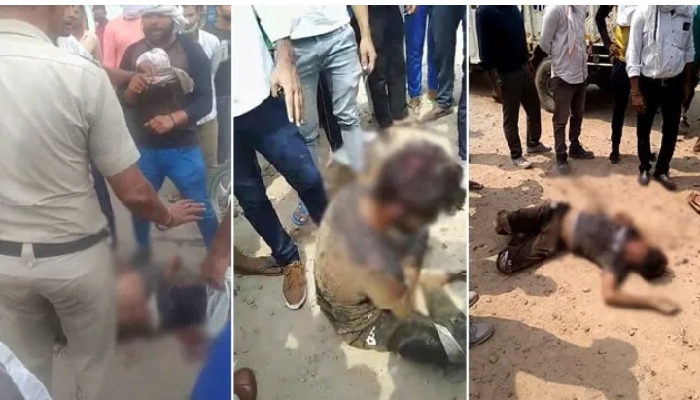
New Delhi, July 1: In a terrific incident with chilling echoes of the 2015 Dadri mob lynching, a Muslim man, who was carrying meat, was savagely attacked by a mob belonging to a saffron outfit in the presence of in BJP ruled Haryana on the eve of Eid al-Adha. 

The incident occurred at around 9 a.m. on Friday, July 31 at Badshahpur village in Haryana’s Gurgaon, when Lukman was transporting meat in a pic-kup truck. 

The attack was captured on mobile phones by onlookers and the video clips of the incident are now spreading on social media. 

A group of saffronite cow vigilantes chased the truck for about 8 km managed waylay it. Lukman, who was driving the truck was pulled out and brutally assaulted on the suspicion that he was transporting cow meat.

Just like Dadri, the police were faster at sending the meat to a lab for testing than catching any one of the suspects. One of the assailants - Pradeep Yadav- has been arrested. 

After being beating to an inch of his life, Lukman was bundled into the pick-up truck and taken back to Gurgaon's Badshahpur village where the goons started thrashing him again.

This is when the police stepped in and stopped them - only to find the assailants fearless enough to even take on them.

Lukman was taken to a hospital and the police filed a case against "unidentified individuals" even though the video of the incident recorded by witnesses shows the faces of the assailants.

The owner of the vehicles said that the meat was buffalo and he has been in the business for 50 years.

The police have so far refused to give a statement on record on the incident and explain their inaction as seen on video.

Comments

Add new comment

  • Coastaldigest.com reserves the right to delete or block any comments.
  • Coastaldigset.com is not responsible for its readers’ comments.
  • Comments that are abusive, incendiary or irrelevant are strictly prohibited.
  • Please use a genuine email ID and provide your name to avoid reject.
News Network
February 19,2020

New Delhi, Feb 19: India will switch to the world's cleanest petrol and diesel from April 1 as it leapfrogs straight to Euro-VI emission compliant fuels from Euro-IV grades now - a feat achieved in just three years and not seen in any of the large economies around the globe.

India will join the select league of nations using petrol and diesel containing just 10 parts per million of sulphur as it looks to cut vehicular emissions that are said to be one of the reasons for the choking pollution in major cities.

Sanjiv Singh, Chairman of Indian Oil Corp (IOC) - the firm that controls roughly half of the country's fuel market, said almost all refineries began producing ultra-low sulphur BS-VI (equivalent to Euro-VI grade) petrol and diesel by the end of 2019 and oil companies have now undertaken the tedious task of replacing every drop of fuel in the country with the new one.

"We are absolutely on track for supplying BS-VI fuel from April 1. Almost all refineries have begun supplying BS-VI fuel and the same has reached storage depots across the country," he said.

From storage depots, the fuel has started travelling to petrol pumps and in the next few weeks all of them will only have BS-VI grade petrol and diesel, he said. "We are 100 per cent confident that fuel that will flow from nozzles at all the petrol pumps in the country on April 1 will be BS-VI emission compliant fuel."

India adopted Euro-III equivalent (or Bharat Stage-III) fuel with a sulphur content of 350 ppm in 2010 and then took seven years to move to BS-IV that had a sulphur content of 50 ppm. From BS-IV to BS-VI it took just three years.

"It was a conscious decision to leapfrog to BS-VI as first upgrading to BS-V and then shifting to BS-VI would have prolonged the journey to 4 to 6 years. Besides, oil refineries, as well as automobile manufacturers, would have had to make investments twice - first to producing BS-V grade fuel and engines and then BS-VI ones," he said.

State-owned oil refineries spent about Rs 35,000 crore to upgrade plants that could produce ultra-low sulphur fuel. This investment is on top of Rs 60,000 crore they spent on refinery upgrades in the previous switchovers.

BS-VI has a sulphur content of just 10 ppm and emission standards are as good as CNG.

Originally, Delhi and its adjoining towns were to have BS-VI fuel supplies by April 2019 and the rest of the country was to get same supplies from April 2020.

But oil marketing companies switched over to supply of BS-VI grade fuels in the national capital territory of Delhi on April 1, 2018.

The supply of BS-VI fuels was further extended to four contiguous districts of Rajasthan and eight of Uttar Pradesh in the National Capital Region (NCR) on April 1, 2019, together with the city of Agra.

BS-VI grade fuels were made available in 7 districts of Haryana from October 1, 2019.

Singh said the new fuel will result in a reduction in NOx in BS-VI compliant vehicles by 25 per cent in petrol cars and by 70 per cent in diesel cars.

The switchover, he said, is a tedious task as every drop of old, higher-sulphur content fuel has to be flushed out in depots, pipelines and tanks before being replaced by BS-VI.

"We are confident of disruption-free switchover to BS-VI supplies across the country," he said. "What we will be supplying is the best quality available anywhere in the world. You don't have any better fuel that is supplied in any part of the world. Perhaps our BS-VI fuel will be better than equivalent fuel in some parts of the US and Europe."

India adopted a fuel upgradation programme in the early 1990s. Low lead gasoline (petrol) was introduced in 1994 in Delhi, Mumbai, Kolkata and Chennai. On February 1, 2000, unleaded gasoline was mandated nationwide.

Similarly, BS-2000 (Euro-I equivalent, BS-1) vehicle emission norms were introduced for new vehicles from April 2000. BS-II (Euro-II equivalent) emission norms for new cars were introduced in Delhi from 2000 and extended to the other metro cities in 2001.

Benzene limits have been reduced progressively from 5 per cent in 2000 to 1 per cent nationwide. Lead content in gasoline was removed in phases and only unleaded gasoline is being produced and sold from February 1, 2000.

The octane number of gasoline signifies the improved performance of the engine. Loss in octane number due to phasing out of lead was made up by installing new facilities in the refinery and changes in refinery operation. RON (Research Octane Number) of gasoline for BS-2000 spec was increased to 88. This has over time been increased to 91.

Singh said sulphur reduction will reduce Particulate Matter (PM) emissions even in the in-use older generation diesel vehicles.

Comments

Add new comment

  • Coastaldigest.com reserves the right to delete or block any comments.
  • Coastaldigset.com is not responsible for its readers’ comments.
  • Comments that are abusive, incendiary or irrelevant are strictly prohibited.
  • Please use a genuine email ID and provide your name to avoid reject.