Gujarat: Hindus help reopen mosque after 30 yrs in riot hit locality

February 26, 2017

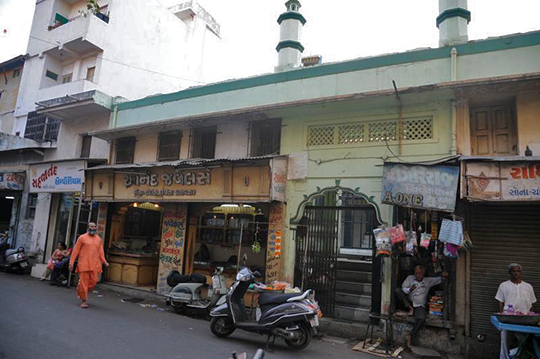
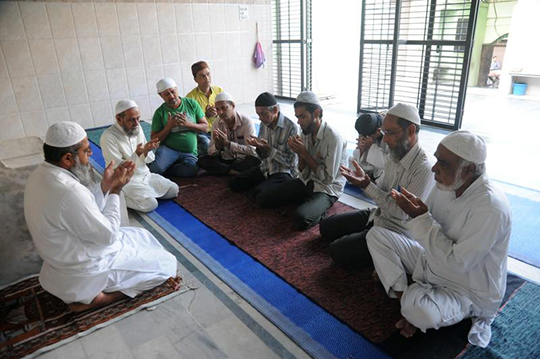
Ahmedabad, Feb 26: The call to prayer from the mosque near Bakri Pol in the communally sensitive Kalupur area is no ordinary azaan. Heard for the first time in 30 years in March 2016, it signifies the voice of compassion and respect drowning out hatred. Kalupur, a patchwork of Hindu and Muslim ghettos, was bloodied by communal riots in 1984. Since the nearly 100-year-old mosque is located in a Hindu locality — near Ramji, Nagdalla Hanuman, and Shesh Narayan temples — Muslims began to avoid it to avert troubles.

sec 1

Polarization intensified during the riots that broke out after the demolition of the Babri Masjid in 1993. By then the Kalupur mosque was overrun with foliage and had begun to crumble.

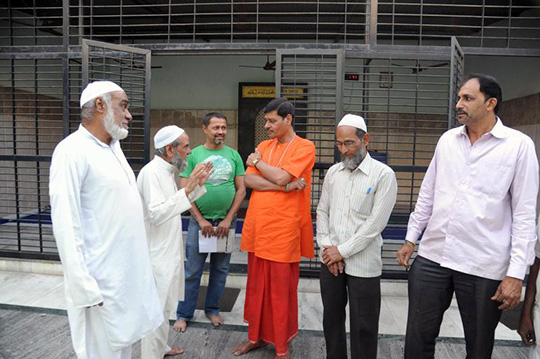
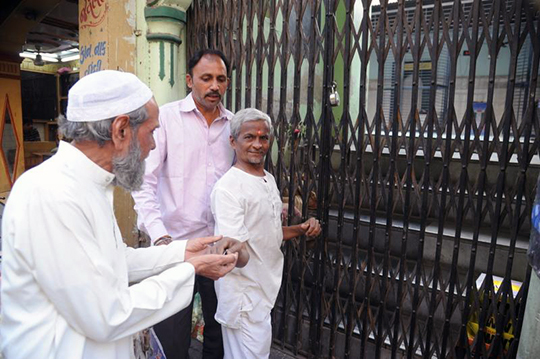
Paradoxically, after the communal riots of 2002, which had riven Gujarat, residents around the mosque were moved by a collective, voluntary desire to save it. Hindus reached out to their Muslim brethren, cleared the wild foliage, and contributed resources for repairs. The mosque reopened in March 2016. A year later, people in the neighbourhood affirm that the reconstruction effort has cemented bonds between communities. So much so, one set of keys to the mosque has been entrusted to Hindus.

"One set of keys is with Poonam Parekh and Kaushik Rami who sell flowers near the mosque," said Aziz Gandhi, social worker in Dariapur. Rami said he lights incense sticks twice a day near the mosque. "We are happy that the mosque that was closed for over three decades is now filled with devotees," he said. The priest of the Nagdalla Hanuman Temple, Chandrakant Sharma, said: "With Haji Usmangani Mansuri and other trustees of the mosque, we renovated the structure." He said that previously Muslim youths had to go to other mosques to offer namaaz. "Now, they they don't have to venture out of their locality," Sharma said. Hamidullah Shaikh, a Dariapur resident, said: "Our Hindu brothers helped us bring labourers to renovate the mosque." It appears a major breach in society has been lovingly repaired.

sec 2

sec 3

sec 4

Comments

Ajz
 - 
Monday, 27 Feb 2017

Better to send these coastal senseless goondas to Gujarat Kalupur..

saif
 - 
Monday, 27 Feb 2017

Real ACHE DIN not from BJP but from true Indian Hindus of Gujarat Kalupur...really everyone need to salute those Hindus....Its my India

Skazi
 - 
Monday, 27 Feb 2017

Masha Allah ..... But in coastal districts the senseless goondas are fighting each other .....

Add new comment

  • Coastaldigest.com reserves the right to delete or block any comments.
  • Coastaldigset.com is not responsible for its readers’ comments.
  • Comments that are abusive, incendiary or irrelevant are strictly prohibited.
  • Please use a genuine email ID and provide your name to avoid reject.
News Network
March 30,2020

Bengaluru, Mar 30: Karnataka Chief Minister BS Yediyurappa on Monday appealed to people to strictly follow the restrictions in the state, saying that the ending of 21-day nationwide lockdown imposed to contain COVID-19 depends on how the public adheres to the rules.

In a press statement, Yediyurappa appealed to the people to help the government to prevent the spread of coronavirus by strictly following the lockdown.

"People of Karnataka are known for tolerance and patience. They are law-abiding citizens. Now, the lockdown in wake of coronavirus is a testing time for them. It has come to test the patience of our people, especially the people of Karnataka. Prime Minister Narendra Modi himself has apologized and said that lockdown was an inevitable step taken by the government to protect people from the pandemic. We have to realise the predicament of a prime minister who always cares for the well being of the country and its people," the statement quoted Yediyurappa as saying.

"At this hour of crisis, it is not good on our part to come out of houses and violate the curfew. The ending of lockdown depends on strictness with which one follows the curfew and maintain social distancing. If one follows the curfew strictly, the lockdown period will automatically end on April 14. Whether to end the lockdown or not is in your hands," he said.

The Chief Minister urged not to test the patience of police, saying, "Already our police are under stress as they are working without any rest. Do not force them to use the force and later blame them for stern action."

He also appealed to follow the lockdown provisions and stay back in their home.
"The government has taken all measures to maintain the supply of essentials and food to the needy. Consider this situation as a blessing in disguise and spend your valuable time reading books which in turn will boost your knowledge and intellectual capacity. My earnest request to even the poor is spending your time by involving yourselves in creative activities inside your houses," Yediyurappa said.

"At the same time, it is time for us to respect the sacrificing work of the doctors, nurses, health staff and civic workers who are working round the clock to save the lives of hundreds of people affected by coronavirus. My appeal to you all strictly follows the curfew rules and maintains the social distance to combat COVID-19," he added.

Comments

Add new comment

  • Coastaldigest.com reserves the right to delete or block any comments.
  • Coastaldigset.com is not responsible for its readers’ comments.
  • Comments that are abusive, incendiary or irrelevant are strictly prohibited.
  • Please use a genuine email ID and provide your name to avoid reject.
Ram Puniyani
February 10,2020

Noam Chomsky is one of the leading peace workers in the world. In the wake of America’s attack on Vietnam, he brought out his classic formulation, ‘manufacturing consent’. The phrase explains the state manipulating public opinion to have the public approve of it policies—in this case, the attack of the American state on Vietnam, which was then struggling to free itself from French colonial rule.

In India, we are witness to manufactured hate against religious minorities. This hatred serves to enhance polarisation in society, which undermines India’s democracy and Constitution and promotes support for a Hindu nation. Hate is being manufactured through multiple mechanisms. For example, it manifests in violence against religious minorities. Some recent ghastly expressions of this manufactured hate was the massive communal violence witnessed in Mumbai (1992-93), Gujarat (2002), Kandhamal (2008) and Muzaffarnagar (2013). Its other manifestation was in the form of lynching of those accused of having killed a cow or consumed beef. A parallel phenomenon is the brutal flogging, often to death, of Dalits who deal with animal carcasses or leather.

Yet another form of this was seen when Shambhulal Regar, indoctrinated by the propaganda of Hindu nationalists, burned alive Afrazul Khan and shot the video of the heinous act. For his brutality, he was praised by many. Regar was incited into the act by the propaganda around love jihad. Lately, we have the same phenomenon of manufactured hate taking on even more dastardly proportions as youth related to Hindu nationalist organisations have been caught using pistols, while police authorities look on.

Anurag Thakur, a BJP minster in the central government recently incited a crowd in Delhi to complete his chant of what should happen to ‘traitors of the country...” with a “they should be shot”. Just two days later, a youth brought a pistol to the site of a protest at Jamia Millia Islamia university and shouted “take Azaadi!” and fired it. One bullet hit a student of Jamia. This happened on 30 January, the day Nathuram Godse had shot Mahatma Gandhi in 1948. A few days later, another youth fired near the site of protests against the CAA and NRC at Shaheen Bagh. Soon after, he said that in India, “only Hindus will rule”.

What is very obvious is that the shootings by those associated with Hindu nationalist organisations are the culmination of a long campaign of spreading hate against religious minorities in India in general and against Muslims in particular. The present phase is the outcome of a long and sustained hate campaign, the beginning of which lies in nationalism in the name of religion; Muslim nationalism and Hindu nationalism. This sectarian nationalism picked up the communal view of history and the communal historiography which the British introduced in order to pursue their ‘divide and rule’ policy.

In India what became part of “social common sense” was that Muslim kings had destroyed Hindu temples, that Islam was spread by force, and that it is a foreign religion, and so on. Campaigns, such as the one for a temple dedicated to the Hindu god Rama to be built at the site where the Babri masjid once stood, further deepened the idea of a Muslim as a “temple-destroyer”. Aurangzeb, Tipu Sultan and other Muslim kings were tarnished as the ones who spread Islam by force in the subcontinent. The tragic Partition, which was primarily due to British policies, and was well-supported by communal streams also, was entirely attributed to Muslims. The Kashmir conflict, which is the outcome of regional, ethnic and other historical issues, coupled with the American policy of supporting Pakistan’s ambitions of regional hegemony, (which also fostered the birth of Al-Qaeda), was also attributed to the Muslims.

With recurring incidents of communal violence, these falsehoods went on going deeper into the social thinking. Violence itself led to ghettoisation of Muslims and further broke inter-community social bonds. On the one hand, a ghettoised community is cut off from others and on the other hand the victims come to be presented as culprits. The percolation of this hate through word-of-mouth propaganda, media and re-writing of school curricula, had a strong impact on social attitudes towards the minorities.

In the last couple of decades, the process of manufacturing hate has been intensified by the social media platforms which are being cleverly used by the communal forces. Swati Chaturvedi’s book, I Am a Troll: Inside the Secret World of the BJP’s Digital Army, tells us how the BJP used social media to spread hate. Whatapp University became the source of understanding for large sections of society and hate for the ‘Other’, went up by leaps and bounds. To add on to this process, the phenomenon of fake news was shrewdly deployed to intensify divisiveness.

Currently, the Shaheen Bagh movement is a big uniting force for the country; but it is being demonised as a gathering of ‘anti-nationals’. Another BJP leader has said that these protesters will indulge in crimes like rape. This has intensified the prevalent hate.

While there is a general dominance of hate, the likes of Shambhulal Regar and the Jamia shooter do get taken in by the incitement and act out the violence that is constantly hinted at. The deeper issue involved is the prevalence of hate, misconceptions and biases, which have become the part of social thinking.

These misconceptions are undoing the amity between different religious communities which was built during the freedom movement. They are undoing the fraternity which emerged with the process of India as a nation in the making. The processes which brought these communities together broadly drew from Gandhi, Bhagat Singh and Ambedkar. It is these values which need to be rooted again in the society. The communal forces have resorted to false propaganda against the minorities, and that needs to be undone with sincerity.

Combating those foundational misconceptions which create hatred is a massive task which needs to be taken up by the social organisations and political parties which have faith in the Indian Constitution and values of freedom movement. It needs to be done right away as a priority issue in with a focus on cultivating Indian fraternity yet again.


Comments

Add new comment

  • Coastaldigest.com reserves the right to delete or block any comments.
  • Coastaldigset.com is not responsible for its readers’ comments.
  • Comments that are abusive, incendiary or irrelevant are strictly prohibited.
  • Please use a genuine email ID and provide your name to avoid reject.
News Network
April 12,2020

Mangaluru, Apr 12: A 10-month-old baby who tested COVID-19 positive on March 27 completed treatment and discharged from hospital on Saturday.

He was the youngest positive case in Karnataka, from Sajipanadu village in Bantwal taluk.

The child had been with his mother to a relative's house at Monetepadau village, situated on the Karnataka-Kerala border in the first week of March.

A few days later the child developed an acute respiratory illness and tested positive for the COVID-19 virus.

Treating the breastfeeding child was challenging for doctors as he had to be isolated. A team of doctors from Wenlock Hospital took up this challenge and successfully cured the baby.

Test reports on his mother and grandmother too have returned negative. They too had been under quarantine and were discharged with the baby.

Another positive development was that no COVID-19 case has been reported from the child's village.  

The entire Sajipanadu village was completely sealed after the child tested positive and the district had provided all the necessary supplies to the villagers.

Comments

Add new comment

  • Coastaldigest.com reserves the right to delete or block any comments.
  • Coastaldigset.com is not responsible for its readers’ comments.
  • Comments that are abusive, incendiary or irrelevant are strictly prohibited.
  • Please use a genuine email ID and provide your name to avoid reject.