Gujarat: Hindus help reopen mosque after 30 yrs in riot hit locality

February 26, 2017

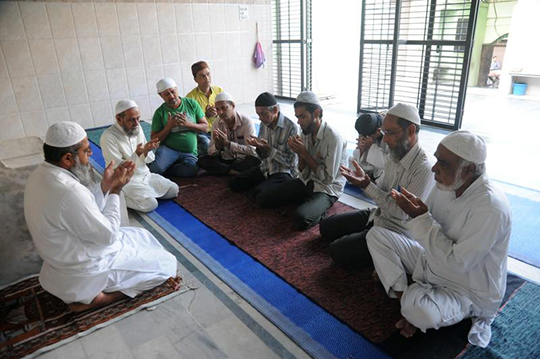
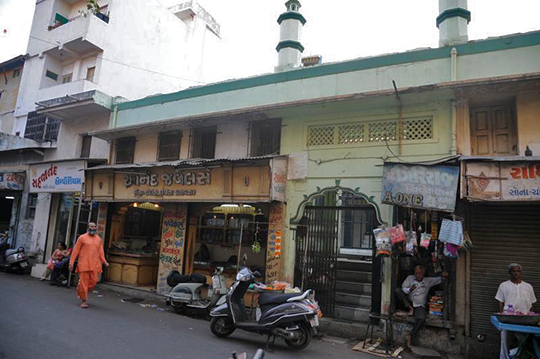
Ahmedabad, Feb 26: The call to prayer from the mosque near Bakri Pol in the communally sensitive Kalupur area is no ordinary azaan. Heard for the first time in 30 years in March 2016, it signifies the voice of compassion and respect drowning out hatred. Kalupur, a patchwork of Hindu and Muslim ghettos, was bloodied by communal riots in 1984. Since the nearly 100-year-old mosque is located in a Hindu locality — near Ramji, Nagdalla Hanuman, and Shesh Narayan temples — Muslims began to avoid it to avert troubles.
sec 1

Polarization intensified during the riots that broke out after the demolition of the Babri Masjid in 1993. By then the Kalupur mosque was overrun with foliage and had begun to crumble.

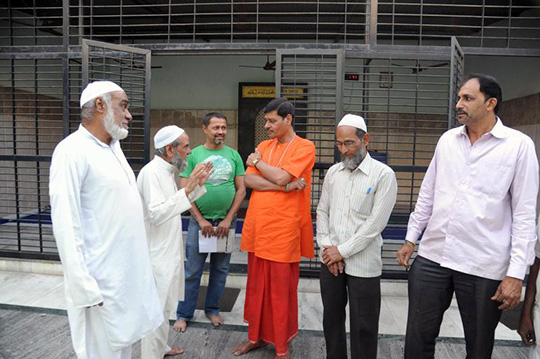
Paradoxically, after the communal riots of 2002, which had riven Gujarat, residents around the mosque were moved by a collective, voluntary desire to save it. Hindus reached out to their Muslim brethren, cleared the wild foliage, and contributed resources for repairs. The mosque reopened in March 2016. A year later, people in the neighbourhood affirm that the reconstruction effort has cemented bonds between communities. So much so, one set of keys to the mosque has been entrusted to Hindus.

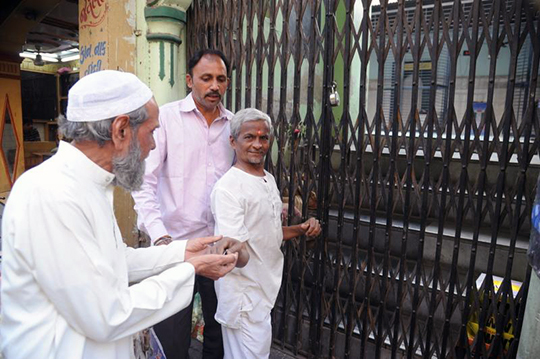
"One set of keys is with Poonam Parekh and Kaushik Rami who sell flowers near the mosque," said Aziz Gandhi, social worker in Dariapur. Rami said he lights incense sticks twice a day near the mosque. "We are happy that the mosque that was closed for over three decades is now filled with devotees," he said. The priest of the Nagdalla Hanuman Temple, Chandrakant Sharma, said: "With Haji Usmangani Mansuri and other trustees of the mosque, we renovated the structure." He said that previously Muslim youths had to go to other mosques to offer namaaz. "Now, they they don't have to venture out of their locality," Sharma said. Hamidullah Shaikh, a Dariapur resident, said: "Our Hindu brothers helped us bring labourers to renovate the mosque." It appears a major breach in society has been lovingly repaired.
sec 2

sec 3

sec 4

Comments

Ajz
 - 
Monday, 27 Feb 2017

Better to send these coastal senseless goondas to Gujarat Kalupur..

saif
 - 
Monday, 27 Feb 2017

Real ACHE DIN not from BJP but from true Indian Hindus of Gujarat Kalupur...really everyone need to salute those Hindus....Its my India

Skazi
 - 
Monday, 27 Feb 2017

Masha Allah ..... But in coastal districts the senseless goondas are fighting each other .....

Add new comment

  • Coastaldigest.com reserves the right to delete or block any comments.
  • Coastaldigset.com is not responsible for its readers’ comments.
  • Comments that are abusive, incendiary or irrelevant are strictly prohibited.
  • Please use a genuine email ID and provide your name to avoid reject.
coastaldigest.com web desk
May 30,2020

Udupi, May 30: Following the announcement of re-opening of places of worship from June 8, Ibrahim Musliyar Bekal, the Qadhi of Udupi has called upon the Centre and State governments to issue uniform guidelines for Muslims to be followed while going to mosques for congregational prayers.

In a media statement, he said that even though the government is relaxing the lockdown in a phased manner things will not be like before as people have to follow the precautionary measures to control the spread of the coronavirus. 

He said that the union and state governments after holding discussions with the authorities of Central Waqf Council and the State Waqf Boards and Islamic scholars, should form a uniform guidelines for all mosques.

He also suggested a few guidelines such as offering congregational prayers soon after adaan, closing the mosque soon after prayers, maintaining physical distance and avoiding the use of toilet in mosques. 

He also suggested the sick, elderly people and children to prefer to offer prayers in homes instead of mosques until situation becomes normal. 

Comments

Add new comment

  • Coastaldigest.com reserves the right to delete or block any comments.
  • Coastaldigset.com is not responsible for its readers’ comments.
  • Comments that are abusive, incendiary or irrelevant are strictly prohibited.
  • Please use a genuine email ID and provide your name to avoid reject.
News Network
May 30,2020

Bengaluru, May 30: Health Minister B Sriramulu banned the consumption of chewing tobacco in public places on Saturday, which is marked as World Tobacco Day. The ban would include chewing paan masala and spitting in public places.

In June 2013, the state banned the manufacture, storage, sale, or distribution of gutka and paan masala containing tobacco or nicotine as ingredients to reduce the prevalence of tobacco use. On October 26, 2016, the state proscribed all kinds of chewing tobacco, containing tobacco or nicotine or both in accordance with the Supreme Court order.

Karnataka is the second state in India to ban e-cigarettes. The state also prohibited single cigarettes. Until September 2019, the state counselled 15,698 patients in tobacco cessation centres set up in private dental colleges.

Comments

Add new comment

  • Coastaldigest.com reserves the right to delete or block any comments.
  • Coastaldigset.com is not responsible for its readers’ comments.
  • Comments that are abusive, incendiary or irrelevant are strictly prohibited.
  • Please use a genuine email ID and provide your name to avoid reject.
News Network
June 26,2020

Bengaluru, Jun 26: The National Restaurant Association of India (NRAI) on Thursday came up with a Standard Operating Procedure (SOP) for restaurants whereby among other physical distancing norms, it has suggested a 2-metre gap between tables.

Formulated in partnership with Releski, a Bengaluru based skill-tech company, the SoP suggests that in case of back-to-back seating, people sitting with their backs towards each other will have their seats divided by 'Plexiglass' divider raised up to 2 meters from the ground.

"In a typical restaurant, the improvised seating plan should have a minimum distance of 2 metres between tables. The distance of 2 metres (6 feet) between tables should measure from one edge of the table to the other table's edge," it said.

In case of loose or free seating such as in banquet style or food court style seating, a minimum 2 meters of distance should be maintained between tables.

The guidelines noted that, to encourage physical distancing, restaurants have to sacrifice their seating capacity, to promote health and safety, and also to gain trust from their patrons.

"In order to perform this, divide your restaurants under different sectors. Pull out your restaurant's floor plan and colour code different sections red and yellow. Red sections are potential areas where maximum footfall or traffic is observed. Yellow sections are areas where the footfalls are average," it said.

All the red sections are encircled or bordered by placing barricades or Q manager and will open at specific points to access the yellow section and all the opening points will have hand sanitisers and sprays, and every guest who walks from red zones to yellow zones will sanitise himself/herself to reduce the chances of contamination.

For air conditioning, the guidelines of CPWD shall be followed which inter alia emphasises that the temperature setting of all air conditioning devices should be in the range of 24-30 degree Celsius, relative humidity should be in the range of 40- 65 per cent, intake of fresh air should be as much as possible and cross ventilation should be adequate, the guidelines suggested.

The industry body has also suggested appointment of a COVID-free Ambassador who would operate as the Chief Health Officer within the restaurant team, preferably from the management team in each shift.

The ambassador's would put the new daily work routines into practice, to monitor compliance with good practice and to lead the preventative measures, adapt to health & safety recommendations and requirements of the restaurant and oversee the implementation of the norms.

Anurag Katriar, President of NRAI and CEO & Executive Director of deGustibus Hospitality, said: "Every restaurant cutting across formats is facing the harsh reality of subdued to shut business volumes in the present and the uncertainty of business environment in the future. One thing is certain that hygiene and safety will be a key differentiator in the post-pandemic restaurant operations."

Comments

Add new comment

  • Coastaldigest.com reserves the right to delete or block any comments.
  • Coastaldigset.com is not responsible for its readers’ comments.
  • Comments that are abusive, incendiary or irrelevant are strictly prohibited.
  • Please use a genuine email ID and provide your name to avoid reject.