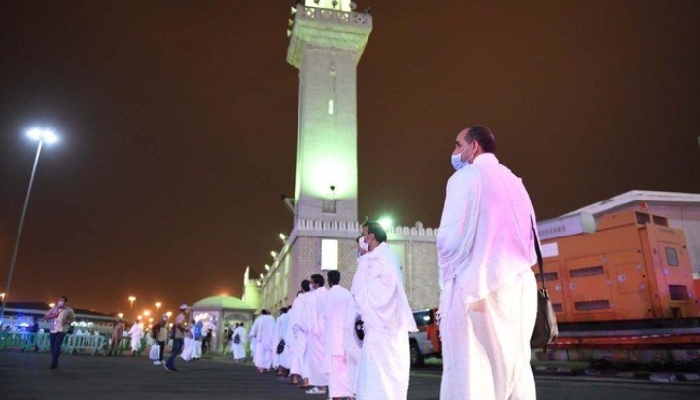
Haj 2017 season begins with first pilgrim arrivals

Arab News
July 25, 2017

Madinah, Jul 25: The Haj 2017 season has begun, with the first flights arriving from Pakistan on Monday.

The first group of 329 pilgrims from Islamabad arrived at Prince Mohammed bin Abdul Aziz Airport in Madinah.

The group was received by Sajid Yousafani, director general of the Pakistan Haj Mission; Asif Memon, deputy consul general; and Ashraf Lanja, joint secretary at the Ministry of Religious Affairs.

The second flight from Pakistan, carrying 253 pilgrims, arrived in Jeddah. It was the first Haj flight to land at King Abdul Aziz International Airport.

Abdul Hakeem Al-Tamimi, chairman of the General Authority of Civil Aviation (GACA), and other Saudi officials were present at the airport to receive the pilgrims.

Al-Tamimi greeted the pilgrims with gifts and flowers. Elaborate measures have been made at both airports to receive pilgrims.

Some 1,954 pilgrims arrived in Saudi Arabia on Monday under the government’s Haj program. The number of flights arriving at both airports is expected to increase in the coming days.

Comments

Fairman
 - 
Tuesday, 25 Jul 2017

Patriotism is not by singing any song, nor saluting the flag.
it is by respecting the people and their rights.

Even the constitution can be wrong, it is not from the God.
It can have errors,
Nothing should be by force, including
Praying,
following religion
food habit,

it is the choice of the people.
The court does not what it says, what the verdict is.

Add new comment

  • Coastaldigest.com reserves the right to delete or block any comments.
  • Coastaldigset.com is not responsible for its readers’ comments.
  • Comments that are abusive, incendiary or irrelevant are strictly prohibited.
  • Please use a genuine email ID and provide your name to avoid reject.
News Network
March 11,2020

Riyadh, Mar 11: Energy titan Saudi Aramco said Tuesday it will boost crude oil supplies to 12.3 million barrels per day in April, flooding markets as it escalates a price war with Russia.

Riyadh had already slashed its price for April delivery after Russia refused its proposal that producer alliance OPEC+ orchestrate a co-ordinated cut of 1.5 million barrels per day.

The production cut had been mooted to shore up global oil prices, which have gone into meltdown as the deadly new coronavirus casts a pall over the world economy, but now price cuts and rising output indicate an unravelling of OPEC+ co-operation.

"Saudi Aramco announces that it will provide its customers with 12.3 million barrels per day of crude oil in April," the company said in a statement to the Saudi stock exchange.

Saudi Arabia, the world's biggest crude exporter has been pumping some 9.8 million bpd so its announcement on Tuesday means it will be adding at least 2.5 million bpd from April.

"The Company has agreed with its customers to provide them with such volumes starting 1 April 2020. The Company expects that this will have a positive, long-term financial effect," the statement said.

Saudi Arabia says it has an output capacity of 12 million bpd but it is not known for how long it can sustain such levels.

The kingdom also has millions of barrels of crude stored in strategic reserves to be used when needed and is expected to use it to provide the extra supply to the global market.

"Production above 12 million bpd shows the Saudis have something to prove," director of Britain-based RS Energy Bill Farren-Price said.

"This is a grab for market share. The taps are open and the prices have been cut sharply," Farren-Price told AFP.

In a quick response, Russian Energy Minister Alexander Novak said Moscow could boost production in the short term "by 200,00-300,000 bpd, with a potential of 500,000 bpd in the near future".

But he stressed that Moscow was in favour of extending a December agreement that had seen OPEC and Russia agree to cut production by 500,000 barrels per day in 2020, lowering output from October 2018 levels by 1.7 million barrels per day.

The events of recent days have signalled a disintegration of collaboration between OPEC and Russia.

Russia is a non-OPEC member and the world's second-biggest oil producer, but Moscow and other non-members have in recent years co-operated with the oil cartel in an arrangement known as OPEC+.

The Saudi price cuts over the weekend, which were the first salvo in the price war, sent oil prices crashing -- registering the single biggest one-day loss in three decades on Monday.

Saudi Arabia draws around 70 per cent of its revenues from oil, and the revenues are key to ambitious reform programmes launched by Crown Prince Mohammed bin Salman.

Comments

Add new comment

  • Coastaldigest.com reserves the right to delete or block any comments.
  • Coastaldigset.com is not responsible for its readers’ comments.
  • Comments that are abusive, incendiary or irrelevant are strictly prohibited.
  • Please use a genuine email ID and provide your name to avoid reject.
Agencies
July 31,2020

Jeddah, Jul 31: Hajj 2020 pilgrims arrived in Muzdalifah Thursday night to rest after spending the day in Arafat.

Earlier, the pilgrims scaled Mount Arafat to pray and repent, as a highly unusual Hajj approached its climax. They listened to a sermon delivered by Sheikh Abdullah Al-Manea and prayed Dhuhr and Asr prayers together at the Al-Namirah Mosque in Arafat.

This year’s pilgrimage is the smallest in modern times, after the number of participants was greatly restricted to prevent the spread of the coronavirus. 

Tight security was in place around the foot of the rocky hill outside Makkah, also known as Jabal Al-Rahma or Mount of Mercy, in preparation for the high point of the annual ritual.

Video footage shown on state television showed the pilgrims setting off on their climb to the summit. They wore face masks and observed strict social-distancing rules imposed by Saudi authorities.As sprinklers sprayed water on them to provide relief from the summer desert heat, the pilgrims raised their palms as they climbed the slopes of the hill — the site of Prophet Muhammad’s last sermon. When they reached the top they recited holy verses and prayed for forgiveness for their sins.

Earlier, the pilgrims were taken in buses from Mina to Mount Arafat. Strict precautionary measures were in place, with each group accompanied by security teams, ambulances and civil defense vehicles. 

When they arrived, their temperatures were checked before they entered Namirah Mosque to hear a sermon that was translated into 10 languages.

“The camps were set up for pilgrims in Arafat early on,” said Minister of Hajj and Umrah Muhammad Salih Bentin. The sermon at Namirah Mosque was delivered by Sheikh Abdullah Al-Manea, who led the pilgrims in noon and afternoon prayers.

“During Hajj this year, we reiterate that it is essential for pilgrims, as well as everyone assisting them, to adhere to the precautionary regulations that have been implemented,” Al-Manea, a member of the Council of Senior Scholars, said during his sermon. “This is to be done for their own safety.

“Precautions have been put in place to protect lives against the damage that the pandemic can cause, and also to actualize Islam’s teachings pertaining to safeguarding human life by Allah’s permission.”

The stay in Arafat is described as the pinnacle of Hajj and Muslims around the world reflect the actions of pilgrims by asking for forgiveness and praying for their deepest desires.
Pilgrims left Arafat in coaches for Muzdalifah after sunset and will pray the Maghrib and Isha prayers there.

After sunset prayers, the pilgrims made their way down Mount Arafat to Muzdalifah, where they will spend the night before the final Hajj ritual, the symbolic stoning of the devil. 

This year, each pilgrim received sanitized pebbles in advance of the event on Friday, which is the first day of Eid Al-Adha.
This year the Kingdom faced the unprecedented challenge of ensuring pilgrims attending Hajj were protected as much as possible from the risks of the coronavirus.

They will then sleep, pray the Fajr prayer there tomorrow and then leave for Mina.

Comments

Add new comment

  • Coastaldigest.com reserves the right to delete or block any comments.
  • Coastaldigset.com is not responsible for its readers’ comments.
  • Comments that are abusive, incendiary or irrelevant are strictly prohibited.
  • Please use a genuine email ID and provide your name to avoid reject.
coastaldigest.com news network
June 16,2020

Dubai, Jun 16: In a humanitarian gesture, a UAE-based Pakistani businessman has come forward to offer free interim accommodation options to covid lockdown hit expatriates. 

The men benefitted from Ali Rao's housing initiative include Indians, Pakistanis and Africans. 

Inspired by the ongoing efforts taken by the UAE leadership to take care of all UAE residents, Ali Rao, CEO of Rao Holdings LLC in Dubai is offering free shared accommodation to unemployed male bachelors and workers, especially expatriates who do not have a place to stay.

Ali Rao currently has a capacity of 100 accommodation options that he wishes to offer to those who cannot afford house rent. 

"We have already placed 25 such men in these housing options spread across Al Quoz, Jebel Ali and Muhaisnah areas of Dubai," Ali Rao told local media. He works in collaboration with major charities in Dubai, who refer the cases to Rao.

"One of our companies - the property management division - deals with industrial housing accommodation. We decided to put this space to good use when I came across media articles that highlighted the plight of these homeless men," he said. 

Rao has already sheltered 25 homeless workers in the Al Quoz area. "We have received applications for 35 more, however, many of these men are due to return to their home countries, so we are awaiting confirmation from the charities," he explained. He has provided them with free Wi-Fi, bedding, blankets, bedsheets, and pillows.

"In one unit, we provide them with food and the other unit, social workers and the associated charities deliver food," he added. The housing is exclusively for men and not for women and families. "Many are seeking jobs, so they needed Wi-Fi. I went to the camps today and set up a Wi-Fi connection. Someone wanted to eat eggs, so we got him some eggs and rice. These are simple things most of us take for granted, but to many people this is vital," he added.

Since most of the residents are looking to return to their home countries, Rao is also in the process of providing them with air tickets.

"If the need arises, we will add more units," he explained. Rao said, "The ongoing pandemic has hit everyone hard, especially those with no security to fall back on. The economic and income disparities have only increased in this time, with those dependent on daily wages being rendered homeless in massive numbers across the globe."

He added, "I felt heartbroken and if I would stand by and watch, I would feel very small as a human being, I won't be able to stand in front of the creator I thought to myself. These are some very difficult times for all of us."

A beneficiary of the programme said, "I am very happy with this initiative as living outside in the summer is very difficult. It's very hot. I want to thank God and this company for providing me with a roof over my head."


Comments

Add new comment

  • Coastaldigest.com reserves the right to delete or block any comments.
  • Coastaldigset.com is not responsible for its readers’ comments.
  • Comments that are abusive, incendiary or irrelevant are strictly prohibited.
  • Please use a genuine email ID and provide your name to avoid reject.