


Haji Ali Dargah decides to grant access to women, finally

October 24, 2016

New Delhi, Oct 24: Women will be granted access to the sanctum sanctorum of the Haji Ali shrine in Mumbai on par with men, the Dargah Trust told the Supreme Court today and sought four weeks to make the requisite infrastructural changes.
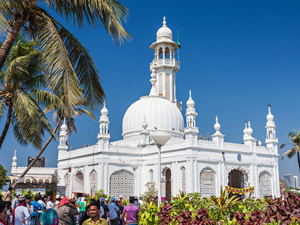
haji aliA bench comprising Chief Justice T S Thakur and Justices D Y Chandrachud and L Nageswara Rao granted time to the trust and disposed off its appeal against the Bombay High Court order asking it to give equal access to women also.

Senior advocate Gopal Subramanium, appearing for the trust, said an additional affidavit has been filed on behalf of the Dargah trust saying it is willing to allow women inside the shrine.

The apex court, on October 17, had extended the stay granted by Bombay High Court to facilitate an appeal against its decision to lift the ban on entry of women near the sanctum sanctorum of the Dargah in Mumbai.

Earlier, the Supreme Court had expressed hope that the Trust, which had challenged the high court judgement, "will take a stand which is progressive".

Subramanium, had also assured the bench that he was on a "progressive mission" and said all holy books and scriptures promoted equality and nothing which is regressive in character should be suggested.

The bench had also remarked that "if you are not allowing both men and women to go beyond a point, there is no problem. But if you are allowing some to go beyond a point while others are not, it is a problem."

The counsel, appearing for a women's group which has challenged the practice of the Trust not to allow women near the sanctum sanctorum, had submitted that the position was different before 2011 than what it is today.

The Trust moved the apex court challenging the Bombay High Court order lifting the ban on women from entering the sanctum sanctorum of the renowned Muslim shrine in South Mumbai.

The High Court on August 26 had held that the ban imposed by the Trust on women from entering the sanctum sanctorum of the Haji Ali Dargah, contravened Articles 14, 15 and 25 of the Constitution and said women should be permitted to enter the sanctum sanctorum like men.

The High Court had allowed a PIL filed by two women, Zakia Soman and Noorjehan Niaz, from NGO Bharatiya Muslim Mahila Andolan, challenging the ban on women's entry into the sanctum sanctorum of the dargah from 2012.

It had granted a six-week stay on the order on a request by the Dargah Trust to enable it to appeal before the Supreme Court.

The high court had held that the Trust had no power to alter or modify the mode or manner of religious practices of any individual or any group.

The High Court in its 56-page judgement had also noted that the "right to manage the Trust cannot override the right to practice religion itself".

It had said the trust has not been able to justify the ban legally or otherwise. Hence it cannot be said that the prohibition was an essential and integral part of Islam and whether taking away that part of the practice would result in a fundamental change in the character of the religion or belief.

It had also refused to accept the Trust's justification that the ban was imposed for safety and security of women, in particular, to prevent sexual harassment at places of worship.

The Trust had claimed that the ban was in keeping with an order of the Supreme Court wherein stringent directions have been issued to ensure that there is no sexual harassment to women at places of worship.

The court had noted that the aims, objectives and activities of the Haji Ali Dargah Trust were not governed by any custom or tradition and held that it was a public charitable trust and hence, open to people all over the world, irrespective of their caste, creed or gender.

The Maharashtra government had earlier told the court that women should be barred from entering the inner sanctorum of Haji Ali Dargah only if it is so enshrined in the Quran.

Comments

Syed
 - 
Monday, 24 Oct 2016

Performing Dargah Pooja is unpardonable sin in Islam.

Rashid
 - 
Monday, 24 Oct 2016

visiting these graves (darghas) either by men or women is against islamic belief ... whatever the decision , won't make any difference to community

Abdul
 - 
Monday, 24 Oct 2016

Wrong Number!..
Worship creator, not his creation.

Rikaz
 - 
Monday, 24 Oct 2016

Abbiya, you misunderstood about the concept of performing umrah and Haj....visiting grave of anyone is not allowed and which is prohibited for ladies....performing umrah or haj is religious duty....once in a life time if a Muslim financially strong enough is bound to perform these religious obligations.,,,,

Well Wisher
 - 
Monday, 24 Oct 2016

The last paragraph is so funny. Maharashtra Govt. was right. \Aaneye illaandmyake Ambaari ellind bantu kanawwa?\" There is nothing mentioned in the Qur'an about Dargah. In fact, Dargah & Durgah are the 2 faces of the same coin. Idol worship is major sin (Shirk) in Islam. Prophet also denied women's entry to the grave yard. I request MH govt to completely shut the dargah. It is just a money making, sexual harassment center. No relation with Islam. It is nothing but a Mafia."

Add new comment

  • Coastaldigest.com reserves the right to delete or block any comments.
  • Coastaldigset.com is not responsible for its readers’ comments.
  • Comments that are abusive, incendiary or irrelevant are strictly prohibited.
  • Please use a genuine email ID and provide your name to avoid reject.
News Network
January 31,2020

Jan 31: A bunch of fishermen in Kerala is being praised for releasing an endangered shark back into water. A video posted on Twitter shows the fishermen releasing the whale shark that was trapped in their nets back into the sea.

The video was posted on Twitter by InSeason Fish - a group working towards environmental conservation, sustainable fisheries and healthy oceans. Filmed in Kerala's Kozhikode, it shows fishermen on a fishing vessel with the huge whale shark.

Whale sharks are the largest fish in the ocean and can reach up to 40 feet in length. Distinguished by their white spots, this shark is on International Union for Conservation of Nature's list of endangered species.

In the video, at least seven fishermen are seen working together to lift the thrashing whale shark up with the help of ropes and releasing it into the water.

Watch the video below:

Comments

Add new comment

  • Coastaldigest.com reserves the right to delete or block any comments.
  • Coastaldigset.com is not responsible for its readers’ comments.
  • Comments that are abusive, incendiary or irrelevant are strictly prohibited.
  • Please use a genuine email ID and provide your name to avoid reject.
News Network
July 14,2020

Bengaluru, Jul 14: The Karnataka government on Tuesday made changes to the Land Reforms Act 1961 through an ordinance to allow non-agriculturists to buy and own farmland for farming.

“The Land Reforms Act has been amended through an ordinance and notified after Governor Vajubhai R Vala gave his assent to it on Monday night,” a Revenue Department official told media persons.

It now permits non-farmers to buy farmland and grow food crops. But they can’t use it for other activities.

“Sections 79 A, B and C of the Act have been repealed, paving way for bona fide citizens to invest in farmland and take to farming as a hobby, passion or additional occupation, which is rewarding,” the official said.

The amended Act will enable the state to attract investment in the farm sector and boost food output. The farm sector’s contribution to the state’s gross domestic product (GDP) has been less than the manufacturing and services sectors over the last two decades.

Criticism by farmers, the Congress and the JD(S) since the cabinet approved changes on June 11 forced the state government to retain section 80 of the Act, with an amendment, to prevent sale of dam water irrigated farmland.

“The ordinance has also added a new section (80A), which says relaxations under the Act will not apply to land given to farmers under the Karnataka SC and ST (Scheduled Caste and Tribe) Act 1978,” the official said.

The changes permit mortgage of farmland only to the state-run institutions, firms and cooperative societies specified in the Act. The ordinance also makes legal cases pending in courts against the sections amended redundant as the new Act addresses the concerns raised in them.

“Besides generating substantial revenue for the state government, the Act will now allow farmers who find the occupation non-remunerative and risky due to droughts/floods and labour shortage to sell their surplus land to urban buyers,” the official said.

Ruling BJP Rajya Sabha member KC Ramamurthy from Bengaluru said the amended Act would allow any citizen to buy farmland.

“Though hundreds of people petitioned successive governments for the past 45 years to abolish the ‘draconian’ sections, they were ignored. I compliment Chief Minister BS Yediyurappa and Revenue Minister R Ashoka for the decision to allow everyone to buy farmland irrespective of their occupation or profession,” Ramamurthy told media persons.

Comments

Add new comment

  • Coastaldigest.com reserves the right to delete or block any comments.
  • Coastaldigset.com is not responsible for its readers’ comments.
  • Comments that are abusive, incendiary or irrelevant are strictly prohibited.
  • Please use a genuine email ID and provide your name to avoid reject.
Agencies
July 8,2020

The Central Board of Secondary Education (CBSE) has rationalised by up to 30 per cent the syllabus for classes 9 to 12 for the academic year 2020-21 to reduce course load on students amid the COVID-19 crisis, Union HRD Minister Ramesh Pokhriyal 'Nishank' announced on Tuesday.

The curriculum has been rationalised while retaining the core elements, the Human Resource Development said.

Among the chapters dropped after the rationalisation exercise are lessons on democracy and diversity, demonetisation, nationalism, secularism, India's relations with its neighbours and growth of local governments in India, among others.

"Looking at the extraordinary situation prevailing in the country and the world, CBSE was advised to revise the curriculum and reduce course load for the students of classes 9 to 12.

"To aid the decision, a few weeks back I also invited suggestions from all educationists on the reduction of syllabus for students and I am glad to share that we received more than 1.5K suggestions. Thank you, everyone, for the overwhelming response," Nishank tweeted.

"Considering the importance of learning achievement, it has been decided to rationalise syllabus up to 30 per cent by retaining the core concepts," he added.

The Union minister said the changes made in the syllabi have been finalised by the respective course committees with the approval of the curriculum committee and the Governing Body of the Board.

"The heads of schools and teachers have been advised by the board to ensure that the topics that have been reduced are also explained to the students to the extent required to connect different topics. However, the reduced syllabus will not be part of the topics for internal assessment and year-end board examination.

"Alternative academic calendar and inputs from the NCERT on transacting the curriculum using different strategies shall also be part of the teaching pedagogy in the affiliated schools," a senior official of the HRD ministry said.

For classes 1 to 8, the National Council of Education Research and Training (NCERT) has already notified an alternative calendar and learning outcomes.

According to the updated curriculum, among the chapters deleted from class 10 syllabus are-- democracy and diversity, gender, religion and caste, popular struggles and movement, challenges to democracy

For class 11, the deleted portions included chapters on federalism, citizenship, nationalism, secularism, growth of local governments in India.

Similarly, class 12 students will not be required to study chapters on India's relations with its neighbours, changing nature of India's economic development, social movements in India and demonetisation, among others.

Universities and schools across the country have been closed since March 16 when the central government announced a nationwide classroom shutdown as one of the measures to contain the COVID-19 outbreak.

A nationwide lockdown was announced on March 24, which came into effect the next day. While the government has eased several restrictions, schools and colleges continue to remain closed.

Comments

Add new comment

  • Coastaldigest.com reserves the right to delete or block any comments.
  • Coastaldigset.com is not responsible for its readers’ comments.
  • Comments that are abusive, incendiary or irrelevant are strictly prohibited.
  • Please use a genuine email ID and provide your name to avoid reject.