


Haji Ali Dargah decides to grant access to women, finally

October 24, 2016

New Delhi, Oct 24: Women will be granted access to the sanctum sanctorum of the Haji Ali shrine in Mumbai on par with men, the Dargah Trust told the Supreme Court today and sought four weeks to make the requisite infrastructural changes.
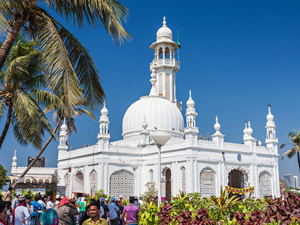
haji aliA bench comprising Chief Justice T S Thakur and Justices D Y Chandrachud and L Nageswara Rao granted time to the trust and disposed off its appeal against the Bombay High Court order asking it to give equal access to women also.

Senior advocate Gopal Subramanium, appearing for the trust, said an additional affidavit has been filed on behalf of the Dargah trust saying it is willing to allow women inside the shrine.

The apex court, on October 17, had extended the stay granted by Bombay High Court to facilitate an appeal against its decision to lift the ban on entry of women near the sanctum sanctorum of the Dargah in Mumbai.

Earlier, the Supreme Court had expressed hope that the Trust, which had challenged the high court judgement, "will take a stand which is progressive".

Subramanium, had also assured the bench that he was on a "progressive mission" and said all holy books and scriptures promoted equality and nothing which is regressive in character should be suggested.

The bench had also remarked that "if you are not allowing both men and women to go beyond a point, there is no problem. But if you are allowing some to go beyond a point while others are not, it is a problem."

The counsel, appearing for a women's group which has challenged the practice of the Trust not to allow women near the sanctum sanctorum, had submitted that the position was different before 2011 than what it is today.

The Trust moved the apex court challenging the Bombay High Court order lifting the ban on women from entering the sanctum sanctorum of the renowned Muslim shrine in South Mumbai.

The High Court on August 26 had held that the ban imposed by the Trust on women from entering the sanctum sanctorum of the Haji Ali Dargah, contravened Articles 14, 15 and 25 of the Constitution and said women should be permitted to enter the sanctum sanctorum like men.

The High Court had allowed a PIL filed by two women, Zakia Soman and Noorjehan Niaz, from NGO Bharatiya Muslim Mahila Andolan, challenging the ban on women's entry into the sanctum sanctorum of the dargah from 2012.

It had granted a six-week stay on the order on a request by the Dargah Trust to enable it to appeal before the Supreme Court.

The high court had held that the Trust had no power to alter or modify the mode or manner of religious practices of any individual or any group.

The High Court in its 56-page judgement had also noted that the "right to manage the Trust cannot override the right to practice religion itself".

It had said the trust has not been able to justify the ban legally or otherwise. Hence it cannot be said that the prohibition was an essential and integral part of Islam and whether taking away that part of the practice would result in a fundamental change in the character of the religion or belief.

It had also refused to accept the Trust's justification that the ban was imposed for safety and security of women, in particular, to prevent sexual harassment at places of worship.

The Trust had claimed that the ban was in keeping with an order of the Supreme Court wherein stringent directions have been issued to ensure that there is no sexual harassment to women at places of worship.

The court had noted that the aims, objectives and activities of the Haji Ali Dargah Trust were not governed by any custom or tradition and held that it was a public charitable trust and hence, open to people all over the world, irrespective of their caste, creed or gender.

The Maharashtra government had earlier told the court that women should be barred from entering the inner sanctorum of Haji Ali Dargah only if it is so enshrined in the Quran.

Comments

Syed
 - 
Monday, 24 Oct 2016

Performing Dargah Pooja is unpardonable sin in Islam.

Rashid
 - 
Monday, 24 Oct 2016

visiting these graves (darghas) either by men or women is against islamic belief ... whatever the decision , won't make any difference to community

Abdul
 - 
Monday, 24 Oct 2016

Wrong Number!..
Worship creator, not his creation.

Rikaz
 - 
Monday, 24 Oct 2016

Abbiya, you misunderstood about the concept of performing umrah and Haj....visiting grave of anyone is not allowed and which is prohibited for ladies....performing umrah or haj is religious duty....once in a life time if a Muslim financially strong enough is bound to perform these religious obligations.,,,,

Well Wisher
 - 
Monday, 24 Oct 2016

The last paragraph is so funny. Maharashtra Govt. was right. \Aaneye illaandmyake Ambaari ellind bantu kanawwa?\" There is nothing mentioned in the Qur'an about Dargah. In fact, Dargah & Durgah are the 2 faces of the same coin. Idol worship is major sin (Shirk) in Islam. Prophet also denied women's entry to the grave yard. I request MH govt to completely shut the dargah. It is just a money making, sexual harassment center. No relation with Islam. It is nothing but a Mafia."

Add new comment

  • Coastaldigest.com reserves the right to delete or block any comments.
  • Coastaldigset.com is not responsible for its readers’ comments.
  • Comments that are abusive, incendiary or irrelevant are strictly prohibited.
  • Please use a genuine email ID and provide your name to avoid reject.
coastaldigest.com web desk
July 25,2020

Bengaluru, July 25: A 105-year-old person from Bengaluru’s Basaveshwar Nagar, who was under treatment for covid-19 at a hospital for past five days, breathed his last today. He was a former government account who retired in 1973. He was the oldest known covid-19 patient in the state so far.

Many members of the patient's family are said to be infected and are hospitalised at various facilities. The funeral will be overseen by two uninfected family members.

The patient 74411 died on Saturday morning at around 9 a.m., said Dr Prasanna, Managing Director of Pristine Hospital And Research Centre where the former was admitted.

“The patient was initially doing well when he admitted on July 20. He did not have significant lung changes when he was admitted. However, after three days, his blood pressure started to drop so he was put on oxygen in the ICU. Yesterday morning, with continued deterioration, he was placed on non-invasive ventilator support,” Dr Prasanna said.

“Finally, by last night, his oxygen saturation levels began to plummet abruptly and we had to intubate him for ventilator support. His condition continued to deteriorate, however. The cause of death was respiratory failure and the onset of sepsis,” he added.

Although earmarked for supplies of Remdesivir by the government, the hospital did not receive the drugs. An appeal to Dr K Sudhakar, Minister of Medical Education by the hospital staff resulted in an assurance that the medication would arrive. “However, in the end, we had to source the medication ourselves on Friday,” medical staff said.

Dr Thrilok Chandra, Head, Critical Care Support Unit (CCSU), which oversees the care of critical or vulnerable-aged Covid-19 patients, had said that Patient 74411 had been diagnosed early. “He was identified when the disease was still in the early stages in his body. He only had symptoms of Influenza-Like Illness (ILI), so the symptoms were not severe,” Dr Chandra had said.

“It’s very sad. We were rooting for him to pull through. He had no comorbidities at all. He had been bed-ridden from last year, but he was healthy. His only potential comorbidity was his advanced age,” Dr Prasanna said.

According to government data, 34% of Covid-19 fatalities in India are aged between 60 and 74 years of age. Fourteen per cent are aged above 74.

Comments

Add new comment

  • Coastaldigest.com reserves the right to delete or block any comments.
  • Coastaldigset.com is not responsible for its readers’ comments.
  • Comments that are abusive, incendiary or irrelevant are strictly prohibited.
  • Please use a genuine email ID and provide your name to avoid reject.
News Network
March 29,2020

Karnataka on Saturday reported 12 new cases, the highest in a single day so far, taking the tally in the state to 76.

Late at night, the Mysuru district commissioner said five more people had tested positive in the district. But it was yet to be confirmed by the state health department.

Of the cases, 41 are from Bengaluru, eight from Chikkaballapur, while Uttara Kannada and Dakshina Kannada districts have seven each.

Interestingly, the highest number of patients are those from Dubai or those who had transit travel via Dubai. Out of 76 cases, 17 cases (22%) have travel history to Dubai, the capital of Emirate of Dubai and the most populous city in the United Arab Emirates (UAE).

Medical Education Minister Dr K Sudhakar, who is also in-charge of COVID-19 operations, said that Dubai has been a major concern as far as Karnataka COVID-19 patients are concerned. “Most of the positive cases have come through Dubai suggesting something amiss there,” he said. 

Echoing the same, Dr Prakash Kumar, Joint Director, Communicable Diseases, Department of Health and Family Welfare, said, “The layover in Dubai is around six to seven hours. We are seeing Dubai to be the new epicentre of the virus as far as India is concerned.”

UAE was initially not on the list of countries from where passengers were screened. It was added much later when clusters of patients with travel history to Dubai began popping up all over the country.

Patient-19 has infected the maximum so far.

Out of the 12 cases that tested positive on Saturday, five are contacts of Patient 19. All of them are being treated at a Chikkaballapur hospital. Two of them are from Hindupur, Andhra Pradesh, and three are residents of Gauribidanur taluk in Chikkabalapur district.

P19, a 31-year-old man from Chikkaballapur, had travelled to Mecca, Saudi Arabia, and returned to India on March 14. Existing patient clusters suggest that P19 had infected the maximum number of people. Officials did not reveal how many people he originally travelled with to Mecca.

Amid the rise in cases, Jawaid Akhtar, Additional Chief Secretary (Health), maintained that the state had not reached stage 3. But he had no definitive answer as to how the Mysuru patient contracted the virus despite health officials he was in touch with not testing positive.

Health Commissioner Pankaj Kumar Pandey said around 1,000 primary contacts of all positive cases have been classified as high-risk and low-risk. The high-risk patients are in government hospitals while the low-risk ones in quarantine facilities.

Comments

Add new comment

  • Coastaldigest.com reserves the right to delete or block any comments.
  • Coastaldigset.com is not responsible for its readers’ comments.
  • Comments that are abusive, incendiary or irrelevant are strictly prohibited.
  • Please use a genuine email ID and provide your name to avoid reject.
News Network
March 19,2020

Bengaluru, Mar 19: To better enforce social distancing and prevent further spread of Covid-19, the Karnataka health and family welfare department on Wednesday said it will "stamp the back of the palm" of international passengers advised to be on home quarantine, along with the date they are allowed to get out of home. The stamping process began at 12am Thursday.

Pankaj Kumar Pandey, commissioner, health and family welfare, said: "It is noted that a few passengers under home quarantine are not following the instructions. Therefore, it has been decided to stamp the back of the palm of their left hand with a specially designed stamp which will indicate the last day of quarantine."

He said the special stamp will use an indelible ink and "airports in Karnataka have been instructed to follow this without fail". On average, about 3,000 people are arriving in Bengaluru on international flights every day.

The department said social distancing is the only known method of combating the spread of Covid-19 and added, "International passengers are segregated as symptomatic and asymptomatic."

High-risk flyers kept at mass quarantine unit

The symptomatic passengers (Group-A) are taken to designated hospitals; asymptomatic ones, depending on the port of origin, are taken to the quarantine centre or permitted to go on home quarantine.

At the mass quarantine centre, the asymptomatic passengers are divided into moderate-risk (Group-B) and high-risk (Group-C) categories.

“The high-risk passengers are kept at a mass quarantine centre for medical observation. The moderate-risk passengers are being sent for home quarantine where they need to spend 14 days,” the statement added.

Pandey said: “International passengers changing flights within the country cannot be stopped. Ideally, they should be stamped at the first port of entry when they arrive from a foreign country which is not happening.” He said this issue will be brought to the notice of the Directorate-General of Civil Aviation.

Comments

Add new comment

  • Coastaldigest.com reserves the right to delete or block any comments.
  • Coastaldigset.com is not responsible for its readers’ comments.
  • Comments that are abusive, incendiary or irrelevant are strictly prohibited.
  • Please use a genuine email ID and provide your name to avoid reject.