


Haji Ali Dargah decides to grant access to women, finally

October 24, 2016

New Delhi, Oct 24: Women will be granted access to the sanctum sanctorum of the Haji Ali shrine in Mumbai on par with men, the Dargah Trust told the Supreme Court today and sought four weeks to make the requisite infrastructural changes.
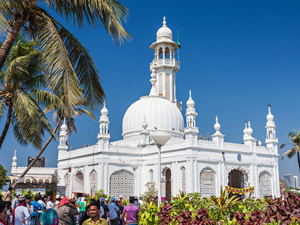
haji aliA bench comprising Chief Justice T S Thakur and Justices D Y Chandrachud and L Nageswara Rao granted time to the trust and disposed off its appeal against the Bombay High Court order asking it to give equal access to women also.

Senior advocate Gopal Subramanium, appearing for the trust, said an additional affidavit has been filed on behalf of the Dargah trust saying it is willing to allow women inside the shrine.

The apex court, on October 17, had extended the stay granted by Bombay High Court to facilitate an appeal against its decision to lift the ban on entry of women near the sanctum sanctorum of the Dargah in Mumbai.

Earlier, the Supreme Court had expressed hope that the Trust, which had challenged the high court judgement, "will take a stand which is progressive".

Subramanium, had also assured the bench that he was on a "progressive mission" and said all holy books and scriptures promoted equality and nothing which is regressive in character should be suggested.

The bench had also remarked that "if you are not allowing both men and women to go beyond a point, there is no problem. But if you are allowing some to go beyond a point while others are not, it is a problem."

The counsel, appearing for a women's group which has challenged the practice of the Trust not to allow women near the sanctum sanctorum, had submitted that the position was different before 2011 than what it is today.

The Trust moved the apex court challenging the Bombay High Court order lifting the ban on women from entering the sanctum sanctorum of the renowned Muslim shrine in South Mumbai.

The High Court on August 26 had held that the ban imposed by the Trust on women from entering the sanctum sanctorum of the Haji Ali Dargah, contravened Articles 14, 15 and 25 of the Constitution and said women should be permitted to enter the sanctum sanctorum like men.

The High Court had allowed a PIL filed by two women, Zakia Soman and Noorjehan Niaz, from NGO Bharatiya Muslim Mahila Andolan, challenging the ban on women's entry into the sanctum sanctorum of the dargah from 2012.

It had granted a six-week stay on the order on a request by the Dargah Trust to enable it to appeal before the Supreme Court.

The high court had held that the Trust had no power to alter or modify the mode or manner of religious practices of any individual or any group.

The High Court in its 56-page judgement had also noted that the "right to manage the Trust cannot override the right to practice religion itself".

It had said the trust has not been able to justify the ban legally or otherwise. Hence it cannot be said that the prohibition was an essential and integral part of Islam and whether taking away that part of the practice would result in a fundamental change in the character of the religion or belief.

It had also refused to accept the Trust's justification that the ban was imposed for safety and security of women, in particular, to prevent sexual harassment at places of worship.

The Trust had claimed that the ban was in keeping with an order of the Supreme Court wherein stringent directions have been issued to ensure that there is no sexual harassment to women at places of worship.

The court had noted that the aims, objectives and activities of the Haji Ali Dargah Trust were not governed by any custom or tradition and held that it was a public charitable trust and hence, open to people all over the world, irrespective of their caste, creed or gender.

The Maharashtra government had earlier told the court that women should be barred from entering the inner sanctorum of Haji Ali Dargah only if it is so enshrined in the Quran.

Comments

Syed
 - 
Monday, 24 Oct 2016

Performing Dargah Pooja is unpardonable sin in Islam.

Rashid
 - 
Monday, 24 Oct 2016

visiting these graves (darghas) either by men or women is against islamic belief ... whatever the decision , won't make any difference to community

Abdul
 - 
Monday, 24 Oct 2016

Wrong Number!..
Worship creator, not his creation.

Rikaz
 - 
Monday, 24 Oct 2016

Abbiya, you misunderstood about the concept of performing umrah and Haj....visiting grave of anyone is not allowed and which is prohibited for ladies....performing umrah or haj is religious duty....once in a life time if a Muslim financially strong enough is bound to perform these religious obligations.,,,,

Well Wisher
 - 
Monday, 24 Oct 2016

The last paragraph is so funny. Maharashtra Govt. was right. \Aaneye illaandmyake Ambaari ellind bantu kanawwa?\" There is nothing mentioned in the Qur'an about Dargah. In fact, Dargah & Durgah are the 2 faces of the same coin. Idol worship is major sin (Shirk) in Islam. Prophet also denied women's entry to the grave yard. I request MH govt to completely shut the dargah. It is just a money making, sexual harassment center. No relation with Islam. It is nothing but a Mafia."

Add new comment

  • Coastaldigest.com reserves the right to delete or block any comments.
  • Coastaldigset.com is not responsible for its readers’ comments.
  • Comments that are abusive, incendiary or irrelevant are strictly prohibited.
  • Please use a genuine email ID and provide your name to avoid reject.
coastaldigest.com news network
June 14,2020

Newsroom, June 14: Bollywood star Sushant Singh Rajput, who was found dead in his house in Mumbai’s Bandra today, was heartbroken after the death of his former manager Disha Salian.

34-year-old actor had posted a heartfelt note after her death: “It’s such devastating news. My deepest condolences to Disha’s family and friends. May your soul rest in peace.” 

The police are considering 28-year-old Disha’s death as an accidental one and the investigation is on to find if it was a suicide. She died after falling off the 14th floor of a building in Malad, Mumbai on June 8.

It is not yet known if there is any connection between the two deaths. Sushant’s house help reportedly found him hanging inside his room on Sunday and cops are investigating the case. He was recently seen in Nitesh Tiwari’s Chhichhore and more recently on Netflix opposite Jacqueline Fernandez in Drive.

Who is Disha Salian?

Disha Salian hails from Karnataka’s coastal district of Udupi. She was born in 1992 into a business family background. She reportedly migrated to Mumbai with her family at an early age. 

After completing her education, she worked in the Times of India Group for more than three years. The she went on the become the celebrity manager at Media Vantage.

Apart from Sushant, she had great links with many popular celebrities like Bharti Singh, Alisha Panwar, and others.

Comments

Add new comment

  • Coastaldigest.com reserves the right to delete or block any comments.
  • Coastaldigset.com is not responsible for its readers’ comments.
  • Comments that are abusive, incendiary or irrelevant are strictly prohibited.
  • Please use a genuine email ID and provide your name to avoid reject.
Ram Puniyani
January 9,2020

‘Go to Pakistan’ has probably been most often used phrase used against Muslims in India. Recently in yet another such incident the SP of Meerut, UP has been in the news and a video is circulating where he, Akhilesh Narayan Singh, is allegedly using the jibe ‘Go to Pakistan’. In the video he is seen shouting at protestors at Lisari Gate area in Meerut, “The ones (protestors) wearing those black or yellow armbands, tell them to go to Pakistan”. His seniors stood by him calling it ‘natural reaction to shouting of pro Pakistan slogans. Many BJP leaders like Uma Bhararti also defended the officer. Breaking ranks with fellow politicians, Mukhtar Abbas Naqvi of BJP, criticised the said officer and asked for suitable action against him. Interestingly this is same Naqvi, who earlier when the beef related arguments were going on; had stated that those who want to eat beef can go to Pakistan.

Interestingly this is probably the first time that any BJP leader has opposed the use of this jibe against the Indian Muslims. True to the dominance of trolls who support divisive politics, Naqvi has been trolled on the issue. As such vibe ‘Go to Pakistan’ has been a strong tool in the hands of aggressive elements to demonise Muslims in general and to humiliate those with Muslim names. One recalls that when due to the rising intolerance in the society many eminent writers, film makers were returning their awards, Aamir Khan said that his wife Kiran Rao is worried about their son. Immediately BJP worthies like Giriraj Singh pounced on him that he can go to Pakistan.

The strategy of BJP combine has been on one hand to use this ‘go to Pakistan’ to humiliate Muslims on the other from last few years another Pakistan dimension has been added. Those who are critical of the policies of BJP-RSS have on one hand been called as anti National and on the other it is being said that ‘they are speaking the language of Pakistan’.

Use of Pakistan to label the Muslims and dissidents here in India has been a very shrewd tool in the hands of communal forces. One remembers that the ‘cricket nationalism’ was also the one to use it. In case of India-Pakistan cricket match, the national hysteria, which it created, was also aiming at Indian Muslims. What was propagated was that Indian Muslims cheer for Pakistan victory and they root for Pakistan. There was an unfortunate grain of truth in this as a section of disgruntled, alienated Muslim did that. That was not the total picture, as most Indian Muslims were cheering for Indian victory. Many a Muslim cricketers contributed massively to Indian cricket victories. The cricket legends like Nawab Mansoor Ali Khan Pataudi, Irfan Pathan, and Mohammad Azaruddin are just the few among the long list of those who brought glories for India in the field of cricket.

Even in matters of defence there are legions of Muslims who contributed to Indian efforts in the war against Pakistan all through. Abdul Hamid’s role in 1965 India Pak war and the role of Muslim soldiers in Kargil war will be part of Indian military history. There have been generals in army who contributed in many ways for the role which military has been playing in service of the nation. General Zamiruddin Shah, when asked to handle Gujarat carnage, does recount how despite the lack of support from local administration for some time, eventually the military was able to quell the violence in some ways.

During freedom movement Muslims were as much part of the struggle against British rule as any other community. While the perception has been created that Muslims were demanding Pakistan, the truth is somewhere else. It was only the elite section of Muslims who supported the politics of Muslim League and later the same Muslim League could mobilize some other section and unleash the violence like ‘Direct Action’ in Kolkata, which in a way precipitated the actual process of partition, which was the goal of British and aim of Muslim League apart from this being the outcome of ‘Two Nation theory’.

Not much is popularized about the role of great number of Muslims who were part of National movement, who steadfastly opposed the idea and politics which led to the sad partition of the subcontinent. Few excellent accounts of the role of Muslims in freedom movement like Syed Nasir Ahmad, Ubaidur Rahman, Satish Ganjoo and Shamsul Islam are few of these not too well know books which give the outline of the great Muslim freedom fighters like Khan Abdul Gaffar Khan, Maulana Abul Kalam Azad, Ansari Brothers, Ashfaqulla Khan.

Immediately after partition tragedy the communal propaganda did the overdrive to blame the whole partition process on Muslim separatism, this totally undermined the fact that how poor Muslims had taken out massive marches to oppose the Lahore Resolution of separate Pakistan moved by Mohammad Ali Jinnah. The whole Muslim community started being seen as the homogenous, ‘The other’ and other misconceptions started against the community, the one’s relating them to atrocities of Muslim kings started being made as the part of popular folklore, leading the Hate against them. This Hate in turn laid the foundation of violence and eventual ghettoisation of this community.

The interactive-syncretism prevalent in India well presented by Gandhi-Nehru was pushed to the margins as those believing in pluralism did not actively engage with the issue. The economic marginalization of this community, coupled with the increasing insecurity in turn led to some of them to identify with Pakistan, and this small section was again presented as the representative of the whole Muslim community.

Today the battle of perception is heavily tilted against the Muslim community. It is a bit of a surprise as Naqvi is differing from his other fellow colleagues to say that the action should be taken against the erring police officer. The hope is that all round efforts are stepped up to combat the perception constructed against this religious minority in India. 

Comments

Prakash SS
 - 
Thursday, 9 Jan 2020

it is very much understandable if Pakistan is bad country our PM Namo would never visited without any invitation, that time Pakistan was good he prised their Mutton biriyani and Karak chai in pakistan. we feel something is wrong with our PM and his chelas. 

Add new comment

  • Coastaldigest.com reserves the right to delete or block any comments.
  • Coastaldigset.com is not responsible for its readers’ comments.
  • Comments that are abusive, incendiary or irrelevant are strictly prohibited.
  • Please use a genuine email ID and provide your name to avoid reject.
News Network
June 18,2020

Mysuru, Jun 18: The Karnataka government's proposal announced on Thursday to hold online classes for students amid concerns over COVID-19 has not gone down well with thousands of tribal students residing in villages across the state.

A team from Karnataka State Commission for Protection of Child Rights (KSCPCR) visited a few tribal hamlets in Mysuru and Kodagu recently and found that the students, unlike their urban counterparts, lack accessibility to not just smartphones and computers, but basic necessities like power supply.

''When such is the situation in the tribal hamlets, how can you expect students to catch up on their studies if classes are held online?'' wondered M L Parashurama Member, KSCPCR, who toured villages like Thithimathi, Beematagere, Devamachchi and Gaddadi in Kodagu's Virajpet taluk, besides Bavali, Balyadi, Machchuru, and Anemone in Mysuru's HD Kote taluk along with Chairperson Antony Sebastian.

Comments

Add new comment

  • Coastaldigest.com reserves the right to delete or block any comments.
  • Coastaldigset.com is not responsible for its readers’ comments.
  • Comments that are abusive, incendiary or irrelevant are strictly prohibited.
  • Please use a genuine email ID and provide your name to avoid reject.