Hand-made artifacts showcase India's culturally enriched regions

[email protected] (CD Network, Photos by Suresh Vamanjoor)
December 6, 2013

Mangalore, Dec 6: A ten-day exhibition featuring the rich and varied art and craft traditions from various parts of India,'Cottage Mela 2013' organised by Central Cottage Industries Emporium (CCIE) was inaugurated here on Friday, providing a platform for the cultural and artistic interchange between artisans and customers.

The exhibition-cum-sale was inaugurated by owner of Woodlands Hotel, Mangalore Ramesh Bhat in the premises of the hotel.

Several customers were seen interacting with artisans from Rajasthan, Kashmir, Tamil Nadu, Hyderabad and other parts of the country, admiring hand-made art objects and jewellery.

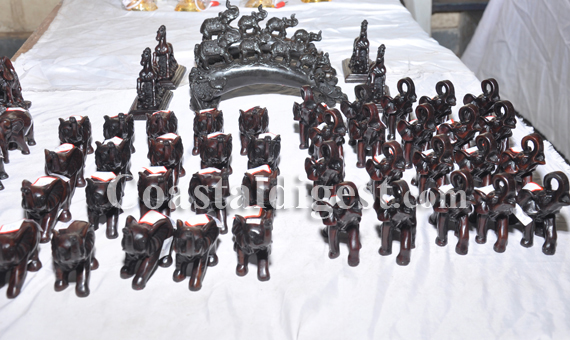
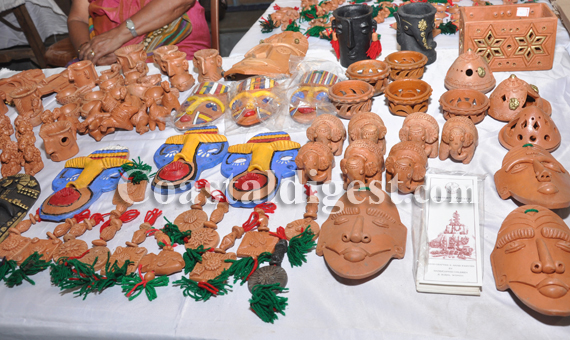
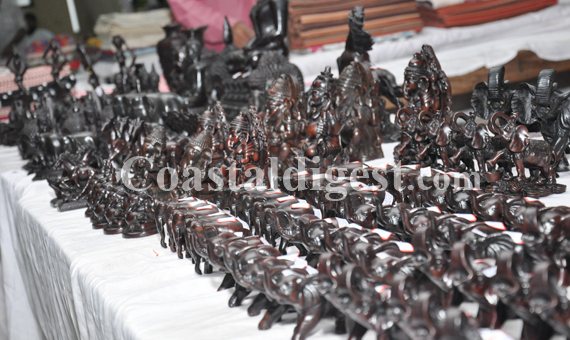
Exquisitely-made handicrafts such as silver jewellery, ethnic show pieces made from terra-cotta, paintings, metal ware, woodcraft, show pieces made of marble dust from Tamil Nadu, pottery, lamps, Kashmiri hand-woven carpets, hand-crafted wooden furniture, brass and bronze idols and semi-precious stone jewellery were on display at the exhibition.

The sale also presented several kinds of textiles such as handloom and cotton sarees and dresses, kurtas, jackets and scarves from Bihar, Rajasthan, Lucknow and Kashmir.

Apart from the special attraction of hand-knotted carpets, handmade silver jewellery made by artisans from Kashmir caught the fancy of women who walked into the mela.

Another crowd-puller were exquisite art products and show pieces creatively made out of terra-cotta that were kept on display by Mangalorean Merlin Raskina, who has been making show-pieces and conducting exhibitions from the past 20 years.

The mela will be open till December 15 from 10 a.m. to 7 p.m. For further details, contact Inayath Shah – 9448071867.

hm

hm1

hm2

hm3

Comments

Add new comment

  • Coastaldigest.com reserves the right to delete or block any comments.
  • Coastaldigset.com is not responsible for its readers’ comments.
  • Comments that are abusive, incendiary or irrelevant are strictly prohibited.
  • Please use a genuine email ID and provide your name to avoid reject.
News Network
January 12,2020

Bengaluru, Jan 12: Chief Justice of India, Sharad Arvind Bobde on Saturday hinted at the possibility of Artificial Intelligence being developed for the court system while making it clear that it will never replace human discretion.

Speaking at an event here, Bobde said, "We have a possibility of developing Artificial Intelligence for the court system. Only for the purpose of ensuring that the undue delay in justice is prevented."

"I must make it clear at the outset as there are times when even judges have asked this. AI is not going to replace human judges or human discretion", he added.

Sharing more details of his vision, he stated, "It is only the repetitive, mathematical and mechanical parts of the judgments for which help can be taken from the system...we are exploring the possibility of implementing it."

Bobde stressed on the requirement of developing AI for judiciary while outlining the number of pending cases in different courts.

"Some people are in jail for 10-15 years and we are not in position to deal with their appeals. The high court's and Supreme Court take so long and ultimately the courts feel that it is just to release them on bail", he said.

Bobde also endorsed employing every talent and skill to ensure delivery of justice in a reasonable time.

"We must employ every talent, every skill we possess to ensure that justice is received within reasonable time. Delay in justice can't be a reason for anybody to take law into their hands. But it's very important for us as courts to ensure there's no undue delay in justice", he said.

CJI Bobde also highlighted the need for pre-litigation mediation and said, "Pre-litigation mediation is the need of the hour especially in the backdrop of a significant pendency that the courts are tackling with. There are innumerable areas where pre-litigation mediation could solve the problem."

He also stressed that the position of a judge is very unique under the constitution and they have to deal with a variety of problems.

"The foundation of civilisation rests on the law. Judicial officers have to deal with a variety of problems...Judges without adequate knowledge, skills and experience may cause distortion, delay and miscarriage of justice", he said.

Earlier in the day, Chief Justice of India Bobde inaugurated the phase-1 of the new building of the Karnataka Judicial Academy on Crescent Road in Bengaluru.

The new building has three floors, besides, the ground floor and two basement floors.

Comments

Add new comment

  • Coastaldigest.com reserves the right to delete or block any comments.
  • Coastaldigset.com is not responsible for its readers’ comments.
  • Comments that are abusive, incendiary or irrelevant are strictly prohibited.
  • Please use a genuine email ID and provide your name to avoid reject.
News Network
May 10,2020

Mangaluru, May 10: A young photographer has drowned in River Phalguni near Maravoor on the outskirts of the city.

The victim has been identified as Kaushik, 22, who was working for Diya Studio in Kavoor. A resident of Kavoor, he was the only son of his mother.

The tragedy occurred when he had been to the river along with four friends to collect freshwater snails.

It is learnt that local residents rushed to the spot when Kaushik’s friends raised alarm. However, they could not rescue him.

Kaushik’s body was retrieved from the water after sometime. A case has been registered at Kavoor police station.

Comments

Add new comment

  • Coastaldigest.com reserves the right to delete or block any comments.
  • Coastaldigset.com is not responsible for its readers’ comments.
  • Comments that are abusive, incendiary or irrelevant are strictly prohibited.
  • Please use a genuine email ID and provide your name to avoid reject.
News Network
April 2,2020

The current physical distancing guidelines provided by the World Health Organisation (WHO) and by the US Centers for Disease Control and Prevention (CDC) may not be adequate to curb the coronavirus spread, according to a research which says the gas cloud from a cough or sneeze may help virus particles travel up to 8 metres. The research, published in the Journal of the American Medical Association, noted that the the current guidelines issued by the WHO and CDC are based on outdated models from the 1930s of how gas clouds from a cough, sneeze, or exhalation spread.

Study author, MIT associate professor Lydia Bourouiba, warned that droplets of all sizes can travel 23 to 27 feet, or 7-8 metres, carrying the pathogen.

According to Bourouiba, the current guidelines are based on "arbitrary" assumptions of droplet size, "overly simplified", and "may limit the effectiveness of the proposed interventions" against the deadly pandemic.

 She explained that the old guidelines assume droplets to be one of two categories, small or large, taking short-range semi-ballistic trajectories when a person exhales, coughs, or sneezes.

However based on more recent discoveries, the MIT scientist said, sneezes and coughs are made of a puff cloud that carries ambient air, transporting within it clusters of droplets of a wide range of sizes.

Bourouiba warned that this puff cloud, with ambient air entrapped in it, can offer the droplets moisture and warmth that can prevent it from evaporation in the outer environment.

"The locally moist and warm atmosphere within the turbulent gas cloud allows the contained droplets to evade evaporation for much longer than occurs with isolated droplets," she said.

"Under these conditions, the lifetime of a droplet could be considerably extended by a factor of up to 1000, from a fraction of a second to minutes," the researcher explained in the study.

The MIT scientist, who has researched the dynamics of coughs and sneezes for years, added that these droplets settle along the trajectory of a cough or sneeze contaminating surfaces, with their residues staying suspended in the air for hours.

"Even when maximum containment policies were enforced, the rapid international spread of COVID-19 suggests that using arbitrary droplet size cutoffs may not accurately reflect what actually occurs with respiratory emissions, possibly contributing to the ineffectiveness of some procedures used to limit the spread of respiratory disease," Bourouiba wrote in the study

Comments

Add new comment

  • Coastaldigest.com reserves the right to delete or block any comments.
  • Coastaldigset.com is not responsible for its readers’ comments.
  • Comments that are abusive, incendiary or irrelevant are strictly prohibited.
  • Please use a genuine email ID and provide your name to avoid reject.