Hand-made artifacts showcase India's culturally enriched regions

[email protected] (CD Network, Photos by Suresh Vamanjoor)
December 6, 2013

Mangalore, Dec 6: A ten-day exhibition featuring the rich and varied art and craft traditions from various parts of India,'Cottage Mela 2013' organised by Central Cottage Industries Emporium (CCIE) was inaugurated here on Friday, providing a platform for the cultural and artistic interchange between artisans and customers.

The exhibition-cum-sale was inaugurated by owner of Woodlands Hotel, Mangalore Ramesh Bhat in the premises of the hotel.

Several customers were seen interacting with artisans from Rajasthan, Kashmir, Tamil Nadu, Hyderabad and other parts of the country, admiring hand-made art objects and jewellery.

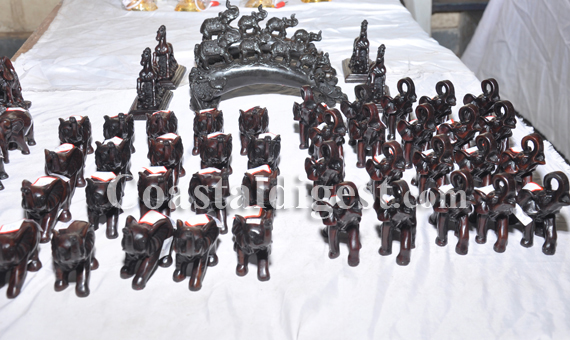
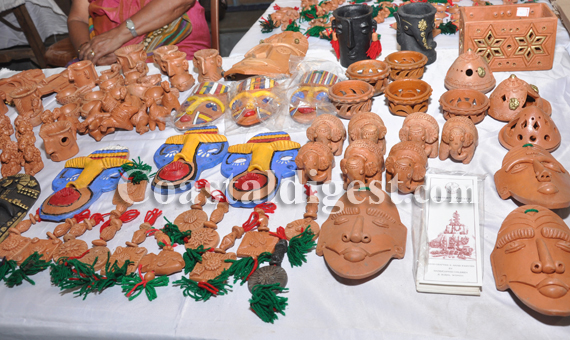
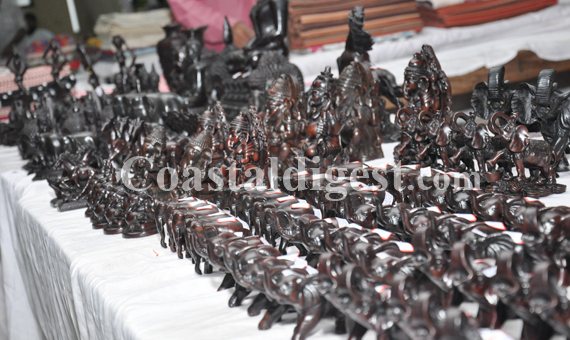
Exquisitely-made handicrafts such as silver jewellery, ethnic show pieces made from terra-cotta, paintings, metal ware, woodcraft, show pieces made of marble dust from Tamil Nadu, pottery, lamps, Kashmiri hand-woven carpets, hand-crafted wooden furniture, brass and bronze idols and semi-precious stone jewellery were on display at the exhibition.

The sale also presented several kinds of textiles such as handloom and cotton sarees and dresses, kurtas, jackets and scarves from Bihar, Rajasthan, Lucknow and Kashmir.

Apart from the special attraction of hand-knotted carpets, handmade silver jewellery made by artisans from Kashmir caught the fancy of women who walked into the mela.

Another crowd-puller were exquisite art products and show pieces creatively made out of terra-cotta that were kept on display by Mangalorean Merlin Raskina, who has been making show-pieces and conducting exhibitions from the past 20 years.

The mela will be open till December 15 from 10 a.m. to 7 p.m. For further details, contact Inayath Shah – 9448071867.

hm

hm1

hm2

hm3

Comments

Add new comment

  • Coastaldigest.com reserves the right to delete or block any comments.
  • Coastaldigset.com is not responsible for its readers’ comments.
  • Comments that are abusive, incendiary or irrelevant are strictly prohibited.
  • Please use a genuine email ID and provide your name to avoid reject.
News Network
April 28,2020

Bengaluru, Apr 28: Former Karnataka chief minister Siddaramaiah on Tuesday suggested that the government can allow sale of liquor in green zones. 

“Merely because there is an economic slowdown in the state, I don’t recommend that alcohol should be allowed to be sold. But, wherever there are green districts, they can open (liquor sale) with certain restrictions, I think,” Siddaramaiah, the leader of the Opposition, told reporters. 

There are 14 districts in the state that are categorised as green because they do not have any active COVID-19 cases. The green districts are: Yadgir, Raichur, Koppal, Haveri, Davangere, Shivamogga, Chitradurga, Udupi, Chikmagalur, Hassan, Kodagu, Chamarajanagar, Ramanagara and Kolar.

There is tremendous pressure on the B S Yediyurappa administration to revive the economy as the lockdown has dried up all revenue sources. Excise, alone, accounts for 18 per cent of Karnataka’s own tax revenue. 

The Excise department recently suggested allowing regulated sale of liquor through the state-run MSIL outlets. The government, however, did not approve it fearing crowding and backlash from the Centre.

Comments

Add new comment

  • Coastaldigest.com reserves the right to delete or block any comments.
  • Coastaldigset.com is not responsible for its readers’ comments.
  • Comments that are abusive, incendiary or irrelevant are strictly prohibited.
  • Please use a genuine email ID and provide your name to avoid reject.
News Network
March 11,2020

Bengaluru, Mar 11: Did Congress party’s Man Friday, DK Shivakumar, not rise up to the occasion and save the situation for the party, whose rebel MLAs were flown into Bengaluru to unsettle the Kamal Nath-led government in Madhya Pradesh? Shivakumar told The New Indian Express on Tuesday, “So far, I have not got any clear direction on what has to be done. But I am in touch with the central leaders. The party does not want to antagonise them... They are our own MLAs.”

He said that the Tenth Schedule, which makes defections illegal, is very strong. “It is not so easy for them once they are expelled. There are courts and then they have to get re-elected. It is not easy to get minister’s post after getting re-elected,” he added.

When pointed out that rebels from the Congress and JD(S) who joined the BJP have got re-elected and become ministers, he said, “There are other issues here.”

Asked about Digvijay Singh, who is at the centre of the controversy in MP and who was AICC general secretary in-charge of Karnataka, not being able to prevent the rebellion in his home state, Shivakumar said, “I do not want to comment on any of our national leaders.”But he was confident that the Congress government would be saved in MP. “I am aware of the developments and keeping track of them,” he said.

Congress leaders seemed wiser after the event.

One of them, who wished not to be identified, said the party clearly did not see the writing on the wall. “Jyotiraditya Scindia supported the BJP at the Centre when it scrapped Article 370. Later too he was not in line with the Congress position on several issues. But during the recent Delhi violence, he criticised the BJP, sending confusing signals,” he added.

Comments

Add new comment

  • Coastaldigest.com reserves the right to delete or block any comments.
  • Coastaldigset.com is not responsible for its readers’ comments.
  • Comments that are abusive, incendiary or irrelevant are strictly prohibited.
  • Please use a genuine email ID and provide your name to avoid reject.
News Network
February 28,2020

Bengaluru, Feb 28: Historian S. Shettar, 85, breathed his last early on February 28 in Bengaluru. He was suffering from respiratory problems and was hospitalised for over a week.

Shettar was known for his multi-disciplinary work, encompassing linguistics, epigraphy, anthropology, the study of religions and art history. He had extensively worked on the Jain practice of ritual death in Karnataka and Asoka edicts. He had studied and compiled early edicts in Kannada and worked extensively on the growth of Kannada language down the ages.

Born in 1935 at Hampasagara, Ballari district, he went on to study at Cambridge University and started his career as a Professor of History at Karnatak University, Dharwad, his alma mater. He later headed the National Museum Institute of the History of Art, Conservation and Museology in 1978 and Indian Council for Historical Research in 1996. He was also a visiting professor at the National Institute of Advanced Studies, Bengaluru.

He was a bilingual historian who wrote in English for most of his career, but started writing in Kannada in later years. In the last two decades, he developed a keen interest in linguistics and wrote multiple books on classical Kannada and Prakrit. His 2007 book “Shangam Tamilagam” is considered a seminal work in the study of the early period of Dravidian languages. It won him Bhasha Samman from Central Sahitya Akademi. He later wrote two works on Halegannada, classical Kannada. His most recent work was “Prakrita Jagadvalaya” in 2018.

Comments

Add new comment

  • Coastaldigest.com reserves the right to delete or block any comments.
  • Coastaldigset.com is not responsible for its readers’ comments.
  • Comments that are abusive, incendiary or irrelevant are strictly prohibited.
  • Please use a genuine email ID and provide your name to avoid reject.