Haryana govt magazine praises veil, sparks row

Agencies
June 28, 2017

Chandigarh, Jun 28: A photo caption in a Haryana government magazine describing 'ghoonghat' (veil) as the "identity of the State" has sparked a controversy, with the opposition saying it reflected the "regressive" mindset of the BJP government.veil

However, senior Minister Anil Vij dismissed the opposition charge, saying that BJP government had taken a number of steps for women empowerment and was not endorsing that women should be forced to keep a 'ghoongat'.

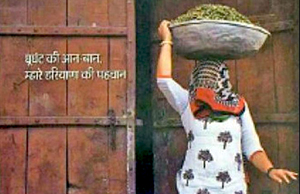
The recent issue of Krishi Samvad, a supplement of the Haryana Samvad magazine, a monthly magazine published by the State government, carries a photograph of a veiled woman.

The woman's face can be seen covered with a 'ghoongat'. The woman is seen carrying cattle feed on her head, even as the caption reads: "Ghoongat kiaan-baan, mahra Haryana kipechchan (pride of the veil is the identity of my Haryana".

The front cover of the magazine carries the photo of Chief Minister Manohar Lal Khattar.

Reacting sharply to the description, former Chief Minister Bhupinder Singh Hooda and senior Congress leader and party spokesperson Randeep Surjewala said it reflected the regressive attitude of the ruling BJP government.

"This shows regressive mindset of the BJP government. Women from Haryana are ahead in every field. Just three days back, a young woman from the state was crowned as Miss India. Girls from the state have made a mark in sports arena and other fields. India-born US astronaut late Kalpana Chawla hailed from Haryana," Hooda said.

Recently, Haryana girl Manushi Chhillar was crowned Femina Miss India 2017.

"Women wearing veil was not the original culture of Haryana. This practice started only after foreign invasions and because of the fear of invaders. In south India, there was no 'purdah' system. Therefore, what I want to say is that BJP government wants to move back in time rather than thinking ahead and taking the state forward," he said.

Surjewala said it was a "regressive mindset and objectification of women, which is part of the DNA of the BJP".

"The BJP government has failed to realise that Haryana girls and women have excelled in fields such as space science, sports and the armed forces to name just a few," Surjewala said.

Dismissing the opposition criticism, Vij told PTI over phone, "What you are seeing in a government magazine should only be seen as what was Haryana's tradition. Nowhere are we saying that we want to force veil on women. We are in favour of women empowerment and we have done a lot in this regard".

He said the sex ratio has improved from 862 to 950 as a result of the steps taken by the state government.

"We are committed to women's education and have decided to open colleges for women after every 20 km. As regards the photo in the magazine, this has been the tradition in some parts of the state, but it is not binding.

"We are not forcing anyone to wear ghoongat. It is not like burqa and only those women who want to do ghoongat, it is as per their wish," Vij said.

Comments

Fairman
 - 
Wednesday, 28 Jun 2017

It seems that the BJP in Haryana seems to be protecting of women.

Why the goongat or veil is required. Just to segregate from male intervention. When there is no gender segregation, people take it for granted. They take easy in molester of ladies.
People commit these sins or crime whenever there is easy access for it.
Better prevent from beginning. It is not against empowerment of sign of uncivilization of women.

Add new comment

  • Coastaldigest.com reserves the right to delete or block any comments.
  • Coastaldigset.com is not responsible for its readers’ comments.
  • Comments that are abusive, incendiary or irrelevant are strictly prohibited.
  • Please use a genuine email ID and provide your name to avoid reject.
News Network
March 30,2020

Mangaluru Mar 30: The Mangaluru South Police has registered a criminal case against a man over a 'derogatory post' against the district administration. According to DC Sindhu B Rupesh, the man identified as Melwyn Pinto had sent a derogatory message on WhatsApp.

She warned on taking stringent action against miscreants who are spreading false information and rumours about district administration under DM Act provisions.

Meanwhile, City Commissioner of Police Dr P S Harsha said, "We have noticed people going around on merry rides without purpose either on two-wheelers or in cars during the lockdown period."

Comments

Add new comment

  • Coastaldigest.com reserves the right to delete or block any comments.
  • Coastaldigset.com is not responsible for its readers’ comments.
  • Comments that are abusive, incendiary or irrelevant are strictly prohibited.
  • Please use a genuine email ID and provide your name to avoid reject.
News Network
January 11,2020

Bengaluru, Jan 11: The Chief Justice of India Justice Sharad Arvind Bobde on Saturday inaugurated the phase-1 of the new building of the Karnataka Judicial Academy on Crescent Road in Bengaluru.

The new building has three floors, besides, the ground floor and two basement floors.

While Chief Minister B S Yediyurappa inaugurated the 319-seater multi-purpose auditorium, at which Chief Justice of the High Court of Karnataka Justice Abhay Shreeniwas Oka felicitated Justice Bobde.

Justice Ravi Malimath, President of the Karnataka Judicial Academy and Judge of the High Court of Karnataka, in his welcome address said that the academy has so far trained as many as 4000 judicial officers and striving for excellence in the field of judiciary.

The building, built in the first phase, has parking in the lower and the upper basement, which can accommodate 44 cars and 124 two-wheelers, the ground floor consists of a 319-seater multi-purpose air-conditioned auditorium, a lecture hall with 84 seats, two lecture halls with 40 seats each and a VIP lounge. The First Floor has a lecture hall with 84 seats, two lecture halls with 40 seats each, a VIP lounge, two discussion rooms and an administrative office for the staff of the academy.

The second phase, to be built has a parking facility for 36 four-wheelers and 22 two-wheelers in the lower basement and 32 four-wheelers and 30 two-wheelers in the upper basement.

The total cost of the project, including Phase-1 and Phase-2, to be executed by the Public Works Department in the sprawling 2.2 acres plot of the Karnataka Judicial Academy is around Rs 96.02 Crore.

Comments

Add new comment

  • Coastaldigest.com reserves the right to delete or block any comments.
  • Coastaldigset.com is not responsible for its readers’ comments.
  • Comments that are abusive, incendiary or irrelevant are strictly prohibited.
  • Please use a genuine email ID and provide your name to avoid reject.
Ram Puniyani
February 4,2020

As democracy is seeping in slowly all over the world, there is an organization which is monitoring the degree of democracy in the individual countries, The Economist Intelligence Unit. As such in each country there are diverse factors which on one hand work to deepen it, while others weaken it. Overall there is a march from theoretical democracy to substantive one. The substantive democracy will herald not just the formal equality, freedom and community feeling in the country but will be founded on the substantive quality of these values. In India while the introduction of modern education, transport, communication laid the backdrop of beginning of the process, the direction towards deepening of the process begins with Mahatma Gandhi when he led the non-cooperation movement in 1920, in which average people participated. The movement of freedom for India went on to become the ‘greatest ever mass movement’ in the World.

The approval and standards for democracy were enshrined in Indian Constitution, which begins ‘We the people of India’, and was adopted on 26th January 1950. With this Constitution and the policies adopted by Nehru the process of democratization started seeping further, the dreaded Emergency in 1975, which was lifted later restored democratic freedoms in some degree. This process of democratisation is facing an opposition since the decade of 1990s after the launch of Ram Temple agitation, and has seen the further erosion with BJP led Government coming to power in 2014. The state has been proactively attacking civil liberties, pluralism and participative political culture with democracy becoming flawed in a serious way. And this is what got reflected in the slipping of India by ten places, to 51st, in 2019. On the index of democracy India slipped down from the score of 7.23 to 6.90. The impact of sectarian BJP politics is writ on the state of the nation, country.

Ironically this lowering of score has come at a time when the popular protests, the deepening of democracy has been given a boost and is picking up with the Shaheen Bagh protests. The protest which began in Shaheen Bagh, Delhi in the backdrop of this Government getting the Citizenship amendment Bill getting converted into an act and mercilessly attacking the students of Jamia Milia Islamia, Aligarh Muslim University along with high handed approach in Jamia Nagar and neighbouring areas.  From 15th December 2019, the laudable protest is on.

It is interesting to note that the lead in this protest has been taken by the Muslim women, from the Burqa-Hijab clad to ‘not looking Muslim’ women and was joined by students and youth from all the communities, and later by the people from all the communities. Interestingly this time around this Muslim women initiated protest has contrast from all the protests which earlier had begun by Muslims. The protests opposing Shah Bano Judgment, the protests opposing entry of women in Haji Ali, the protests opposing the Government move to abolish triple Talaq. So far the maulanas from top were initiating the protests, with beard and skull cap dominating the marches and protests. The protests were by and large for protecting Sharia, Islam and were restricted to Muslim community participating.

This time around while Narendra Modi pronounced that ‘protesters can be identified by their clothes’, those who can be identified by their external appearance are greatly outnumbered by all those identified or not identified by their appearance.

The protests are not to save Islam or any other religion but to protect Indian Constitution. The slogans are structured around ‘Defence of democracy and Indian Constitution’. The theme slogans are not Allahu Akbar’ or Nara-E-Tadbeer’ but around preamble of Indian Constitution. The lead songs have come to be Faiz Ahmad Faiz’s ‘Hum Dekhenge’, a protest against Zia Ul Haq’s attempts to crush democracy in the name of religion. Another leading protest song is from Varun Grover, ‘Tanashah Aayenge…Hum Kagaz nahin Dikhayenge’, a call to civil disobedience against the CAA-NRC exercise and characterising the dictatorial nature of the current ruling regime.

While BJP was telling us that primary problem of Muslim women is Triple talaq, the Muslim women led movements has articulated that primary problem is the very threat to Muslim community. All other communities, cutting across religious lines, those below poverty line, those landless and shelter less people also see that if the citizenship of Muslims can be threatened because of lack of some papers, they will be not far behind in the victimization process being unleashed by this Government.

While CAA-NRC has acted as the precipitating factor, the policies of Modi regime, starting from failure to fulfil the tall promises of bringing back black money, the cruel impact of demonetisation, the rising process of commodities, the rising unemployment, the divisive policies of the ruling dispensation are the base on which these protest movements are standing. The spread of the protest movement, spontaneous but having similar message is remarkable. Shaheen Bagh is no more just a physical space; it’s a symbol of resistance against the divisive policies, against the policies which are increasing the sufferings of poor workers, the farmers and the average sections of society.

What is clear is that as identity issues, emotive issues like Ram Temple, Cow Beef, Love Jihad and Ghar Wapasi aimed to divide the society, Shaheen Bagh is uniting the society like never before. The democratisation process which faced erosion is getting a boost through people coming together around the Preamble of Indian Constitution, singing of Jan Gan Man, waving of tricolour and upholding the national icons like Gandhi, Bhagat Singh, Ambedkar and Maulana Azad. One can feel the sentiments which built India; one can see the courage of people to protect what India’s freedom movement and Indian Constitution gave them.

Surely the communal forces are spreading canards and falsehood against the protests. As such these protests which is a solid foundation of our democracy. The spontaneity of the movement is a strength which needs to be channelized to uphold Indian Constitution and democratic ethos of our beloved country.


Comments

Add new comment

  • Coastaldigest.com reserves the right to delete or block any comments.
  • Coastaldigset.com is not responsible for its readers’ comments.
  • Comments that are abusive, incendiary or irrelevant are strictly prohibited.
  • Please use a genuine email ID and provide your name to avoid reject.