


Haryana govt magazine praises veil, sparks row

Agencies
June 28, 2017

Chandigarh, Jun 28: A photo caption in a Haryana government magazine describing 'ghoonghat' (veil) as the "identity of the State" has sparked a controversy, with the opposition saying it reflected the "regressive" mindset of the BJP government.veil
However, senior Minister Anil Vij dismissed the opposition charge, saying that BJP government had taken a number of steps for women empowerment and was not endorsing that women should be forced to keep a 'ghoongat'.

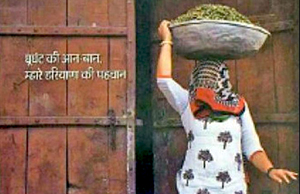
The recent issue of Krishi Samvad, a supplement of the Haryana Samvad magazine, a monthly magazine published by the State government, carries a photograph of a veiled woman.

The woman's face can be seen covered with a 'ghoongat'. The woman is seen carrying cattle feed on her head, even as the caption reads: "Ghoongat kiaan-baan, mahra Haryana kipechchan (pride of the veil is the identity of my Haryana".

The front cover of the magazine carries the photo of Chief Minister Manohar Lal Khattar.

Reacting sharply to the description, former Chief Minister Bhupinder Singh Hooda and senior Congress leader and party spokesperson Randeep Surjewala said it reflected the regressive attitude of the ruling BJP government.

"This shows regressive mindset of the BJP government. Women from Haryana are ahead in every field. Just three days back, a young woman from the state was crowned as Miss India. Girls from the state have made a mark in sports arena and other fields. India-born US astronaut late Kalpana Chawla hailed from Haryana," Hooda said.

Recently, Haryana girl Manushi Chhillar was crowned Femina Miss India 2017.

"Women wearing veil was not the original culture of Haryana. This practice started only after foreign invasions and because of the fear of invaders. In south India, there was no 'purdah' system. Therefore, what I want to say is that BJP government wants to move back in time rather than thinking ahead and taking the state forward," he said.

Surjewala said it was a "regressive mindset and objectification of women, which is part of the DNA of the BJP".

"The BJP government has failed to realise that Haryana girls and women have excelled in fields such as space science, sports and the armed forces to name just a few," Surjewala said.

Dismissing the opposition criticism, Vij told PTI over phone, "What you are seeing in a government magazine should only be seen as what was Haryana's tradition. Nowhere are we saying that we want to force veil on women. We are in favour of women empowerment and we have done a lot in this regard".

He said the sex ratio has improved from 862 to 950 as a result of the steps taken by the state government.

"We are committed to women's education and have decided to open colleges for women after every 20 km. As regards the photo in the magazine, this has been the tradition in some parts of the state, but it is not binding.

"We are not forcing anyone to wear ghoongat. It is not like burqa and only those women who want to do ghoongat, it is as per their wish," Vij said.

Comments

Fairman
 - 
Wednesday, 28 Jun 2017

It seems that the BJP in Haryana seems to be protecting of women.

Why the goongat or veil is required. Just to segregate from male intervention. When there is no gender segregation, people take it for granted. They take easy in molester of ladies.
People commit these sins or crime whenever there is easy access for it.
Better prevent from beginning. It is not against empowerment of sign of uncivilization of women.

Add new comment

  • Coastaldigest.com reserves the right to delete or block any comments.
  • Coastaldigset.com is not responsible for its readers’ comments.
  • Comments that are abusive, incendiary or irrelevant are strictly prohibited.
  • Please use a genuine email ID and provide your name to avoid reject.
coastaldigest.com news network
May 20,2020

Mangaluru/Udupi, May 20: Islamic scholars belonging to different schools of thoughts including two prominent Qadis have issued special guidelines asking all Muslims in the region to offer prayers and celebrate Eid al-Fitr at home this year in keeping with the extended covid-19 lockdown.

Eid al-Fitr which marks the end of the month-long dawn-to-sunset fasting of Ramadan is rather a ‘humanitarian event’ than a fiesta. This year Eid is likely to be observed in coastal Karnataka on May 23 or May 24 depending on sighting of the new moon.  

Amid the Covid-19 pandemic, the Muslims are preparing for — and reconciling itself to — a most unusual Eid bereft of all the usual trappings like huge prayer congregations, ceaseless shopping, social visits and the inviting warmth of an Eid Mubarak embrace.

In their separate messages, Udupi Qadi Bekal Ibrahim Musliyar and Mangaluru Qadi Twaqa Ahmed Musliyar have urged Muslims to refrain from all kinds of public gatherings during Eid. Noting that Muslims in the region have followed all the advisories in issued by the government to contain the spread of coronavirus in the blessed month of Ramadan, they have urged them to follow the guidelines during Eid too.

On social media groups, messages like “no new clothes, just wear your best clothes” are being circulated among family and friends, urging people to fill the festive void with the spirit of giving. The suggestions range from paying a needy child’s school fee or someone’s rent to helping a lockdown-hit trader revive his business.

Following guidelines are issued by the top clerics ahead Eid

1) There will be no Eid prayer in mosques or Eid-gahs. Hence, Muslims should offer Eid al-Fitr prayer in their homes with family members.

2) Distributing Zakat al-Fitr among needy is mandatory. However necessary safety measures should be taken while going out such as wearing masks and maintaining physical distance. As there is lockdown from 7 p.m. to 7 a.m. every day, Zakat al-Fitr can be distributed a day before Eid or on the day of Eid before evening. 

3) Women, children and elderly people should not step out of the houses.

4) Avoid visiting graveyards or other places.

5) All mosques are closed due to lockdown. Hence, observe Eid in a simple way and set an example for the society. 

6) Strictly follow all the guidelines issued by the state and central governments

Comments

Add new comment

  • Coastaldigest.com reserves the right to delete or block any comments.
  • Coastaldigset.com is not responsible for its readers’ comments.
  • Comments that are abusive, incendiary or irrelevant are strictly prohibited.
  • Please use a genuine email ID and provide your name to avoid reject.
News Networks
March 7,2020

Bengaluru, Mar 7: Karnataka Chief Minister BS Yediyurappa on Friday said that the Upper Krishna Project (UKP) will be completed within the next three years.

Speaking in the Assembly, the Chief Minister said: "After discussing with the officials of the finance department, we have decided to allocate Rs 10,000 crore funds for the third phase of UKP. This project will be completed within a span of three years."

Yediyurappa also said that the government will hold talks for additional funds from the Central government.

The leader of Opposition, Siddaramaiah, interrupted and said that the CM has announced this just to gain the confidence of MLAs from north Karnataka.

"The government could have announced it in the budget itself or else the Chief Minister could have announced it at the time of discussion on the budget. Where are the funds with the government to complete the project? CM has announced this just to gain the confidence of MLAs who hail from north Karnataka," said Siddaramaiah.

Deputy Chief Minister Govinda Karajol while speaking to the media welcomed the Chief Minister's statement and said that the earlier government didn't allocate a single penny in the last seven years he added.

Comments

Add new comment

  • Coastaldigest.com reserves the right to delete or block any comments.
  • Coastaldigset.com is not responsible for its readers’ comments.
  • Comments that are abusive, incendiary or irrelevant are strictly prohibited.
  • Please use a genuine email ID and provide your name to avoid reject.
Agencies
February 20,2020

India ranked 77th on a sustainability index that takes into account per capita carbon emissions and ability of children in a nation to live healthy lives and secures 131st spot on a flourishing ranking that measures the best chance at survival and well-being for children, according to a UN-backed report.

The report was released on Wednesday by a commission of over 40 child and adolescent health experts from around the world. It was commissioned by the World Health Organization (WHO), UN Children's Fund (UNICEF) and The Lancet medical journal.

In the report assessing the capacity of 180 countries to ensure that their youngsters can survive and thrive, India ranks 77th on the Sustainability Index and 131 on the Flourishing Index, it said.

Flourishing is the geometric mean of Surviving and Thriving. For Surviving, the authors selected maternal survival, survival in children younger than 5 years old, suicide, access to maternal and child health services, basic hygiene and sanitation, and lack of extreme poverty.

For Thriving, the domains were educational achievement, growth and nutrition, reproductive freedom, and protection from violence.

Under the Sustainability Index, the authors noted that promoting today's national conditions for children to survive and thrive must not come at the cost of eroding future global conditions for children's ability to flourish.

The Sustainability Index ranks countries on excess carbon emissions compared with the 2030 target. This provides a convenient and available proxy for a country's contribution to sustainability in future.

The report noted that under realistic assumptions about possible trajectories towards sustainable greenhouse gas emissions, models predict that global carbon emissions need to be reduced from 39·7 giga­ tonnes to 22·8 gigatonnes per year by 2030 to maintain even a 66 per cent chance of keeping global warming below 1·5°C.

It said that the world's survival depended on children being able to flourish, but no country is doing enough to give them a sustainable future.

"No country in the world is currently providing the conditions we need to support every child to grow up and have a healthy future," said Anthony Costello, Professor of Global Health and Sustainability at University College London, one of the lead authors of the report.

"Especially, they're under immediate threat from climate change and from commercial marketing, which has grown hugely in the last decade," said Costello – former WHO Director of Mother, Child and Adolescent health.

Norway leads the table for survival, health, education and nutrition rates - followed by South Korea and the Netherlands. Central African Republic, Chad and Somalia come at the bottom.

However, when taking into account per capita CO2 emissions, these top countries trail behind, with Norway 156th, the Republic of Korea 166th and the Netherlands 160th.

Each of the three emits 210 per cent more CO2 per capita than their 2030 target, the data shows, while the US, Australia, and Saudi Arabia are among the 10 worst emitters. The lowest emitters are Burundi, Chad and Somalia.

According to the report, the only countries on track to beat CO2 emission per capita targets by 2030, while also performing fairly – within the top 70 – on child flourishing measures are: Albania, Armenia, Grenada, Jordan, Moldova, Sri Lanka, Tunisia, Uruguay and Vietnam.

"More than 2 billion people live in countries where development is hampered by humanitarian crises, conflicts, and natural disasters, problems increasingly linked with climate change," said Minister Awa Coll-Seck from Senegal, Co-Chair of the commission.

The report also highlights the distinct threat posed to children from harmful marketing.

Evidence suggests that children in some countries see as many as 30,000 advertisements on television alone in a single year, while youth exposure to vaping (e-cigarettes) advertisements increased by more than 250 per cent in the US over two years, reaching more than 24 million young people.

Studies in Australia, Canada, Mexico, New Zealand and the US – among many others – have shown that self-regulation has not hampered commercial ability to advertise to children.

Children's exposure to commercial marketing of junk food and sugary beverages is associated with purchase of unhealthy foods and overweight and obesity, linking predatory marketing to the alarming rise in childhood obesity, it said.

The number of obese children and adolescents increased from 11 million in 1975 to 124 million in 2016 – an 11-fold increase, with dire individual and societal costs, the report said.

To protect children, the authors call for a new global movement driven by and for children.

Specific recommendations include stopping CO2 emissions with the utmost urgency, to ensure children have a future on this planet; placing children and adolescents at the centre of global efforts to achieve sustainable development, the report said.

New policies and investment in all sectors to work towards child health and rights; incorporating children's voices into policy decisions and tightening national regulation of harmful commercial marketing, supported by a new Optional Protocol to the UN Convention on the Rights of the Child, it said.

Comments

Add new comment

  • Coastaldigest.com reserves the right to delete or block any comments.
  • Coastaldigset.com is not responsible for its readers’ comments.
  • Comments that are abusive, incendiary or irrelevant are strictly prohibited.
  • Please use a genuine email ID and provide your name to avoid reject.