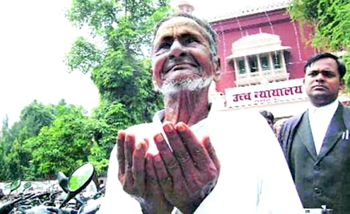
Hashim Ansari, oldest litigant in Babri Masjid case dies at 95

July 20, 2016

ansari

Ayodhya, Jul 20: The oldest litigant in the Ram Janmabhoomi-Babri mosque dispute, Mohammad Hashim Ansari died here today due to heart-related ailments.

Ansari, 95, took his last breath at his residence in the wee hours, according to his son Iqbal.

Ansari had been associated with the Babri mosque dispute case since December 1949.

In 1961, he along with six others became main plaintiff in the 'Ayodhya title suit' filed by the Sunni Central Waqf Board in the court of Faizabad civil judge.

Five other plaintiffs were Mohammad Farooq, Shahabuddin, Maulana Nisaar, Mahmood Sahab and Hashim Ansari.

He was first to file the suit in the court of civil judge of Faizabad on the matter.

Allahabad High Court in 2010 in its majority verdict allotted one-third of the disputed site in Ayodhya to Nirmohi Akahara. The other two-thirds portion has been given equally to be shared by the Waqf Board and the side representing Ram Lalla.

Soon after the verdict, Ansari had called for burying the dispute and making "a fresh start".

Comments

SK
 - 
Wednesday, 20 Jul 2016

Inna lillahi wa inna ilaihi Rajivoon..... The man who fought for the justice as per the constitution of India.......

Add new comment

  • Coastaldigest.com reserves the right to delete or block any comments.
  • Coastaldigset.com is not responsible for its readers’ comments.
  • Comments that are abusive, incendiary or irrelevant are strictly prohibited.
  • Please use a genuine email ID and provide your name to avoid reject.
News Network
March 26,2020

Hubballi, Mar 25: The people living in rural areas of North-Karnataka region have become more aware about deadly Corona virus as they are leaving no stone unturned to prevent people of Bengaluru and other metropolitan cities from entering into their villages. People have put thorny plants on all roads at the outskirts connecting their villages and deployed youths to conduct patrolling round the clock till next 21 days.

Their motto is to prevent their own villagers getting infected from the outsiders especially from cities like Bengaluru and other two-tier cities where positive virus cases are on the rise. They have also take precautionary measures in the wake of Chief Minister B S Yediyurappa's call to the people to return to their native places.

Several people have also dug up the roads leading to their villages to block the entry of outside vehicles. They have put a condition to the outsiders to enter into their villages only after proper health check-up to confirm that they are not infected with Corona positive.

"We don't have access to the proper medical care if Corona virus is entered into our village. The Primary Health Centres are not functioning properly and these centers are facing lack of adequate staff and medical equipments unlike in big cities.Therefore, those who have deserted our village to employ in various jobs in Bengaluru and other cities should confirm that they are tested negative for the virus", said Mallikarjun Patil of Kudal village in Hangal taluk of Haveri district. The village has totally banned the outsiders into their village and warned their fellow villagers to return immediately if they have visited to their relatives' homes in neighboring villages to observe 21-day lockdown.

Hundreds of youths in Itanal village of Chikkodi taluk of Belagavi have also resorted to similar tactics and patrolling in all roads at the outskirts by holding sticks to prevent outsiders from entering into their village until April 14.

People of Hunagunti village in Ron taluk and Kotamuchagi village in Gadag taluk have also adopted similar plan by parking tractors at th outskirts to prohibit the entry of outsiders. They have also created awareness in their villages by beating drums urging the people not to venture outside village for next three weeks.

The police officials have resorted to lati-charge at various places in urban areas when people gathered in large numbers to buy essential commodities.

Comments

Add new comment

  • Coastaldigest.com reserves the right to delete or block any comments.
  • Coastaldigset.com is not responsible for its readers’ comments.
  • Comments that are abusive, incendiary or irrelevant are strictly prohibited.
  • Please use a genuine email ID and provide your name to avoid reject.
News Network
February 22,2020

Bengaluru, Feb 22: Thanks to joint efforts by the Protector of Emigrants in Bengaluru and Indian Embassy in Qatar, a 26-year-old woman from Karnataka who had been kept in confinement in Qatar has been rescued and brought back to India.

Anupama (name changed) from Holenarasipura in Hassan district arrived in Bengaluru on Thursday night. She was allegedly locked up in a house for 14 days, restrained from using a mobile and wasn't fed. There were three other women with her. On the midnight of February 12, they broke the window panes and fled before contacting local police.

Anupama, a diploma graduate in computer science, was jobless and her friend working in Kuwait suggested she try for a job abroad. She contacted an agency based in Chikkamagaluru which offered her a nanny's job in Qatar. After document verification, the agency demanded she pay Rs 2 lakh but she said she didn't have that kind of money.

The agency sent Anupama on a visitor visa but told her if questioned by immigration officials, she must claim she was visiting her sister. They also gave her a return ticket.

As Anupama was travelling abroad for the first time, she said she was ignorant about several things.

On January 12, Anupama left Bengaluru. But as she reached Qatar, all her documents, including passport, were confiscated by the agency. Her return ticket was cancelled and she was sent to a house to work as babysitter-cum-cook for Rs 30,000. She lived with four other maids in the same house, where they were made to work for 16-18 hours a day.

"I used to wake up around 5.30am every day and had to prepare breakfast for the employers by 6.30am. My work would end around 11pm every day. We never even got time to eat," Anupama told media on Friday. Four days into work, Anupama's nose started bleeding. However, the employers cared little and insisted she continue to work. After 18 days, she requested her employers that she be relieved.

The agency sent her to a house where three women were already present and locked her up with them. "They used to give us a glass of raw rice, an onion, tomato and potato to cook for ourselves. While we got rice every day, we had to use the vegetables for three days. We were not supposed to use mobiles or go out. Two people were monitoring us," she recalled.

Anupama and the others decided to approach police but for that they needed to escape. Around 1.30am on February 12, the four women managed to break window panes and jumped out. They ran for more than a kilometre and managed to approach police, who summoned the agency and got the women to speak to their families.

Anupama called her brother-in-law, who approached the Protector of Emigrants office in Koramangala, Bengaluru. Shubham Singh, PoE in Bengaluru, said they took up the issue with the Indian Embassy in Qatar, which immediately got in touch with Qatar police. Anupama said, "We were kept in prison for a couple of days and were sent to the deportation centre later."

Meanwhile, the Indian embassy got the agency to return the women's documents. However, the agents did not pay their salaries. Two of the women were sent to Hyderabad and the third to Kerala. On Friday, Anupama met Singh at his office, where her statement was recorded. "We have started the process of initiating action against the agency in India," he said.


Comments

Add new comment

  • Coastaldigest.com reserves the right to delete or block any comments.
  • Coastaldigset.com is not responsible for its readers’ comments.
  • Comments that are abusive, incendiary or irrelevant are strictly prohibited.
  • Please use a genuine email ID and provide your name to avoid reject.
News Network
April 23,2020

Riyadh, Apr 22: In an extraordinary initiative, the government of the Kingdom of Saudi Arabia has decided to facilitate the travel of expatriates who have an exit and reentry visa or final exit visa to return to their countries.

This is in line with the order of Custodian of the Two Holy Mosques King Salman, according to the Saudi Press Agency.

According to the initiative, called “Auda” (return), expatriates can apply seeking permission for travel to their countries through the Absher portal of the ministry.

Announcing this, Saudi's Ministry of Interior said that the initiative will be implemented in cooperation with a number of relevant government agencies.

Requests for travel from expatriates will be received and approved in coordination with the relevant authorities to complete their travel procedures on board international flights.

As per the initiative, a text message will be sent to the beneficiary stating the travel date, ticket number and reservation details, and by which the beneficiary can obtain his travel ticket and complete the travel procedures.

Clarifying the procedures for the travel, the ministry said that the applicant shall select the icon (Auda) after visiting the Absher portal and fill the following fields: iqama (residency permit) number, date of birth, mobile number, departure city and airport of arrival.

It is not mandatory for the expatriate to have his own Absher account for availing of the service, the ministry said, adding that this facility is to enable expatriates to benefit from this initiative.

The departure will be through the following airports: King Khalid International Airport in Riyadh, King Abdulaziz International Airport in Jeddah, Prince Muhammad International Airport in Madinah, and King Fahd International Airport in Dammam.

Those expatriates who are outside these cities can benefit from the service through entering airport of departure after completion of their travel procedures in sufficient period of time.

Comments

Add new comment

  • Coastaldigest.com reserves the right to delete or block any comments.
  • Coastaldigset.com is not responsible for its readers’ comments.
  • Comments that are abusive, incendiary or irrelevant are strictly prohibited.
  • Please use a genuine email ID and provide your name to avoid reject.