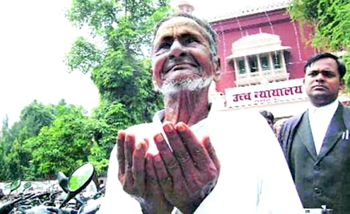
Hashim Ansari, oldest litigant in Babri Masjid case dies at 95

July 20, 2016

ansari

Ayodhya, Jul 20: The oldest litigant in the Ram Janmabhoomi-Babri mosque dispute, Mohammad Hashim Ansari died here today due to heart-related ailments.

Ansari, 95, took his last breath at his residence in the wee hours, according to his son Iqbal.

Ansari had been associated with the Babri mosque dispute case since December 1949.

In 1961, he along with six others became main plaintiff in the 'Ayodhya title suit' filed by the Sunni Central Waqf Board in the court of Faizabad civil judge.

Five other plaintiffs were Mohammad Farooq, Shahabuddin, Maulana Nisaar, Mahmood Sahab and Hashim Ansari.

He was first to file the suit in the court of civil judge of Faizabad on the matter.

Allahabad High Court in 2010 in its majority verdict allotted one-third of the disputed site in Ayodhya to Nirmohi Akahara. The other two-thirds portion has been given equally to be shared by the Waqf Board and the side representing Ram Lalla.

Soon after the verdict, Ansari had called for burying the dispute and making "a fresh start".

Comments

SK
 - 
Wednesday, 20 Jul 2016

Inna lillahi wa inna ilaihi Rajivoon..... The man who fought for the justice as per the constitution of India.......

Add new comment

  • Coastaldigest.com reserves the right to delete or block any comments.
  • Coastaldigset.com is not responsible for its readers’ comments.
  • Comments that are abusive, incendiary or irrelevant are strictly prohibited.
  • Please use a genuine email ID and provide your name to avoid reject.
Agencies
May 8,2020

Washington D.C., May 8: The prime time for brain development in a child's life is the first year, where the infant spends most of the time asleep. It is the time when neural connections form and sensory memories are encoded.

However, when sleep is disrupted, as occurs more often among children with autism, brain development may be affected, too.

New research led by the University of Washington finds that sleep problems in a baby's first 12 months may not only precede an autism diagnosis but also may be associated with altered growth trajectory in a key part of the brain, the hippocampus.

The study, which was published in the American Journal of Psychiatry, researchers report that in a sample of more than 400 taken of 6- to 12-month-old infants, those who were later diagnosed with autism were more likely to have had difficulty falling asleep.

It also states that this sleep difficulty was associated with altered growth trajectories in the hippocampus.

"The hippocampus is critical for learning and memory, and changes in the size of the hippocampus have been associated with poor sleep in adults and older children.

As many as 80 per cent of the children with autism spectrum disorder have sleep problems," said Annette Estes, director of the UW Autism Center and senior author of the study.

"In our clinical experience, parents have a lot of concerns about their children's sleep, and in our work on early autism intervention, we observed that sleep problems were holding children and families back," added Estes, who is also a UW professor of speech and hearing sciences.

"It could be that altered sleep is part-and-parcel of autism for some children. One clue is that behavioural interventions to improve sleep don't work for all children with autism, even when their parents are doing everything just right. This suggests that there may be a biological component to sleep problems for some children with autism," said Estes.

To consider links among sleep, brain development, and autism, researchers at the IBIS Network looked at MRI scans of 432 infants, surveyed parents about sleep patterns, and measured cognitive functioning using a standardized assessment.

At the outset of the study, infants were classified according to their risk for developing autism: Those who were at higher risk of developing autism -- about two-thirds of the study sample -- had an older sibling who had already been diagnosed.

Infant siblings of children with autism have a 20 per cent chance of developing autism spectrum disorder -- a much higher risk than children in the general population.

In the current study, 127 of the 432 infants were identified as "low risk" at the time the MRI scans were taken because they had no family history of autism.

They later evaluated all the participants at 24 months of age to determine whether they had developed autism. Of the roughly 300 children originally considered "high familial risk," 71 were diagnosed with autism spectrum disorder at that age.

Problems with sleep were more common among the infants later diagnosed with an autism spectrum disorder, as were larger hippocampi. No other subcortical brain structures were affected, including the amygdala, which is responsible for certain emotions and aspects of memory, or the thalamus, a signal transmitter from the spinal cord to the cerebral cortex.

The authors note that while parents reported more sleep difficulties among infants who developed autism compared to those who did not, the differences were very subtle and only observed when looking at group averages across hundreds of infants.

Sleep patterns in the first years of life change rapidly as infants transition from sleeping around the clock to a more adult-like sleep/wake cycle. Until further research is completed, Estes said, it is not possible to interpret challenges with sleep as an early sign of increased risk for autism.


Comments

Add new comment

  • Coastaldigest.com reserves the right to delete or block any comments.
  • Coastaldigset.com is not responsible for its readers’ comments.
  • Comments that are abusive, incendiary or irrelevant are strictly prohibited.
  • Please use a genuine email ID and provide your name to avoid reject.
News Network
March 23,2020

Mangaluru, Mar 23: People in Thukkottu and Ullal area of Mangaluru are in panic after a local woman who recently returned from a foreign country fell ill.

On receiving information the health officials from Ullal PHC visited the house of the woman, who is suffering from fever and cold. They provided her medicines and asked her to remain quarantined at home.

It is said that the woman's mother, who had come to a grocery shop near Thokkottu, informed the shopkeeper that her daughter, who had returned from abroad, was suffering from fever.

The alert shopkeeper, understanding the gravity of the situation, informed ZP Standing Committee on Health and Education President Dhanalakshmi Gatti, who in turn brought the issue to the notice of health officials.

The health officials rushed to her house and diagnosed her. However, the authorities have requested the local people not to be panicked as it is not yet confirmed whether the woman is suffering from COVID-19 caused by the novel coronavirus.

Comments

Add new comment

  • Coastaldigest.com reserves the right to delete or block any comments.
  • Coastaldigset.com is not responsible for its readers’ comments.
  • Comments that are abusive, incendiary or irrelevant are strictly prohibited.
  • Please use a genuine email ID and provide your name to avoid reject.
News Network
April 2,2020

Kasaragod, Apr 2: Kerala reported 21 new cases of coronavirus with eight from the worst affected Kasaragod district, taking the tally of active patients to 256, Chief Minister Pinarayi Vijayan said on Thursday.

Besides, Kasaragod, five positive cases have been detected from Idukki, two from Kollam and one each from Thiruvananthapuram, Pathnamthitta, Thrissur, Malappuram, Kozhikode and Kannur, he told reporters here.

At least 1.65 lakh people are under survillence in the state, 643 in various hospitals.

Presently, 256 people are under treatment for the virus in the state where two fatalities have occurred, Vijayan said.

Comments

Add new comment

  • Coastaldigest.com reserves the right to delete or block any comments.
  • Coastaldigset.com is not responsible for its readers’ comments.
  • Comments that are abusive, incendiary or irrelevant are strictly prohibited.
  • Please use a genuine email ID and provide your name to avoid reject.