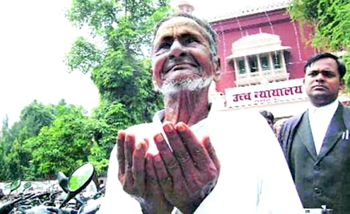
Hashim Ansari, oldest litigant in Babri Masjid case dies at 95

July 20, 2016

ansari

Ayodhya, Jul 20: The oldest litigant in the Ram Janmabhoomi-Babri mosque dispute, Mohammad Hashim Ansari died here today due to heart-related ailments.

Ansari, 95, took his last breath at his residence in the wee hours, according to his son Iqbal.

Ansari had been associated with the Babri mosque dispute case since December 1949.

In 1961, he along with six others became main plaintiff in the 'Ayodhya title suit' filed by the Sunni Central Waqf Board in the court of Faizabad civil judge.

Five other plaintiffs were Mohammad Farooq, Shahabuddin, Maulana Nisaar, Mahmood Sahab and Hashim Ansari.

He was first to file the suit in the court of civil judge of Faizabad on the matter.

Allahabad High Court in 2010 in its majority verdict allotted one-third of the disputed site in Ayodhya to Nirmohi Akahara. The other two-thirds portion has been given equally to be shared by the Waqf Board and the side representing Ram Lalla.

Soon after the verdict, Ansari had called for burying the dispute and making "a fresh start".

Comments

SK
 - 
Wednesday, 20 Jul 2016

Inna lillahi wa inna ilaihi Rajivoon..... The man who fought for the justice as per the constitution of India.......

Add new comment

  • Coastaldigest.com reserves the right to delete or block any comments.
  • Coastaldigset.com is not responsible for its readers’ comments.
  • Comments that are abusive, incendiary or irrelevant are strictly prohibited.
  • Please use a genuine email ID and provide your name to avoid reject.
News Network
July 6,2020

Tumuku, Jul 6: Senior Congress leader and Kunigal MLA Dr H D Ranganathm tested positive for COVID-19 on Monday.

The 48-year-old Congress legislature, a doctor by himself, was admitted to Manipal hospital and recovering, he said in a tweet.

Dr Ranganath said he took all precautions, yet could not save himself from the virus and advice people to not to take the contagion lightly.

Comments

Add new comment

  • Coastaldigest.com reserves the right to delete or block any comments.
  • Coastaldigset.com is not responsible for its readers’ comments.
  • Comments that are abusive, incendiary or irrelevant are strictly prohibited.
  • Please use a genuine email ID and provide your name to avoid reject.
News Network
June 2,2020

Bengaluru, Jun 2: Chief Minister BS Yediyurappa on Tuesday interacted with District Collectors (DCs) and Superintendents of Police (SPs) regarding COVID- 19 situation in the State.

In the meeting held through a video conference, he said that DCs, SPs and the District Panchayat Chief Executive Officer (CEO) be divided into taluks and ordered them to take appropriate measures to control COVID-19.

He was speaking today in a video conversation with District Collector, District Panchayat Chief Executives and Superintendents of Police in Kalaburgi, Vijayapura, Udupi, Yadagiri, Raichuru and Belagavi districts regarding measures to control the spread of COVID-19.

The Chief Minister instructed officials to monitor the investments in taluka centres. He also ordered to create a task force in the village panchayats, who will be monitoring things closely.

The Chief Minister also directed for the creation of ward-level watchdog committee in every village and city and an FIR should be registered in case of a home quarantine violation.

Home Minister Basavaraja Bommai, Revenue Minister R Ashok, Chief Secretary TM Vijayabhaskar, Development Commissioner Vandita Sharma, Police Chief Director Praveen Sood, Health Department general secretary Javed Akhtar and secretary Pankaj Kumar Pandey were also present in the meeting.

Comments

Add new comment

  • Coastaldigest.com reserves the right to delete or block any comments.
  • Coastaldigset.com is not responsible for its readers’ comments.
  • Comments that are abusive, incendiary or irrelevant are strictly prohibited.
  • Please use a genuine email ID and provide your name to avoid reject.
News Network
April 2,2020

The current physical distancing guidelines provided by the World Health Organisation (WHO) and by the US Centers for Disease Control and Prevention (CDC) may not be adequate to curb the coronavirus spread, according to a research which says the gas cloud from a cough or sneeze may help virus particles travel up to 8 metres. The research, published in the Journal of the American Medical Association, noted that the the current guidelines issued by the WHO and CDC are based on outdated models from the 1930s of how gas clouds from a cough, sneeze, or exhalation spread.

Study author, MIT associate professor Lydia Bourouiba, warned that droplets of all sizes can travel 23 to 27 feet, or 7-8 metres, carrying the pathogen.

According to Bourouiba, the current guidelines are based on "arbitrary" assumptions of droplet size, "overly simplified", and "may limit the effectiveness of the proposed interventions" against the deadly pandemic.

 She explained that the old guidelines assume droplets to be one of two categories, small or large, taking short-range semi-ballistic trajectories when a person exhales, coughs, or sneezes.

However based on more recent discoveries, the MIT scientist said, sneezes and coughs are made of a puff cloud that carries ambient air, transporting within it clusters of droplets of a wide range of sizes.

Bourouiba warned that this puff cloud, with ambient air entrapped in it, can offer the droplets moisture and warmth that can prevent it from evaporation in the outer environment.

"The locally moist and warm atmosphere within the turbulent gas cloud allows the contained droplets to evade evaporation for much longer than occurs with isolated droplets," she said.

"Under these conditions, the lifetime of a droplet could be considerably extended by a factor of up to 1000, from a fraction of a second to minutes," the researcher explained in the study.

The MIT scientist, who has researched the dynamics of coughs and sneezes for years, added that these droplets settle along the trajectory of a cough or sneeze contaminating surfaces, with their residues staying suspended in the air for hours.

"Even when maximum containment policies were enforced, the rapid international spread of COVID-19 suggests that using arbitrary droplet size cutoffs may not accurately reflect what actually occurs with respiratory emissions, possibly contributing to the ineffectiveness of some procedures used to limit the spread of respiratory disease," Bourouiba wrote in the study


Comments

Add new comment

  • Coastaldigest.com reserves the right to delete or block any comments.
  • Coastaldigset.com is not responsible for its readers’ comments.
  • Comments that are abusive, incendiary or irrelevant are strictly prohibited.
  • Please use a genuine email ID and provide your name to avoid reject.