


Have invited Siddaramaiah; it’s up to him to come: Pejawar seer

News Network
June 16, 2017

Udupi, Jun 16: Vishwesha Tirtha Swami of Paryaya Pejawar Mutt said on Thursday that he had, through his representatives, urged Chief Minister Siddaramaiah to visit the Sri Krishna Mutt/Temple on June 18, when President Pranab Mukherjee was here.pejawar
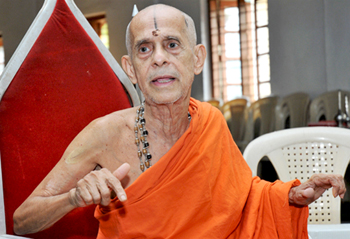
Speaking to presspersons, the seer said that Mr. Siddaramaiah’s secretary had informed his representatives that there was no likelihood of the Chief Minister visiting Udupi.

But there was no response from Mr. Siddaramaiah himself. “Hence, one will have to wait till Sunday to see what happens. I have invited him. It is up to to the Chief Minister to decide,” he said.

To a query, the seer said that he did not know the reason for Mr. Siddaramaiah for not visiting the temple.

He had earlier met Mr. Siddaramaiah at some functions in Bengaluru and Mangaluru and the meeting was civil.

When Mr. Siddaramaiah was facing a by-election after joining the Congress, he had met him (the seer) in Mysuru and sought his blessings. “But after becoming Chief Minister, he has not met me,” he said.

Asked whether Mr. Siddaramaiah was not visiting the Sri Krishna Mutt/Temple because he was saddened over the Kanaka Gopura controversy, the seer said that the Kanaka Gopura was new name for the gopura which was built in 2004-05. It was built in the place of an earlier gopura constructed by late Vidyapurna Tirtha of Krishnapur Mutt during his Paryaya period in 1910-12, which had become dilapidated.

The gopura was located above the Kanakanakindi (as is the present gopura). There was no connection between the saint-composer Sri Kanakadasa and the gopura.

The gopura constructed in 2004-05 was named after Sri Kanakadasa. Hence, there was no controversy over it. In fact, everyone was happy that the gopura was named after Sri Kanakadasa and there was no reason to be dissatisfied with it.

Besides, a Kanaka Mantapa had been constructed within the Sri Krishna Mutt/Temple premises and an idol of Sri Kanakadasa had been installed there. Kanaka Jayanti was being celebrated here annually. All reverence and respect were being shown to Sri Kanakadasa here. There was no point in making allegations, he said.

Though Mr. Siddaramaiah had not participated in his Paryaya ascension ceremony last year and the Sri Madhwacharya Sapta Shatamanotsava ceremony this year, he had later sent Kanike (offering) to Lord Krishna through his representatives. Mr. Siddaramaiah’s wife had called him to say that an offering had been sent and that they would visit the temple later, the seer recalled.

Comments

Add new comment

  • Coastaldigest.com reserves the right to delete or block any comments.
  • Coastaldigset.com is not responsible for its readers’ comments.
  • Comments that are abusive, incendiary or irrelevant are strictly prohibited.
  • Please use a genuine email ID and provide your name to avoid reject.
coastaldigest.com news network
May 22,2020

It has been 33 years since the night of 22 May, 1987 when nearly 50 Muslim men from Hashimpura, a settlement in Meerut were rounded up and packed into the rear of a truck of the Provincial Armed Constabulary (PAC), an armed police of Uttar Pradesh. It was the blessed month of Ramadan and all the Muslims were fasting.

That night 42 of those on board the truck were killed in two massacres in neighbouring Ghaziabad district. One along the Upper Ganga canal near Muradnagar, the other along the Hindon canal in Makanpur, on the border with Delhi.

The cops had returned home after dumping the dead bodies into the canal. A few days later, the dead bodies were found floating in the canal and a case of murder was registered. 

Vir Bahadur Singh was the chief minister of Uttar Pradesh and Rajiv Gandhi was the prime minister of India when this incident took place. 

Not much has changed for the survivors and the relatives of the victims even today. The wounds are still fresh. Hashimpura remains devoid of basic municipal amenities, the erring silence on the narrow lanes of the locality amid the activities of a daily life speaks of the horror of the fateful day in 1987.

The massacre was the result of one among the many outcomes of the decision taken by the Rajiv Gandhi government to open the locks of Babri Masjid. After a month of rioting, the situation was tense in various parts of Meerut, and a lot spilled over in the nearby areas.

Timeline

May 22, 1987

Nearly 50 Muslims picked up by the PAC personnel from Hashimpura village in Meerut, Uttar Pradesh.
Victims later shot and bodies thrown into a canal. 42 persons declared dead.

1988

UP government orders CB-CID probe in the case.

February 1994

CB-CID submits inquiry report indicting over 60 PAC and police personnel of all ranks.

May 20, 1996

Charge sheet filed against 19 accused before Chief Judicial Magistrate, Ghaziabad by CB-CID of Uttar Pradesh police. 161 people listed as witnesses.

September 2002

Case transferred to Delhi by the Supreme Court on a petition by the families of victims and survivors.

July 2006

Delhi court frames charges of murder, attempt to murder, tampering with evidence and conspiracy under the IPC against 17 accused.

March 8, 2013

Trial court dismisses Subramanian Swamy's plea seeking probe into the alleged role of P Chidambaram, then Minister of State for Home, in the matter.

January 22, 2015

Trial court reserves judgement.

March 21, 2015

Court acquits 16 surviving accused giving them benefit of doubt regarding their identity.

May 18, 2015

Trial court decision challenged in the Delhi HC by the victims' families and eyewitnesses who survived the incident.

May 29, 2015

HC issues notice to the 16 PAC personnel on Uttar Pradesh government's appeal against the trial court verdict.

December 2015

National Human Rights Commission is impleaded in the matter. NHRC also seeks further probe into the massacre.

February 17, 2016

HC tags Swamy's appeal with the other petitions in the matter.

September 6, 2018

Delhi HC reserves verdict in the case.

October 31, 2018

Delhi HC convicts 16 former PAC personnel for life after finding them guilty of the murder of 42 people.

Comments

Add new comment

  • Coastaldigest.com reserves the right to delete or block any comments.
  • Coastaldigset.com is not responsible for its readers’ comments.
  • Comments that are abusive, incendiary or irrelevant are strictly prohibited.
  • Please use a genuine email ID and provide your name to avoid reject.
News Network
April 16,2020

New Delhi, Apr 16: Minority Affairs Minister Mukhtar Abbas Naqvi on Thursday directed state waqf boards to ensure strict implementation of lockdown and social distancing guidelines during the holy month of Ramzan starting next week amid the coronavirus pandemic.

At a meeting via video conferencing, Naqvi asked the state waqf boards' officials to create awareness among people to offer prayers and perform other religious rituals like "iftar (breaking of fast)" during Ramzan, which begins on April 24 or 25, staying inside their homes.

More than seven lakh registered mosques, eidgahs, imambadas, dargahs and other religious and social institutions come under state waqf boards across the country. The Central Waqf Council is the regulatory body of state waqf boards in India.

"We should cooperate with health workers, security forces, administrative officers, sanitation workers. They are working for our safety and well-being even putting their own lives at risk in this coronavirus pandemic," Naqvi said.

"We should also demolish rumours and misinformation being spread about quarantine and isolation centres by creating awareness among people that such centres are only meant to protect people, their families and the society from the pandemic," the minister said.

Naqvi told all the state waqf boards and religious and social organisations that everyone should remain cautious of any type of fake news and conspiracies aimed at creating misinformation. 

"Authorities have been working for safety and well-being of all citizens of the country without any discrimination. Such type of rumours and conspiracies are a nefarious design to weaken the fight against coronavirus," he said.

"We should work united to win this fight against corona by defeating any type of rumour, misinformation and conspiracy," the minister said.

Naqvi asked officials of all the state waqf boards to play an active and effective role in ensuring that people follow the guidelines of the Union Home Ministry, state governments and the Central Waqf Council while fulfilling religious responsibilities during Ramzan.

In view of the challenges of the COVID-19 pandemic, all religious and social activities and mass gatherings in all the temples, gurdwaras, churches and other religious and social places of the country have been stopped, he said. 

Similarly, any mass gatherings in mosques and other Muslim religious places of the country has also been stopped, Naqvi said.

He said that due to the COVID-19 threat, religious leaders as well as religious and social organisations from all regions of the country, have appealed to people to offer prayers and perform all other religious rituals staying inside their homes during Ramzan. 

Most of the Muslim nations of the world have also banned mass gatherings at mosques and other religious places during the holy month, he pointed out.

Prime Minister Narendra Modi, in cooperation with all the state governments, has been working effectively for the safety and well-being of the people, he said.

The cooperation of the people has brought great relief to India in the war against COVID-19 Naqvi said, adding that several challenges are still there before the country. 

"We can defeat these challenges of the coronavirus pandemic by following all the guidelines of the central and state governments strictly," he asserted.

Chairman and senior officials from state waqf boards such as Uttar Pradesh (Shia & Sunni), Andhra Pradesh, Bihar (Shia & Sunni), Dadra & Nagar Haveli, Haryana, Karnataka, Kerala, Madhya Pradesh, Punjab, West Bengal, Andaman & Nicobar, Assam, Manipur, among others participated in the meeting.

State waqf boards from Rajasthan, Telangana, Delhi, Chhattisgarh, Gujarat, Himachal Pradesh, Jammu and Kashmir, Jharkhand, Maharashtra, Odisha, Puducherry, Tamil Nadu, Tripura and Uttarakhand also participated.

Comments

Add new comment

  • Coastaldigest.com reserves the right to delete or block any comments.
  • Coastaldigset.com is not responsible for its readers’ comments.
  • Comments that are abusive, incendiary or irrelevant are strictly prohibited.
  • Please use a genuine email ID and provide your name to avoid reject.
coastaldigest.com news network
May 27,2020

Kolhapur, May 27: Praising the Muslims of Ichalkaranji town in the Kolhapur district for making invaluable contribution for setting up of a new intensive care unit in Indira Gandhi Memorial (IGM) hospital for treatment of corona infected patients, Maharashtra Chief Minister Uddhav Thackeray has said that with this donation, they have set an ideal example before the country.

While dedicating a 10-bed ICU unit at IGM hospital online from Mumbai, during Eid al Fitr, Mr Thackeray said that by donating Rs 36 lakh for ICU unit at IGM hospital, the Muslim community has set an ideal example before the country as to how to celebrate the festival.

The Muslims of Ichalkaranji made the donation following an appeal by the state government about avoiding unnecessary expenses for celebrating the Eid.

Minister of State for Health Rajendra Patil-Yadravkar, MP Dharysheel Mane, MLAs Prakash Awade and Raju Awale, district collector Daulat Desai, district superintendent of police Dr Abhinav Deshmukh, Zilla Parishad chief executive officer Aman Mittal, district surgeon Dr B C Kempipatil and others were present on the occasion.

Comments

Add new comment

  • Coastaldigest.com reserves the right to delete or block any comments.
  • Coastaldigset.com is not responsible for its readers’ comments.
  • Comments that are abusive, incendiary or irrelevant are strictly prohibited.
  • Please use a genuine email ID and provide your name to avoid reject.