


Have invited Siddaramaiah; it’s up to him to come: Pejawar seer

News Network
June 16, 2017

Udupi, Jun 16: Vishwesha Tirtha Swami of Paryaya Pejawar Mutt said on Thursday that he had, through his representatives, urged Chief Minister Siddaramaiah to visit the Sri Krishna Mutt/Temple on June 18, when President Pranab Mukherjee was here.pejawar
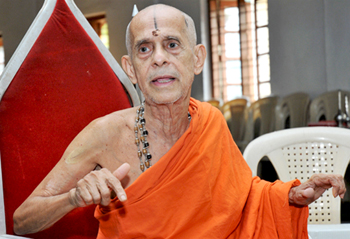
Speaking to presspersons, the seer said that Mr. Siddaramaiah’s secretary had informed his representatives that there was no likelihood of the Chief Minister visiting Udupi.

But there was no response from Mr. Siddaramaiah himself. “Hence, one will have to wait till Sunday to see what happens. I have invited him. It is up to to the Chief Minister to decide,” he said.

To a query, the seer said that he did not know the reason for Mr. Siddaramaiah for not visiting the temple.

He had earlier met Mr. Siddaramaiah at some functions in Bengaluru and Mangaluru and the meeting was civil.

When Mr. Siddaramaiah was facing a by-election after joining the Congress, he had met him (the seer) in Mysuru and sought his blessings. “But after becoming Chief Minister, he has not met me,” he said.

Asked whether Mr. Siddaramaiah was not visiting the Sri Krishna Mutt/Temple because he was saddened over the Kanaka Gopura controversy, the seer said that the Kanaka Gopura was new name for the gopura which was built in 2004-05. It was built in the place of an earlier gopura constructed by late Vidyapurna Tirtha of Krishnapur Mutt during his Paryaya period in 1910-12, which had become dilapidated.

The gopura was located above the Kanakanakindi (as is the present gopura). There was no connection between the saint-composer Sri Kanakadasa and the gopura.

The gopura constructed in 2004-05 was named after Sri Kanakadasa. Hence, there was no controversy over it. In fact, everyone was happy that the gopura was named after Sri Kanakadasa and there was no reason to be dissatisfied with it.

Besides, a Kanaka Mantapa had been constructed within the Sri Krishna Mutt/Temple premises and an idol of Sri Kanakadasa had been installed there. Kanaka Jayanti was being celebrated here annually. All reverence and respect were being shown to Sri Kanakadasa here. There was no point in making allegations, he said.

Though Mr. Siddaramaiah had not participated in his Paryaya ascension ceremony last year and the Sri Madhwacharya Sapta Shatamanotsava ceremony this year, he had later sent Kanike (offering) to Lord Krishna through his representatives. Mr. Siddaramaiah’s wife had called him to say that an offering had been sent and that they would visit the temple later, the seer recalled.

Comments

Add new comment

  • Coastaldigest.com reserves the right to delete or block any comments.
  • Coastaldigset.com is not responsible for its readers’ comments.
  • Comments that are abusive, incendiary or irrelevant are strictly prohibited.
  • Please use a genuine email ID and provide your name to avoid reject.
News Network
July 14,2020

Bengaluru, Jul 14: The Karnataka government on Tuesday made changes to the Land Reforms Act 1961 through an ordinance to allow non-agriculturists to buy and own farmland for farming.

“The Land Reforms Act has been amended through an ordinance and notified after Governor Vajubhai R Vala gave his assent to it on Monday night,” a Revenue Department official told media persons.

It now permits non-farmers to buy farmland and grow food crops. But they can’t use it for other activities.

“Sections 79 A, B and C of the Act have been repealed, paving way for bona fide citizens to invest in farmland and take to farming as a hobby, passion or additional occupation, which is rewarding,” the official said.

The amended Act will enable the state to attract investment in the farm sector and boost food output. The farm sector’s contribution to the state’s gross domestic product (GDP) has been less than the manufacturing and services sectors over the last two decades.

Criticism by farmers, the Congress and the JD(S) since the cabinet approved changes on June 11 forced the state government to retain section 80 of the Act, with an amendment, to prevent sale of dam water irrigated farmland.

“The ordinance has also added a new section (80A), which says relaxations under the Act will not apply to land given to farmers under the Karnataka SC and ST (Scheduled Caste and Tribe) Act 1978,” the official said.

The changes permit mortgage of farmland only to the state-run institutions, firms and cooperative societies specified in the Act. The ordinance also makes legal cases pending in courts against the sections amended redundant as the new Act addresses the concerns raised in them.

“Besides generating substantial revenue for the state government, the Act will now allow farmers who find the occupation non-remunerative and risky due to droughts/floods and labour shortage to sell their surplus land to urban buyers,” the official said.

Ruling BJP Rajya Sabha member KC Ramamurthy from Bengaluru said the amended Act would allow any citizen to buy farmland.

“Though hundreds of people petitioned successive governments for the past 45 years to abolish the ‘draconian’ sections, they were ignored. I compliment Chief Minister BS Yediyurappa and Revenue Minister R Ashoka for the decision to allow everyone to buy farmland irrespective of their occupation or profession,” Ramamurthy told media persons.

Comments

Add new comment

  • Coastaldigest.com reserves the right to delete or block any comments.
  • Coastaldigset.com is not responsible for its readers’ comments.
  • Comments that are abusive, incendiary or irrelevant are strictly prohibited.
  • Please use a genuine email ID and provide your name to avoid reject.
News Network
April 18,2020

Mangaluru, Apr 18: Mangaluru Police have registered a case against two foreign nationals, who were under home quarantine in Kodailbail, for allegedly spitting in the lift of their apartment building on Friday.

The two men, along with three of their roommates, have now been sent to a quarantine facility.

The residents of the residential complex have mentioned in their complaint that they have the CCTV footage of the two spitting in the lift.
Further investigation in the case is underway.

Comments

Add new comment

  • Coastaldigest.com reserves the right to delete or block any comments.
  • Coastaldigset.com is not responsible for its readers’ comments.
  • Comments that are abusive, incendiary or irrelevant are strictly prohibited.
  • Please use a genuine email ID and provide your name to avoid reject.
News Network
February 22,2020

Bengaluru, Feb 22: Thanks to joint efforts by the Protector of Emigrants in Bengaluru and Indian Embassy in Qatar, a 26-year-old woman from Karnataka who had been kept in confinement in Qatar has been rescued and brought back to India.

Anupama (name changed) from Holenarasipura in Hassan district arrived in Bengaluru on Thursday night. She was allegedly locked up in a house for 14 days, restrained from using a mobile and wasn't fed. There were three other women with her. On the midnight of February 12, they broke the window panes and fled before contacting local police.

Anupama, a diploma graduate in computer science, was jobless and her friend working in Kuwait suggested she try for a job abroad. She contacted an agency based in Chikkamagaluru which offered her a nanny's job in Qatar. After document verification, the agency demanded she pay Rs 2 lakh but she said she didn't have that kind of money.

The agency sent Anupama on a visitor visa but told her if questioned by immigration officials, she must claim she was visiting her sister. They also gave her a return ticket.

As Anupama was travelling abroad for the first time, she said she was ignorant about several things.

On January 12, Anupama left Bengaluru. But as she reached Qatar, all her documents, including passport, were confiscated by the agency. Her return ticket was cancelled and she was sent to a house to work as babysitter-cum-cook for Rs 30,000. She lived with four other maids in the same house, where they were made to work for 16-18 hours a day.

"I used to wake up around 5.30am every day and had to prepare breakfast for the employers by 6.30am. My work would end around 11pm every day. We never even got time to eat," Anupama told media on Friday. Four days into work, Anupama's nose started bleeding. However, the employers cared little and insisted she continue to work. After 18 days, she requested her employers that she be relieved.

The agency sent her to a house where three women were already present and locked her up with them. "They used to give us a glass of raw rice, an onion, tomato and potato to cook for ourselves. While we got rice every day, we had to use the vegetables for three days. We were not supposed to use mobiles or go out. Two people were monitoring us," she recalled.

Anupama and the others decided to approach police but for that they needed to escape. Around 1.30am on February 12, the four women managed to break window panes and jumped out. They ran for more than a kilometre and managed to approach police, who summoned the agency and got the women to speak to their families.

Anupama called her brother-in-law, who approached the Protector of Emigrants office in Koramangala, Bengaluru. Shubham Singh, PoE in Bengaluru, said they took up the issue with the Indian Embassy in Qatar, which immediately got in touch with Qatar police. Anupama said, "We were kept in prison for a couple of days and were sent to the deportation centre later."

Meanwhile, the Indian embassy got the agency to return the women's documents. However, the agents did not pay their salaries. Two of the women were sent to Hyderabad and the third to Kerala. On Friday, Anupama met Singh at his office, where her statement was recorded. "We have started the process of initiating action against the agency in India," he said.

Comments

Add new comment

  • Coastaldigest.com reserves the right to delete or block any comments.
  • Coastaldigset.com is not responsible for its readers’ comments.
  • Comments that are abusive, incendiary or irrelevant are strictly prohibited.
  • Please use a genuine email ID and provide your name to avoid reject.