


Have invited Siddaramaiah; it’s up to him to come: Pejawar seer

News Network
June 16, 2017

Udupi, Jun 16: Vishwesha Tirtha Swami of Paryaya Pejawar Mutt said on Thursday that he had, through his representatives, urged Chief Minister Siddaramaiah to visit the Sri Krishna Mutt/Temple on June 18, when President Pranab Mukherjee was here.pejawar
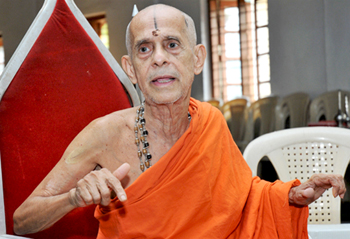
Speaking to presspersons, the seer said that Mr. Siddaramaiah’s secretary had informed his representatives that there was no likelihood of the Chief Minister visiting Udupi.

But there was no response from Mr. Siddaramaiah himself. “Hence, one will have to wait till Sunday to see what happens. I have invited him. It is up to to the Chief Minister to decide,” he said.

To a query, the seer said that he did not know the reason for Mr. Siddaramaiah for not visiting the temple.

He had earlier met Mr. Siddaramaiah at some functions in Bengaluru and Mangaluru and the meeting was civil.

When Mr. Siddaramaiah was facing a by-election after joining the Congress, he had met him (the seer) in Mysuru and sought his blessings. “But after becoming Chief Minister, he has not met me,” he said.

Asked whether Mr. Siddaramaiah was not visiting the Sri Krishna Mutt/Temple because he was saddened over the Kanaka Gopura controversy, the seer said that the Kanaka Gopura was new name for the gopura which was built in 2004-05. It was built in the place of an earlier gopura constructed by late Vidyapurna Tirtha of Krishnapur Mutt during his Paryaya period in 1910-12, which had become dilapidated.

The gopura was located above the Kanakanakindi (as is the present gopura). There was no connection between the saint-composer Sri Kanakadasa and the gopura.

The gopura constructed in 2004-05 was named after Sri Kanakadasa. Hence, there was no controversy over it. In fact, everyone was happy that the gopura was named after Sri Kanakadasa and there was no reason to be dissatisfied with it.

Besides, a Kanaka Mantapa had been constructed within the Sri Krishna Mutt/Temple premises and an idol of Sri Kanakadasa had been installed there. Kanaka Jayanti was being celebrated here annually. All reverence and respect were being shown to Sri Kanakadasa here. There was no point in making allegations, he said.

Though Mr. Siddaramaiah had not participated in his Paryaya ascension ceremony last year and the Sri Madhwacharya Sapta Shatamanotsava ceremony this year, he had later sent Kanike (offering) to Lord Krishna through his representatives. Mr. Siddaramaiah’s wife had called him to say that an offering had been sent and that they would visit the temple later, the seer recalled.

Comments

Add new comment

  • Coastaldigest.com reserves the right to delete or block any comments.
  • Coastaldigset.com is not responsible for its readers’ comments.
  • Comments that are abusive, incendiary or irrelevant are strictly prohibited.
  • Please use a genuine email ID and provide your name to avoid reject.
News Network
March 30,2020

Bengaluru, Mar 30: The coronavirus scare has taken a toll on the poultry industry in Karnataka with many poultry farm owners culling the birds, insiders in the poultry industry said.

At least one lakh birds have been culled in the last one week, the sources said.

Ever since the news spread about novel coronavirus spreading rapidly, the poultry industry started feeling the heat.

The lockdown spelt further trouble for the industry with reduced business compelling farm owners to go in for the culling.

According to Muddukrishna of C N Nischchith Enterprises, a live chicken dealer in Bengaluru, the culling had taken place in Shivamogga, Kolar and other places.

"There is a drastic decline in business. There are neither customers nor enough supply of birds for sale. We are badly hit. There are many poultry farm owners who have incurred tremendous loss due to the lockdown," Muddukrishna told news agency.

Another major poultry industry owner, having his farms in Channapatna, Ramanagar, Anekal and surrounding places, said he had to get rid of at least 4,000 birds in each of these farms.

"This is not restricted to me alone. There are about 64 major poultry industries who have gone for the drastic measure of culling," said the farm owner.

He said in the last one week, at least one lakh birds have been culled as it was hard for them to maintain them.

"Each bird needs at least a kilogram of grains in three days to eat whereas each kg of poultry food costs about Rs 32. We have about two lakh birds in our farm. How can we maintain if there is no business," rued the poultry farm owner.

The industry has suffered a double whammy.

People gave up eating chicken following rumours that the novel coronavirus COVID-19 is similar to SARS, another virus.

Further, the lockdown has blocked the transportation of these birds, he added.

According to the farm owner, in the last one month, he had suffered a loss of around Rs 15 lakh and if the situation continues for the next three months, his condition would be beyond imagination.

Muddukrishna said the poultry farm association had given a memorandum to the animal husbandry and fisheries department seeking direction on the transportation of these birds.

Accordingly, the secretary in the department of Animal Husbandry and Fisheries A B Ibrahim issued a circular to all the city police commissioners, deputy commissioners of the district, superintendent of police and the CEO of Zilla Panchayath on Friday that the animal husbandry services have been declared as essential services.

Ibrahim said in his circular that the production of chicken birds, sheep, goat, pigs, etc in the farm and their transportation, manufacturing feed, liquid nitrogen meant for veterinary use and other items related to the Animal Husbandry should be permitted.

"Despite the order, our vehicles are stopped and drivers are harassed," alleged Muddukrishna.

Comments

Add new comment

  • Coastaldigest.com reserves the right to delete or block any comments.
  • Coastaldigset.com is not responsible for its readers’ comments.
  • Comments that are abusive, incendiary or irrelevant are strictly prohibited.
  • Please use a genuine email ID and provide your name to avoid reject.
coastaldigest.com web desk
January 3,2020

Mangaluru, Jan 3: S Cube Art Gallery has successfully concluded its prestigious assignment from Airports Authority of India (AAI) to beautify Mangaluru Airport with artistic works. AAI had invited tenders for various jobs to be executed in the airport premises. S Cube Art Gallery had made a competitive bid which was subsequently followed up with presentation before selection panel and award of contract. S Cube Art Gallery bagged the contract for six works in two sectors out of the total four sectors for which the tender had been called.

The themes presented by S Cube Art Gallery showcase the Tulu culture and heritage of the people of Coastal Karnataka. The six themes selected are:

1. ‘Human Hand Flying Paper Plane’ – fibre glass and steel sculpture work installed in the circle in the outer precincts of the airport. This is a larger than life sculpture signifying the dreams and aspirations of the air travelers. Artist: Harish Kodialbail, Mangalore

2. ‘Kambala’ – fibre glass sculpture installed at the exit area of the airport. This sculpture is meant to introduce ‘Kambala’, the iconic folk sport of the region to the visitors and tourists. Artist: Harish Kodialbail, Mangalore

3. ‘Fisherman with Boat’ - fibre glass and steel sculpture installed at the entrance to departures lounge of the airport. It symbolizes the fishing culture of the coastal region depicting the soaring aspirations, life of courage and adventure as well as the daily struggles of the fisher folk. Artist: Harish Kodialbail, Mangalore

4. ‘Tiger Dance’ - fibre glass and steel sculpture installed at the arrivals lounge of the airport. This work depicts the world famous ‘Mangalore Pilivesha’ showing tiger dancers in various typical postures to the visiting tourists. Artist: Harish Kodialbail, Mangalore

5. ‘Folk Art Forms’ – six individual terracotta sculptures with Tulunadu cultural themes installed alongside the domestic and international corridors of the airport. Artist: Venki Palimaru, Udupi

6. ‘Jain Miniature Paintings’ – Jain miniature paintings (18x6 feet) – Two works of acrylic on canvas displayed on the wall on either sides of the exit area. The work was conceived after referring to authentic traditional Jain paintings in Moodbidri Jain Mutt and Shravanabelagola Mutt. Artist: Reshma S. Shetty, Mangalore

The total value of the contract was Rs. 56 lakhs. The work was completed over a period of six months and concluded in the month of July, 2019.  S Cube Art Gallery is grateful to the Airports Authority of India for giving the opportunity to participate in this project and showcase the artistic talents of the region.

Comments

Add new comment

  • Coastaldigest.com reserves the right to delete or block any comments.
  • Coastaldigset.com is not responsible for its readers’ comments.
  • Comments that are abusive, incendiary or irrelevant are strictly prohibited.
  • Please use a genuine email ID and provide your name to avoid reject.
Agencies
May 8,2020

Washington D.C., May 8: The prime time for brain development in a child's life is the first year, where the infant spends most of the time asleep. It is the time when neural connections form and sensory memories are encoded.

However, when sleep is disrupted, as occurs more often among children with autism, brain development may be affected, too.

New research led by the University of Washington finds that sleep problems in a baby's first 12 months may not only precede an autism diagnosis but also may be associated with altered growth trajectory in a key part of the brain, the hippocampus.

The study, which was published in the American Journal of Psychiatry, researchers report that in a sample of more than 400 taken of 6- to 12-month-old infants, those who were later diagnosed with autism were more likely to have had difficulty falling asleep.

It also states that this sleep difficulty was associated with altered growth trajectories in the hippocampus.

"The hippocampus is critical for learning and memory, and changes in the size of the hippocampus have been associated with poor sleep in adults and older children.

As many as 80 per cent of the children with autism spectrum disorder have sleep problems," said Annette Estes, director of the UW Autism Center and senior author of the study.

"In our clinical experience, parents have a lot of concerns about their children's sleep, and in our work on early autism intervention, we observed that sleep problems were holding children and families back," added Estes, who is also a UW professor of speech and hearing sciences.

"It could be that altered sleep is part-and-parcel of autism for some children. One clue is that behavioural interventions to improve sleep don't work for all children with autism, even when their parents are doing everything just right. This suggests that there may be a biological component to sleep problems for some children with autism," said Estes.

To consider links among sleep, brain development, and autism, researchers at the IBIS Network looked at MRI scans of 432 infants, surveyed parents about sleep patterns, and measured cognitive functioning using a standardized assessment.

At the outset of the study, infants were classified according to their risk for developing autism: Those who were at higher risk of developing autism -- about two-thirds of the study sample -- had an older sibling who had already been diagnosed.

Infant siblings of children with autism have a 20 per cent chance of developing autism spectrum disorder -- a much higher risk than children in the general population.

In the current study, 127 of the 432 infants were identified as "low risk" at the time the MRI scans were taken because they had no family history of autism.

They later evaluated all the participants at 24 months of age to determine whether they had developed autism. Of the roughly 300 children originally considered "high familial risk," 71 were diagnosed with autism spectrum disorder at that age.

Problems with sleep were more common among the infants later diagnosed with an autism spectrum disorder, as were larger hippocampi. No other subcortical brain structures were affected, including the amygdala, which is responsible for certain emotions and aspects of memory, or the thalamus, a signal transmitter from the spinal cord to the cerebral cortex.

The authors note that while parents reported more sleep difficulties among infants who developed autism compared to those who did not, the differences were very subtle and only observed when looking at group averages across hundreds of infants.

Sleep patterns in the first years of life change rapidly as infants transition from sleeping around the clock to a more adult-like sleep/wake cycle. Until further research is completed, Estes said, it is not possible to interpret challenges with sleep as an early sign of increased risk for autism.

Comments

Add new comment

  • Coastaldigest.com reserves the right to delete or block any comments.
  • Coastaldigset.com is not responsible for its readers’ comments.
  • Comments that are abusive, incendiary or irrelevant are strictly prohibited.
  • Please use a genuine email ID and provide your name to avoid reject.