


Have invited Siddaramaiah; it’s up to him to come: Pejawar seer

News Network
June 16, 2017

Udupi, Jun 16: Vishwesha Tirtha Swami of Paryaya Pejawar Mutt said on Thursday that he had, through his representatives, urged Chief Minister Siddaramaiah to visit the Sri Krishna Mutt/Temple on June 18, when President Pranab Mukherjee was here.pejawar
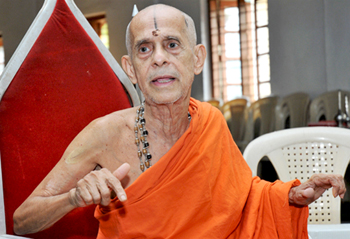
Speaking to presspersons, the seer said that Mr. Siddaramaiah’s secretary had informed his representatives that there was no likelihood of the Chief Minister visiting Udupi.

But there was no response from Mr. Siddaramaiah himself. “Hence, one will have to wait till Sunday to see what happens. I have invited him. It is up to to the Chief Minister to decide,” he said.

To a query, the seer said that he did not know the reason for Mr. Siddaramaiah for not visiting the temple.

He had earlier met Mr. Siddaramaiah at some functions in Bengaluru and Mangaluru and the meeting was civil.

When Mr. Siddaramaiah was facing a by-election after joining the Congress, he had met him (the seer) in Mysuru and sought his blessings. “But after becoming Chief Minister, he has not met me,” he said.

Asked whether Mr. Siddaramaiah was not visiting the Sri Krishna Mutt/Temple because he was saddened over the Kanaka Gopura controversy, the seer said that the Kanaka Gopura was new name for the gopura which was built in 2004-05. It was built in the place of an earlier gopura constructed by late Vidyapurna Tirtha of Krishnapur Mutt during his Paryaya period in 1910-12, which had become dilapidated.

The gopura was located above the Kanakanakindi (as is the present gopura). There was no connection between the saint-composer Sri Kanakadasa and the gopura.

The gopura constructed in 2004-05 was named after Sri Kanakadasa. Hence, there was no controversy over it. In fact, everyone was happy that the gopura was named after Sri Kanakadasa and there was no reason to be dissatisfied with it.

Besides, a Kanaka Mantapa had been constructed within the Sri Krishna Mutt/Temple premises and an idol of Sri Kanakadasa had been installed there. Kanaka Jayanti was being celebrated here annually. All reverence and respect were being shown to Sri Kanakadasa here. There was no point in making allegations, he said.

Though Mr. Siddaramaiah had not participated in his Paryaya ascension ceremony last year and the Sri Madhwacharya Sapta Shatamanotsava ceremony this year, he had later sent Kanike (offering) to Lord Krishna through his representatives. Mr. Siddaramaiah’s wife had called him to say that an offering had been sent and that they would visit the temple later, the seer recalled.

Comments

Add new comment

  • Coastaldigest.com reserves the right to delete or block any comments.
  • Coastaldigset.com is not responsible for its readers’ comments.
  • Comments that are abusive, incendiary or irrelevant are strictly prohibited.
  • Please use a genuine email ID and provide your name to avoid reject.
News Network
April 8,2020

Bengaluru, Apr 8: A 65-year-old man from Kalaburagi district became the fifth COVID-19 fatality in Karnataka, where six new positive cases were confirmed, pushing the tally in the state to 181, the health department said on Wednesday.

The man with Severe Acute Respiratory Infection (SARI), died at a designated hospital in Kalaburagi on Tuesday, a day after being shifted from a private hospital where he was initially treated for two days.

"On April 4, he had got admitted to a private hospital, on April 6 he was shifted to ESI hospital, where he passed away," Primary and Secondary Education Minister Suresh Kumar told reporters here.

The private hospital had been locked and its entire medical team quarantined, he said, adding a notice had been served on it for act of "criminal negligence" (by not referring the patient to designated hospital) and will be followed with a police case.

"He was suffering from SARI, on collecting his sample, tests have revealed that he was positive....investigation is on to find how he got infected," the Minister said.

Noting that the hospital in this case did not refer the patient to the designated hospital and kept treating him for two days, he appealed to all private healthcare facilities to inform authorities if anyone showed any indications for COVID-19.

"As of 5 PM on April 8, cumulatively 181 COVID-19 positive cases have been confirmed in the state, it includes 5 deaths and 28 discharges," the health department said in a bulletin.

Out of the positive cases, 71 are those who had come back from foreign countries, while remaining 110 are contacts and those who had gone to Delhi, the Minister said.

Kumar also said an expert committee comprising Narayana Health founder-chairman Dr Devi Prasad Shetty and Jayadeva Institute of Cardiovascular Sciences director Dr C N Manjunath among others, constitutedto devise an exit strategy for the lockdown, has submitted its reports with various recommendations to Chief Minister B S Yediyurappa.

The chief minister and officials were examining it which was likely to come up before the cabinet meeting on Thursday after which the details will be shared, he added.

The health department said the six fresh cases reported on Wednesday included the elderly man from Kalaburagi who died.

Among the positive cases are a woman from Uttara Kannada with history of SARI and contact of a Dubai returnee, a 72- year-old woman from Kalaburagi, who is mother of a patient that tested positive for the disease; a man from Mandya with contact to two patients.

Others include a man from Chikkaballapura with travel history to Delhi and a woman from Bengaluru also with a travel history to the national capital.

Contact tracing is in progress for all the cases, the bulletin added.

The department said out of 148 active cases in the state, 146 COVID-19 positive patients (including 1 pregnant woman) are in isolation at designated hospitals are stable and two in ICU (one each on oxygen and ventilators).

It said out of total 181 cases in the state, six are transit passengers of Kerala.

Bengaluru accounted for the highest in the state with 63 cases, followed by Mysuru (35), Dakshina Kannada (12) Bidar (ten), Uttara Kannada and Kalaburagi (9 each), Chikkaballapur (8) Belagavi (7), Ballari (6), Bagalkote (5), Mandya (4) Davangere, Bengaluru Rural and Udupi (three each), and Kodagu, Tumakuru, Gadag and Dharwad one each.

Those discharged include 16 from Bengaluru, four from Dakshina Kannada, two each from Uttara Kannada, Kalaburagi and Davangere, and one from Bengaluru Rural; while among those dead are two from Kalaburgari and one each are reported from Bengaluru, Bagalkote and Tumakuru.

Comments

Add new comment

  • Coastaldigest.com reserves the right to delete or block any comments.
  • Coastaldigset.com is not responsible for its readers’ comments.
  • Comments that are abusive, incendiary or irrelevant are strictly prohibited.
  • Please use a genuine email ID and provide your name to avoid reject.
News Network
April 28,2020

Bengaluru, Apr 28: Former Karnataka chief minister Siddaramaiah on Tuesday suggested that the government can allow sale of liquor in green zones. 

“Merely because there is an economic slowdown in the state, I don’t recommend that alcohol should be allowed to be sold. But, wherever there are green districts, they can open (liquor sale) with certain restrictions, I think,” Siddaramaiah, the leader of the Opposition, told reporters. 

There are 14 districts in the state that are categorised as green because they do not have any active COVID-19 cases. The green districts are: Yadgir, Raichur, Koppal, Haveri, Davangere, Shivamogga, Chitradurga, Udupi, Chikmagalur, Hassan, Kodagu, Chamarajanagar, Ramanagara and Kolar.

There is tremendous pressure on the B S Yediyurappa administration to revive the economy as the lockdown has dried up all revenue sources. Excise, alone, accounts for 18 per cent of Karnataka’s own tax revenue. 

The Excise department recently suggested allowing regulated sale of liquor through the state-run MSIL outlets. The government, however, did not approve it fearing crowding and backlash from the Centre.

Comments

Add new comment

  • Coastaldigest.com reserves the right to delete or block any comments.
  • Coastaldigset.com is not responsible for its readers’ comments.
  • Comments that are abusive, incendiary or irrelevant are strictly prohibited.
  • Please use a genuine email ID and provide your name to avoid reject.
Media Release
February 14,2020

Veteran journalist P. Sainath has said that the nation is in a crisis. And this crisis is not limited to just the rural area. It has become a national crisis at various areas such as agriculture, education, economy, job creation etc.

He was delivering the endowment lecture on the topic ‘Indian democracy at the post-liberalization and post-truth era’ at Media Manthan 2020 organized by the PG department of journalism and mass communication at St Aloysius College (Autonomous). 

Mr Sainath said that the many policies adopted in the 90s led to India becoming unusually unequal. Referring to the speech Ambedkar had made at the Constituent Assembly while handing over the draft of the Constitution, Mr Sainath said, “Ambedkar had warned about the weakness of Indian democracy that liberty without equality allows the supremacy of a few over the multitude. Liberty, equality and fraternity must be kept together as we cannot have one without the other.” 

Mr Sainath stated that the agrarian crisis was no longer about the loss of productivity, employment or about farmer suicide; it was a societal, civilizational crisis. Commenting on the lopsided policies such as cow-slaughter ban, he explained how cow slaughter ban had adversely affected many industries due to their interdependency. While Muslims who slaughtered cows were rendered helpless, the cattle traders who were mostly OBCs lost their earnings as the cattle prices crashed. An important industry like Kolhapur sandals industry in Maharashtra went bankrupt as a result of the cow slaughter ban in Maharashtra. He said the policymakers had no idea how the rural industries were interconnected. Demonetisation too devastated the rural economy as 98 percent of rural transactions happen through cash. 

Mr Sainath also spoke about the crisis of inequality which affects the Dalits and the Adivasis far more than anyone else as 90 percent of the rural households take home less than Rs 10,000/- per month. “Women are yet another group whose labour is never counted in the gross domestic product. Women and girls globally do unpaid work which amounts to about 12.5 billion working hours per year. Monetarily speaking, this is worth 10.8 trillion dollars,” Mr Sainath added. 

Speaking about the crisis of jobs Mr Sainath said that major companies were laying off employees just to create more profits for the investors and the adoption of artificial intelligence in the industry would further destroy millions of jobs.

Rector of St Aloysius College Institutions Fr Dionysius Vaz SJ, Principal Dr (Fr) Praveen Martis SJ, HOD of Journalism and Mass Communication department Dr (Fr) Melwyn Pinto SJ were present.

‘Veerappan and Vijay Mallya’s business models are interesting!’

Addressing the gathering during his endowment lecture on Friday, Mr Sainath made an interesting comment on the so called ‘revenue model’. “Whenever I visit IIMs and IITs for lectures on my PARI project, the students there ask me what my revenue model for my project is. I tell them that I do not have a revenue model. In fact, journalism does not begin with a revenue model. Gandhiji, Ambedkar, Bhagat Singh were all great journalists. But they did not have a revenue model,” Mr Sainath said.

On a lighter note, he said that the best revenue model that he liked was that of forest brigand Veerappan and liquor baron Vijay Mallya. “Veerappan ruled the forest for forty years and from the top ministers to the villagers he could dictate terms and liver royally. Similarly, Mallya’s revenue model was to steal the banks and run away abroad and live like a king,” Mr Sainath added.

Journalism is not and can never be a business. It is a calling, he opined. While newspaper can be a business, television can be a business, journalism per se cannot be reduced to a business. “Unfortunately today, journalists are recruited on a contract basis and they have no bargaining power; and there are no unions to fight for their cause. Hence, they are at the mercy of the corporate media houses for their survival and are made to write stories that cannot be called journalism,” Mr Sainath said.

Answering a question as to the pressures he faced as a journalist, he said that external pressures from the government or others could be very well handled. It is the internal pressures from once own media house that journalists find it difficult to manage.


Comments

Add new comment

  • Coastaldigest.com reserves the right to delete or block any comments.
  • Coastaldigset.com is not responsible for its readers’ comments.
  • Comments that are abusive, incendiary or irrelevant are strictly prohibited.
  • Please use a genuine email ID and provide your name to avoid reject.