



Hillary Clinton blames FBI director for her election defeat

November 13, 2016

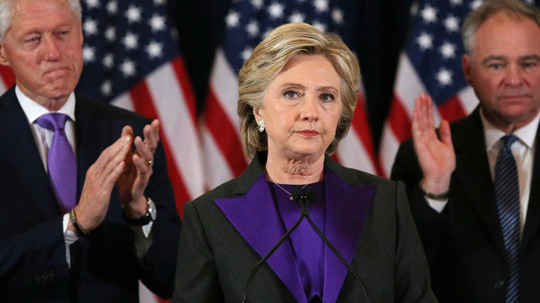
Washington, Nov 13: Hillary Clinton has blamed the FBI for her loss at the hands of her Republican challenger Donald Trump, claiming the decision to revive the probe into her email accounts stopped her momentum towards a historic win.
stream img

"There are lots of reasons why an election like this is not successful. Our analysis is that Comey's letter raising doubts that were groundless, baseless, proven to be, stopped our momentum," Clinton told fundraisers and donors during a conference call yesterday.

Clinton said her campaign was winning until FBI Director James Comey wrote a letter to the Congressional leadership that they have reopened the investigations into the email scandal.

Two days before the elections, the FBI again sent a letter to the Congressional leadership that it did not find anything new in the investigation that was primarily screening of some 650,000 emails that it found in a laptop of one of her aide, Huma Abedin, which she shared with her estranged husband, Anthony Weiner.

"The second letter, even that gave her the clean chit, hit her more as this energised Trump's supporters. Although she got more popular votes, Trump was declared the winner as he grabbed more than 270 electoral college votes, required to win the presidential elections," said the 69-year-old former Secretary of State.

"We dropped, and we had to keep really pushing to regain our advantage, which going into last weekend we had," she said.

"We were once again up in all but two of the battleground states, and we were up considerably in some that we ended up losing. And we were feeling like we had to put it back together," Clinton said.

In an internal campaign memo, Clinton's campaign manager Robby Mook claimed that the former Secretary of State was poised to win the elections, but the two letters from FBI changed the scenario.

"There is no question that a week before the Election Day, Secretary Clinton was poised for a historic win. In the end, less than 110K votes out of tens of millions cast on Election Day made the difference in the race," Mook said.

He also appeared to blame the third party candidate. "It is worth mentioning that Jill Stein alone got 130K votes in those States – and though her votes don't distribute perfectly to cover the margin across the three States, it is an important reminder of 3rd party votes," he said.

"We believe that we lost this election in the last week. Comey's letter in the last 11 days of the election both helped depress our turnout and drove away some of our critical support among college-educated white voters – particularly in the suburbs.

"We also think Comey's second letter, which was intended to absolve Secretary Clinton actually helped to bolster Trump's turnout," Mook added.

Comments

Add new comment

  • Coastaldigest.com reserves the right to delete or block any comments.
  • Coastaldigset.com is not responsible for its readers’ comments.
  • Comments that are abusive, incendiary or irrelevant are strictly prohibited.
  • Please use a genuine email ID and provide your name to avoid reject.
Agencies
June 6,2020

Seoul, Jun 6: South Korea on Saturday reported 51 new cases of COVID-19, mostly in the densely populated capital region, as authorities scramble to stem transmissions among low-income workers who can't afford to stay home.

The figures announced by South Korea's Centers for Disease Control and Prevention brought national totals to 11,719 workers and 273 deaths.

At least 34 of the new coronavirus cases were linked to door-to-door sellers hired by Richway, a Seoul-based health product provider.

Vice Health Minister Kim Gang-lip said the spread of the virus among Richway sellers was particularly alarming as most of them are in their 60s and 70s. He called for officials to strengthen their efforts to find and examine workplaces vulnerable to infections.

More than 120 infections have also been linked to a massive warehouse operated by Coupang, a local e-commerce giant, which has been accused of failing to properly implement preventive measures and having employees work even when sick.

South Korea was reporting around 500 new cases per day in early March due to a massive outbreak surrounding the southern city of Daegu, before officials managed to stabilize the situation with aggressive tracking and testing.

But the recent resurgence of COVID-19 in the greater capital area, where about half of South Korea's 51 million people live, is now threatening to erase some of the country's hard-won gains. It has also led to second-guessing whether officials were too quick to ease social distancing and reopen schools.

Health authorities and hospital officials on Friday participated in a table-top exercise for sharing hospital capacities between Seoul and nearby cities and ensure swift transports of patients so that a spike of cases in one area doesn't overwhelm its hospital system. 

Comments

Add new comment

  • Coastaldigest.com reserves the right to delete or block any comments.
  • Coastaldigset.com is not responsible for its readers’ comments.
  • Comments that are abusive, incendiary or irrelevant are strictly prohibited.
  • Please use a genuine email ID and provide your name to avoid reject.
News Network
April 13,2020

Manila, Apr 13: The Asian Development Bank (ADB) on Monday tripled the size of its response to novel coronavirus disease (COVID-19) pandemic to 20 billion dollars and approved measures to streamline its operations for quicker and more flexible delivery of assistance.

The package expands ADB's 6.5 billion dollars initial response announced on March 18, adding 13.5 billion dollars in resources to help ADB's developing member countries counter the severe macroeconomic and health impacts caused by COVID-19.

The 20 billion dollar package includes about 2.5 billion dollars in concessional and grant resources.

"This pandemic threatens to severely set back economic, social, and development gains in Asia and the Pacific, reverse progress on poverty reduction and throw economies into recession," said ADB President Masatsugu Asakawa.

"Our expanded and comprehensive package of assistance, made possible with the strong support of our board, will be delivered more quickly, flexibly and forcefully to the governments and the private sector in our developing member countries to help them address the urgent challenges in tackling the pandemic and economic downturn," he said in a statement.

ADB's most recent assessment released on April 3 estimates the global impact of the pandemic at between 2.3 and 4.8 per cent of gross domestic product. Regional growth is forecast to decline from 5.2 per cent last year to 2.2 per cent in 2020.

The new package includes the establishment of a COVID-19 pandemic response option under ADB's countercyclical support facility.

Up to 13 billion dollars will be provided through this new option to help governments of developing member countries implement effective countercyclical expenditure programs to mitigate impacts of the COVID-19 pandemic, with a particular focus on the poor and the vulnerable.

Grant resources will continue to be deployed quickly for providing medical and personal protective equipment and supplies from expanded procurement sources.

Some 2 billion dollars from the 20 billion dollar package will be made available for the private sector. Loans and guarantees will be provided to financial institutions to rejuvenate trade and supply chains.

Enhanced microfinance loan and guarantee support and a facility to help liquidity-starved small and medium-sized enterprises, including those run by female entrepreneurs, will be implemented alongside direct financing of companies responding to or impacted by COVID-19.

The response package includes a number of adjustments to policies and business processes that will allow ADB to respond more rapidly and flexibly to the crisis. These include measures to streamline internal business processes, widen the eligibility and scope of various support facilities and make the terms and conditions of lending more tailored.

All support under the expanded package will be provided in close collaboration with international organisations, including the International Monetary Fund, World Bank Group, World Health Organisation, UNICEF, other UN agencies and the broader global community.

Comments

Add new comment

  • Coastaldigest.com reserves the right to delete or block any comments.
  • Coastaldigset.com is not responsible for its readers’ comments.
  • Comments that are abusive, incendiary or irrelevant are strictly prohibited.
  • Please use a genuine email ID and provide your name to avoid reject.
News Network
March 21,2020

United Nations, Mar 21: The UN has called on all nations to stop the use of capital punishment or put a moratorium on it, a day after four men convicted of gang-raping and murdering a 23-year-old woman were hanged in India.

Seven years after the rape and murder of the young medical student, who came to be known as 'Nirbhaya', sent shock waves across the country, the four convicts - Mukesh Singh (32), Pawan Gupta (25), Vinay Sharma (26) and Akshay Kumar Singh (31) - were hanged to death on Friday at 5.30 am in New Delhi's Tihar Jail.

Responding to the hanging, UN Secretary-General Antonio Guterres' spokesperson Stephane Dujarric said the world organisation calls on all nations to stop the use of capital punishment or put a moratorium on it.

"Our position has been clear, is that we call on all States to halt the use of capital punishment or at least put a moratorium on this," Dujarric said at the daily press briefing on Friday.

The horrific gang-rape and murder of the physiotherapy intern on December 16, 2012, who came to be known as Nirbhaya, the fearless, had seared the nation's soul and triggered countrywide outrage.

This was the first time that four men have been hanged together in Tihar Jail, South Asia's largest prison complex that houses more than 16,000 inmates.

The executions were carried out after the men exhausted every possible legal avenue to escape the gallows. Their desperate attempts only postponed the inevitable by less than two months after the first date of execution was set for January 22.

The execution of the four convicts brings the curtains down on the case that shook not just India but also the world with the details of its brutality The widespread protests subsequently paved the way for a change in India's rape laws.

Comments

Add new comment

  • Coastaldigest.com reserves the right to delete or block any comments.
  • Coastaldigset.com is not responsible for its readers’ comments.
  • Comments that are abusive, incendiary or irrelevant are strictly prohibited.
  • Please use a genuine email ID and provide your name to avoid reject.