



Hindi Signboards on Bengaluru Metro Lead to Protest

News Network
June 22, 2017

Bengaluru, Jun 22: The use of Hindi in sign-boards of Bengaluru's Metro rail has sparked off strong protests by pro-Kannada campaigners, who have urged the State government to do away with the three-language policy and stick to two languages.kannada
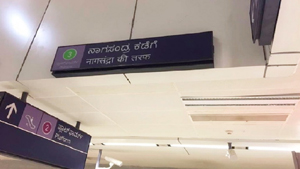
The protests – mostly an online/ social media campaign under the hashtag #NammaMetroHindiBeda – have begun after the inauguration last week of the full phase 1 of the Metro rail, with the north-south corridor being made operational last Saturday.

The social media activism soon drew over 10 lakh responses from across the city and the State, with many weighing in on what they felt was an imposition of Hindi in a local commuter transit system.

"For Kannadigas, there is Kannada signage. For others (migrants), it is in English. There are other community language people here too – like Telugu, Tamil and Malayalam speakers who are greater in number than Hindi-speakers. Why should Hindi be given special status? We are against that," said Arun Javagal, one of the campaigners.

Reiterating that this is not an anti-Hindi protest – in that, the campaigners are neither against the Hindi language nor against Hindi-speakers – the campaigners said they questioned the special treatment being meted by Metro officials to Hindi specifically.

"When we go to north Indian cities, we make the effort to learn Hindi. If there are migrants from other States who come to Karnataka, a large number of them have tried to assimilate here by learning the language. We welcome that. But the small chance that there is, that new migrants will make any effort to learn Kannada, will diminish if the convenience of Hindi is there," said Vallish Kumar, another activist.

Metro officials refused to comment on the language debate, saying this is only an option offered to commuters – nowhere is Kannada neglected. Besides, if Hindi boards are to be shunned, should Hindi films also be banned, they asked, on condition of anonymity.

But Kumar argued that the campaigners have nothing against private initiatives or institutions – only state government institutions that seem to willingly include Hindi where it is not mandated.

"Many Central government services that were earlier in Hindi, English and local languages are not available in the local Kannada language now. This could be postal services, railway tickets, bank documents like cheque books. Why has this slowly crept in? In the case of the Metro, neither the State government nor the Centre has insisted on Hindi signages – but this was a policy adapted by the Bangalore Metro Rail Corporation Board members many years back," Kumar said.

Karnataka is the second southern state seeing a backlash against what they see as forced Hindi imposition in services, after Tamil Nadu that saw protests by many, including political parties, against Hindi sign-boards along highways.

Asked whether this is not language chauvinism that hits at the cosmopolitan nature of a city like Bengaluru, the campaigners said their campaign is only about a local commuter service restricted to a city – not the railways or the airport which are Central government institutions.

"There is fear that, over a period of time, languages would be extinct because very few use them – we have seen this Hindi hegemony bring down the extent of usage of languages like Bhojpuri or Maithili or Santhali," said Javagal.

The campaign drew support from the State government and Opposition MLAs – with Congress spokesperson Dinesh Gundu Rao saying he is against the overuse of Hindi.

"I think Kannada should be given priority and Karnataka will give priority to Kannada. I think people should also learn Kannada. In that sense, I don't see why people need Hindi on signages. If people want to learn and read Hindi, that is up to them. But in signages and hoardings, it isn’t required, we need to look at this seriously," said Rao.

Transport Minister Ramalinga Reddy said he would hold consultations with Metro officials on what prompted this move.

"Bengaluru is a cosmopolitan city; Hindi, English and Kannada are used. Kannada is compulsory and English should be used, but the Centre cannot force Hindi on people. We will talk to the concerned officials about this," Reddy said.

Comments

Add new comment

  • Coastaldigest.com reserves the right to delete or block any comments.
  • Coastaldigset.com is not responsible for its readers’ comments.
  • Comments that are abusive, incendiary or irrelevant are strictly prohibited.
  • Please use a genuine email ID and provide your name to avoid reject.
News Network
February 22,2020

Bengaluru, Feb 22: The Hindu Mahasabha has decided to carry out a 'cleaning ceremony' by using 'gau-mutra' (cow urine) to purify Freedom Park, where pro-Pakistan slogans were shouted as a protest against the CAA, NRC and NRP.

On Thursday, an 18-year-old girl Amulya Leona hadraised slogans of 'Pakistan Zindabad,' after the organisers of the event under the banner of 'Save Constitution' invited her to address the gathering. AIMIM chief Asaduddin Owaisi soon rushed and tried to snatch away mic from her hand.

Amulya, who was arrested by the police soon after the event on charges of Sedition, was remanded to 14-day judicial custody.

Associates of Amulya insisted that she was trying to make a point that nobody in the anti-CAA rallies would hail a ‘long Live Pakistan’ slogan while they would do so for a ‘Long Live Hindustan’ chant.

“She is not dumb. She knew exactly what she was saying. She had a clear narrative in mind, but was interrupted before she could complete it. Her half-comments are now being taken out of context,” said Sujnan, another student-activist. 

“In the end, the campaign is not involved with whatever she said or intended to say. It falls on her to explain herself,” said a protest organiser.

Comments

Add new comment

  • Coastaldigest.com reserves the right to delete or block any comments.
  • Coastaldigset.com is not responsible for its readers’ comments.
  • Comments that are abusive, incendiary or irrelevant are strictly prohibited.
  • Please use a genuine email ID and provide your name to avoid reject.
News Network
February 3,2020

Bengaluru, Feb 3: A wave of dissatisfaction has hit the six-month-old BJP government against the backdrop of chief minister B S Yediyurappa's announcement to induct 13 aspirants in the second cabinet expansion on February 6.

In the first cabinet expansion, the chief minister had inducted 17 ministers on August 20, 2019.

Among the 13, ten will be those defectors from Congress and the JD(S) who were disqualified earlier and won the assembly by-election in December last year.

The rest will be the 'native BJP leaders', as deputy chief minister Govind Karjol put it.

Speculations are rife that Mahadevapura MLA Arvind Limbavali, Hukkeri MLA Umesh Katti and C P Yogeshwar, who had lost to H D Kumaraswamy from Channapatna assembly segment,would be inducted.

If Yogeshwar is included in the cabinet then he will bethe second minister after Deputy chief minister Laxman Savadi who had lost and yet made it to the cabinet.

The possible induction of Yogeshwar and Savadi, who was made deputy chief minister despite losing the assembly elections, are also a "reason" for discontent in the BJP.

Hectic activities began in the power corridor and MLAs started forming groups to impress upon the chief minister to include their members in the ministry.

While one group was from the "Kalyana Karnataka" region, the others were the defectors who will be excluded in the cabinet expansion.

A few MLAS from 'Kalyana Karnataka' region or erstwhile Hyderabad-Karnataka region comprising six districts, met at the Legislature Home and held a meeting.

The meeting was led by Shorapur MLA Narasimha Nayak akaRaju Gouda and Honnalli MLA M P Renukacharya.
The MLAs of the Kalyana Karnataka region were unanimous that their backward region should get representation in the cabinet.

Later, Gouda met the Chief Minister and requested that their region be given adequate representation in the cabinet, which is lacking development.

Talking to reporters, Gouda said, "We had given representations to all the MPs, MLAs and the chief minister. Today also we all had a meeting and later called on the Chief Minister requesting him to make any MLA from our region a minister."

He said any imbalance in cabinet expansion will cause trouble to the MLAs from Kalyana Karnataka region.

"If you make the defeated candidates ministers then include 120 people in the cabinet," an aggrieved Gouda taunted.

Renukacharya too echoed the same sentiments.

"If you give preference to the defeated candidates then what will happen to those who won the election? Where should the winners of election go? We emphasise upon giving preference to the winners."

On the other hand, the defectors who jumped the Congress and the JD(S) ship and helped form the BJP government too had a meeting in Bengaluru, said BJP sources.

They were unanimous that not only the 11 MLAs who won theelection be made ministers but also A H Vishwanath and M T BNagaraj who had unsuccessfully contested the assembly by- polls from Hunasuru and Hoskote on a BJP ticket.

Vishwanath, who was quite vocal on Sunday for dropping his name, was mellowed down on Monday after meeting Yediyurappa.

However, his insistence for getting a cabinet berth remained intact.

"I did not make any proposal before him and will not do it in future because he (Yediyurappa) knows what has to be done,"Vishwanath told reporters after meeting the chief minister.

When he was reminded of Yediyurappa's statement that therewere legal complications in making him a minister, Vishwanath said, "This government has legal experts and the advocate general. They will speak."

Amid speculations that Athani MLA Mahesh Kumathalli may not get a cabinet berth in the reshuffle, the defected MLAs led by Gokak BJP MLA Ramesh Jarkiholi, had a meeting to decide their future strategy, said party sources.

Currently, there are 18 ministers, including the chief minister, in the cabinet, which has a sanctioned strength of 34. Sixteen berths are vacant.

The cabinet expansion exercise will be a delicate task for Yediyurappa as he has to ensure adequate representation for various castes and regions.

The ministry already has eight Lingayats, including Yediyurappa; three Vokkaligas; a Brahmin; three SCs, two OBCs and one ST.

Opposition parties have been critical of the BJP and Yediyurappa over the delay in the cabinet expansion, alleging he is weak and his administration has collapsed.

Reacting to the cabinet expansion, former chief minister Siddaramaiah quipped, "A drama is taking place. Let it happen on February 6. Afterwards we will see what all happens."

Comments

Add new comment

  • Coastaldigest.com reserves the right to delete or block any comments.
  • Coastaldigset.com is not responsible for its readers’ comments.
  • Comments that are abusive, incendiary or irrelevant are strictly prohibited.
  • Please use a genuine email ID and provide your name to avoid reject.
News Network
June 20,2020

Bengaluru, Jun 20: The Karnataka Health Department has issued guidelines on the admission of COVID-19 patients in private hospitals after clinical assessment, mandating that the district surveillance officer (DSO) should be first informed to initiate further procedures, an official said on Friday.

"A health team sent by the DSO should visit the home or hospital where the patient is staying. The team should conduct a rapid assessment of his or her health condition," said Karnataka's Additional Chief Secretary Jawaid Akhtar.

In the rapid health condition assessment, the team should first check the patient's body temperature, followed by SpO2 (oxygen saturation) level and confirm if there are any comorbidities such as hypertension, diabetes, tuberculosis, HIV, cancer, stroke etc.

Depending on the health condition of patients, Akhtar said, two categories have been made.

"Those who have body temperature greater than 37.5 degrees Celsius, SpO2 level below 94 percent, elderly (above 60 years) and suffering from known comorbid conditions should be taken to a dedicated Covid hospital (DCH)," he said.

"All other patients, even if older but not suffering from co-morbidities, those below 60 and suffering from co-morbidities and asymptomatic cases should be taken to a dedicated Covid health centre (DCHC) or a private hospital as opted by the patient," he added.

Private hospitals have been asked to pitch in due to the rising number of cases in Karnataka. Currently, there are 2943 active cases in the state after 337 cases were reported on Friday.

"The patients are assessed clinically and evaluated at DCHCs or private hospitals with appropriate diagnostic tests. After evaluation, if the patients are asymptomatic, they are shifted to a COVID Care Centre (CCC) for further management," said Akhtar.

CCCs are expected to be equipped with ventilated rooms, pulse oximeters, handheld thermal scanners and blood pressure apparatus.

A nurse has to be present round the clock for every 50 patients and should visit each patient twice a day for assessment whereas the medical officer has to visit the CCC once a day. He should also be available on call in case of an emergency.

Staff serving food and others should wear personal protective equipment and an N-95 mask. Explaining the procedures at DCHCs, Akhtar said general examinations for medical conditions like body temperature, BP, pulse, oxygen saturation and urine output should be in place.

Investigations such as complete blood count, fasting blood sugar, random blood sugar, liver function tests, renal function tests, ECG and chest X-ray facilities should be available.

"DCHCs should ensure that above examinations are over in an orderly timeline of 24 hours and depending on the examination, the patient is continued to be lodged at the DCHC or sent to DCH or CCC," said the senior officer.

Likewise, the discharge policy should be done as per the protocols issued by the Health Department from time to time.

The Karnataka government is yet to fix an upper limit on the cost of treating COVID-19 patients in private hospitals. While reports indicated that this could be capped at Rs 5200 per day, health officials are yet to specify this is the case. Private hospitals in the state have asked the government to take a collaborative approach in deciding the fixed cap on treatment cost.

Comments

Add new comment

  • Coastaldigest.com reserves the right to delete or block any comments.
  • Coastaldigset.com is not responsible for its readers’ comments.
  • Comments that are abusive, incendiary or irrelevant are strictly prohibited.
  • Please use a genuine email ID and provide your name to avoid reject.