


Hindi Signboards on Bengaluru Metro Lead to Protest

News Network
June 22, 2017

Bengaluru, Jun 22: The use of Hindi in sign-boards of Bengaluru's Metro rail has sparked off strong protests by pro-Kannada campaigners, who have urged the State government to do away with the three-language policy and stick to two languages.kannada
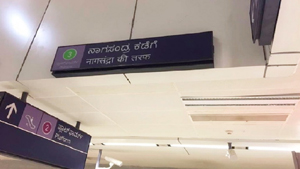
The protests – mostly an online/ social media campaign under the hashtag #NammaMetroHindiBeda – have begun after the inauguration last week of the full phase 1 of the Metro rail, with the north-south corridor being made operational last Saturday.

The social media activism soon drew over 10 lakh responses from across the city and the State, with many weighing in on what they felt was an imposition of Hindi in a local commuter transit system.

"For Kannadigas, there is Kannada signage. For others (migrants), it is in English. There are other community language people here too – like Telugu, Tamil and Malayalam speakers who are greater in number than Hindi-speakers. Why should Hindi be given special status? We are against that," said Arun Javagal, one of the campaigners.

Reiterating that this is not an anti-Hindi protest – in that, the campaigners are neither against the Hindi language nor against Hindi-speakers – the campaigners said they questioned the special treatment being meted by Metro officials to Hindi specifically.

"When we go to north Indian cities, we make the effort to learn Hindi. If there are migrants from other States who come to Karnataka, a large number of them have tried to assimilate here by learning the language. We welcome that. But the small chance that there is, that new migrants will make any effort to learn Kannada, will diminish if the convenience of Hindi is there," said Vallish Kumar, another activist.

Metro officials refused to comment on the language debate, saying this is only an option offered to commuters – nowhere is Kannada neglected. Besides, if Hindi boards are to be shunned, should Hindi films also be banned, they asked, on condition of anonymity.

But Kumar argued that the campaigners have nothing against private initiatives or institutions – only state government institutions that seem to willingly include Hindi where it is not mandated.

"Many Central government services that were earlier in Hindi, English and local languages are not available in the local Kannada language now. This could be postal services, railway tickets, bank documents like cheque books. Why has this slowly crept in? In the case of the Metro, neither the State government nor the Centre has insisted on Hindi signages – but this was a policy adapted by the Bangalore Metro Rail Corporation Board members many years back," Kumar said.

Karnataka is the second southern state seeing a backlash against what they see as forced Hindi imposition in services, after Tamil Nadu that saw protests by many, including political parties, against Hindi sign-boards along highways.

Asked whether this is not language chauvinism that hits at the cosmopolitan nature of a city like Bengaluru, the campaigners said their campaign is only about a local commuter service restricted to a city – not the railways or the airport which are Central government institutions.

"There is fear that, over a period of time, languages would be extinct because very few use them – we have seen this Hindi hegemony bring down the extent of usage of languages like Bhojpuri or Maithili or Santhali," said Javagal.

The campaign drew support from the State government and Opposition MLAs – with Congress spokesperson Dinesh Gundu Rao saying he is against the overuse of Hindi.

"I think Kannada should be given priority and Karnataka will give priority to Kannada. I think people should also learn Kannada. In that sense, I don't see why people need Hindi on signages. If people want to learn and read Hindi, that is up to them. But in signages and hoardings, it isn’t required, we need to look at this seriously," said Rao.

Transport Minister Ramalinga Reddy said he would hold consultations with Metro officials on what prompted this move.

"Bengaluru is a cosmopolitan city; Hindi, English and Kannada are used. Kannada is compulsory and English should be used, but the Centre cannot force Hindi on people. We will talk to the concerned officials about this," Reddy said.

Comments

Add new comment

  • Coastaldigest.com reserves the right to delete or block any comments.
  • Coastaldigset.com is not responsible for its readers’ comments.
  • Comments that are abusive, incendiary or irrelevant are strictly prohibited.
  • Please use a genuine email ID and provide your name to avoid reject.
News Network
February 21,2020

Chikkamgaluru, Feb 21: Wazi Noronha, aka, Vojald, the father of Amulya Leona Noronha, who lives in Koppa taluk of Chickmagalur district has said that he was shocked by his daughter’s pro-Pakistan slogans.

“Let her rot in jail. I don’t mind if police break her bones, I don’t support what she said and I will not approach lawyers for her bail. She has committed a grave mistake,” he said.

Amulya, a 19-year-old student activist, was booked for sedition yesterday after she raised ‘Long Live Pakistan’ slogans at a CAA-NRC rally. A visibly embarrassed Asaduddin Owaisi, AIMIM chief and MP tried to snatch the mic away from her and slammed her. Karnataka Police have registered a case under IPC Section 124A (Offence of sedition) against Amulya.

Mr. Wazi, who owns a two-acre areca plantation and runs a poultry farm, said he would not make any attempts to get her bail. “Let the law take its course. I cannot approve of her statement,” he said.

He said he had cautioned his daughter against getting involved in protests. “I told her to complete studies first and later she could fight for poor people. But what she said yesterday is not acceptable. I don’t know what made her so. I hope a probe would bring out who prompted her to make such statements,” he said.

Mr. Wazi also admitted that he was associated with BJP and had worked for saffronite leaders like Shobha Karandlaje and D N Jeevaraj.

Comments

Add new comment

  • Coastaldigest.com reserves the right to delete or block any comments.
  • Coastaldigset.com is not responsible for its readers’ comments.
  • Comments that are abusive, incendiary or irrelevant are strictly prohibited.
  • Please use a genuine email ID and provide your name to avoid reject.
News Network
May 3,2020

Bengaluru, May 3: The Excise Commissioner of Karnataka has issued an order granting permission to distilleries, breweries and wineries situated outside the containment zones to begin production activity. The permission has been granted on the condition that they strictly comply with COVID-19 related guidelines issued by the Ministry of Home Affairs.

"In view of the state government order and the new guidelines issued by the MHA, permission is granted to distilleries, breweries and wineries situated in rural areas and industrial estates and industrial townships with access control (outside containment zones) to commence only production activity," the Excise Commissioner said in the order.

The Excise Commissioner further said in the order that the Deputy Commissioner of Excise shall ensure that wherever distilleries, breweries and wineries are permitted to carry on production activities, they shall strictly comply with COVID-19 related guidelines issued by the MHA.

Comments

Add new comment

  • Coastaldigest.com reserves the right to delete or block any comments.
  • Coastaldigset.com is not responsible for its readers’ comments.
  • Comments that are abusive, incendiary or irrelevant are strictly prohibited.
  • Please use a genuine email ID and provide your name to avoid reject.
News Network
April 22,2020

Bengaluru, Apr 22: The Karnataka government has announced partial relaxation of COVID-19 lockdown norms in the state allowing certain construction activities, manufacturing of packaging materials, courier services, among others, from April 23.

The activities will be permitted only outside the COVID-19 containment zones identified by the government.

Service provided by self-employed people like electrician, IT repair, plumbers, motor mechanics, and carpenters in local areas have also been given exemption.

Tea, coffee and rubber plantation have been allowed to work with 50 per cent workforce, and a similar exemption have been given to processing, packaging, sale and marketing of these produce.

“To mitigate hardship to the public, select additional activities have been allowed,which will come into effect from 00.00 hours of April 23,” Chief Secretary TM Vijay Bhaskar said in an order on Wednesday.

However, these additional activities will be operationalised by District Administrations and BBMP (city corporation in the case of Bengaluru city) based on strict compliance to the guidelines on lockdown measures, it said.

Before operating these relaxations, district administrations and BBMP (city corporation) shall ensure that all the preparatory arrangements on social distancing in offices, work place establishments as also sectoral requirements are in place, it said, adding that relaxations will not apply in containment zones.

Facing a financial crunch, the state government has been eager to kick-start economic activities in the state that had come to halt due to the coronavirus lockdown.

While hospitality services, bars, malls, theatres, shopping complexes, religious and places of worship among others will continue to remain shut, relaxation of norms has been for activities that are linked to essential services such as health, infrastructure and agriculture.

As per the order, while, public transportation will continue to remain suspended till May 3,private vehicles with passes for emergency services and personnel commuting with passes to places of work and back will be allowed.

Activities permitted include construction of roads, irrigation projects, buildings and all kinds of industrial projects, including MSMEs, in rural areas and all kinds of projects in industrial estates, where workers are available on site and no one is required to be brought in from outside.

Also permitted to function are manufacturing units of essential goods – drugs, pharmaceuticals, medical devices, their raw materials and intermediates;

food processing industries in rural areas, coal production (mines and mineral production and activities incidental to mining) besides manufacturing units of packaging materials.

Comments

Add new comment

  • Coastaldigest.com reserves the right to delete or block any comments.
  • Coastaldigset.com is not responsible for its readers’ comments.
  • Comments that are abusive, incendiary or irrelevant are strictly prohibited.
  • Please use a genuine email ID and provide your name to avoid reject.