Hindu extremists hurl crude bombs at Chennai media house

March 12, 2015

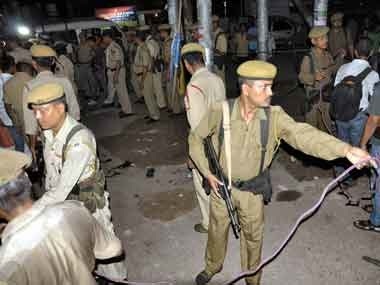
Chennai, Mar 12: Four alleged Hindutva extremists hurled two crude bombs packed in tiffin boxes at the office of a Tamil TV news channel Puthiya Thalaimurai in Chennai at around 3 am on Wednesday, according to reports.

The entire incident was caught on CCTV camera, according to Zee News. The footage showed four men on two bikes hurling two bombs at the office. No one was injured in the attack, said the report.

police

According to PTI, A Hindu Ilaignar Sena worker has taken responsibility for the attack and has surrendered to the police.

Firstpost contacted the CEO of New Generation Media Corporation (Puthiyathalaimurai Group) RBU Shyam Kumar who said that around 3.15 am four men on two bikes went by the office and almost three minutes later came back to hurl the boxes in the office premise.

"Earlier, there have been protests against media houses in Chennai but this is the first time that a group attacked a media house," Kumar told Firstpost.

Kumar said that on Women's Day, the channel planned to air a show on the relevance of the 'thali' or the 'mangalsutra' which was criticised by the Hindu Munani groups. "It was a debate show and we were discussing the relevance of the 'thali'. With more and more women opting not to wear it, we thought it was a good topic to debate on Women's Day," Kumar added.

According to Kumar, last Sunday, a mob attacked a cameraperson and another staff from the TV channel right outside the office. The mob was approaching the office to stage a protest against the show. Kumar said the protests were staged by Hindu Munani groups. Police had arrested ten people, Kumar added.

The broadcast of the debate show has been put on hold for now, an NDTV report said.

With channels and experts debating over curbs on free speech in India, this could set a bad precedence, Kumar said. "The attack was of low intensity but the intent behind the attack was bigger than it seems and we condemn it. If this is what the state of media is in India then we should be worried," he added.

Comments

Mario
 - 
Saturday, 20 Feb 2016

Howdy I am so exciited I found your site, I really found you by accident, while I was briwsing on Aol for something else, Nonethekess I am here now and
wluld just like to say kudos for a incredible post and a alll round exciting blog
(I also love the theme/design), I don’t have time to look over it all at the minute but I have bookmarked it and also added in your RSS feeds, so when I have time I wwill be back to read much more, Please
do keep up thhe superb jo.

my site;Based
Businesses: http://www.cablenelson.com/__media__/js/netsoltrademark.php?d=www.esehi…

Add new comment

  • Coastaldigest.com reserves the right to delete or block any comments.
  • Coastaldigset.com is not responsible for its readers’ comments.
  • Comments that are abusive, incendiary or irrelevant are strictly prohibited.
  • Please use a genuine email ID and provide your name to avoid reject.
News Network
May 20,2020

Bengaluru, May 20: Karnataka Congress leaders held a protest against the state government against amending of APMC Act, at the premises of Vidhan Soudha here.

Few days ago, Karnataka Chief Minister BS Yediyurappa had said that the new amendment in the Agricultural Produce Marketing Committee (APMC) Act will substantially aid the farmers in getting remunerative price for their produce.

"Amendment will not dilute the powers of the work of the APMCs. All these marketing activities will be monitored by the Directorate of State APMC. This new amendment Act will benefit farmers in improving their income & suffering from losses due to market fluctuations," the Karnataka CM tweeted.

Yediyurappa further said that the amendment will indirectly help farmers in doubling their income by 2022.

"This amendment will indirectly help farmers in doubling their income by 2022. I want to clarify that we have not removed the APMC Act, we are only amending 2 sections of the APMC Act which enable farmers to sell their produce at the markets where they intend to," he tweeted.

Comments

Add new comment

  • Coastaldigest.com reserves the right to delete or block any comments.
  • Coastaldigset.com is not responsible for its readers’ comments.
  • Comments that are abusive, incendiary or irrelevant are strictly prohibited.
  • Please use a genuine email ID and provide your name to avoid reject.
Ram Puniyani
January 14,2020

In the beginning of January 2020 two very disturbing events were reported from Pakistan. One was the attack on Nankana Sahib, the holy shrine where Sant Guru Nanak was born. While one report said that the place has been desecrated, the other stated that it was a fight between two Muslim groups. Prime Minister of Pakistan Imran Khan condemned the incident and the main accused Imran Chisti was arrested. The matter related to abduction and conversion of a Sikh girl Jagjit Kaur, daughter of Pathi (One who reads Holy Guru Granth Sahib in Gurudwara) of the Gurudwara. In another incident one Sikh youth Ravinder Singh, who was out on shopping for his marriage, was shot dead in Peshawar.

While these condemnable attacks took place on the Sikh minority in Pakistan, BJP was quick enough to jump to state that it is events like this which justify the Citizenship Amendment Act (CAA). Incidentally CAA is the Act which is discriminatory and relates to citizenship with Religion, which is not as per the norms of Indian constitution. There are constant debates and propaganda that population of Hindus has come down drastically in Pakistan and Bangla Desh. Amit Shah, the Home minister stated that in Pakistan the population of Hindus has come down from 23% at the time of partition to 3.7% at present. And in Bangla Desh it has come down from 22% to present 8%.

While not denying the fact that the religious minorities are getting a rough deal in both these countries, the figures which are presented are totally off the mark. These figures don’t take into consideration the painful migrations, which took place at the time of partition and formation of Bangla Desh later. Pakistan census figures tell a different tale. Their first census was held in 1951. As per this census the overall percentage of Non Muslim in Pakistan (East and West together) was 14.2%, of this in West Pakistan (Now Pakistan) it was 3.44 and in Eat Pakistan it was 23.2. In the census held in Pakistan 1998 it became 3.72%. As far as Bangla Desh is concerned the share of Non Muslims has gone down from 23.2 (1951) to 9.6% in 2011.

The largest minority of Pakistan is Ahmadis, (https://minorityrights.org/country/pakistan/) who are close to 4 Million and are not recognised as Muslims in Pakistan. In Bangla Desh the major migrations of Hindus from Bangla Desh took place in the backdrop of Pakistan army’s atrocities in the then East Pakistan.

As far as UN data on refugees in India it went up by 17% between 2016-2019 and largest numbers were from Tibet and Sri Lanka.  (https://www.un.org/en/development/desa/population/migration/publication…)

The state of minorities is in a way the index of strength of democracy. Most South Asian Countries have not been able to sustain democratic values properly. In Pakistan, the Republic began with Jinnah’s classic speech where secularism was to be central credo of Pakistan. This 11th August speech was in a way what the state policy should be, as per which people of all faiths are free to practice their religion. Soon enough the logic of ‘Two Nation theory” and formation of Pakistan, a separate state for Muslim took over. Army stepped in and dictatorship was to reign there intermittently. Democratic elements were suppressed and the worst came when Zia Ul Haq Islamized the state in collusion with Maulanas. The army was already a strong presence in Pakistan. The popular formulation for Pakistan was that it is ruled by three A’s, Army, America and Allah (Mullah).

Bangla Desh had a different trajectory. Its very formation was a nail in the coffin of ‘two nation theory’; that religion can be the basis of a state. Bangla Desh did begin as a secular republic but communal forces and secular forces kept struggling for their dominance and in 1988 it also became Islamic republic. At another level Myanmar, in the grip of military dictatorship, with democratic elements trying to retain their presence is also seeing a hard battle. Democracy or not, the army and Sanghas (Buddhist Sang has) are strong, in Myanmar as well. The most visible result is persecution of Rohingya Muslims.

Similar phenomenon is dominating in Sri Lanka also where Budhhist Sanghas and army have strong say in the political affairs, irrespective of which Government is ruling. Muslim and Christian minorities are a big victim there, while Tamils (Hindus, Christians etc.) suffered the biggest damage as ethnic and religious minorities. India had the best prospect of democracy, pluralism and secularism flourishing here. The secular constitution, the outcome of India’s freedom struggle, the leadership of Gandhi and Nehru did ensure the rooting of democracy and secularism in a strong way.

India so far had best democratic credentials amongst all the south Asian countries. Despite that though the population of minorities rose mainly due to poverty and illiteracy, their overall marginalisation was order of the day, it went on worsening with the rise of communal forces, with communal forces resorting to identity issues, and indulging in propaganda against minorities.

While other South Asian countries should had followed India to focus more on infrastructure and political culture of liberalism, today India is following the footsteps of Pakistan. The retrograde march of India is most visible in the issues which have dominated the political space during last few years. Issues like Ram Temple, Ghar Wapasi, Love Jihad, Beef-Cow are now finding their peak in CAA.

India’s reversal towards a polity with religion’s identity dominating the political scene was nicely presented by the late Pakistani poetess Fahmida Riaz in her poem, Tum bhi Hum Jaise Nikle (You also turned out to be like us). While trying to resist communal forces has been an arduous task, it is becoming more difficult by the day. This phenomenon has been variously called, Fundamentalism, Communalism or religious nationalism among others. Surely it has nothing to do with the religion as practiced by the great Saint and Sufi traditions of India; it resorts mainly to political mobilization by using religion as a tool.


Comments

Ashi
 - 
Tuesday, 14 Jan 2020

If Malaysia implement similar NRC/CAA, India and China are the loser.

Add new comment

  • Coastaldigest.com reserves the right to delete or block any comments.
  • Coastaldigset.com is not responsible for its readers’ comments.
  • Comments that are abusive, incendiary or irrelevant are strictly prohibited.
  • Please use a genuine email ID and provide your name to avoid reject.
News Network
August 4,2020

Bengaluru, Aug 4: With preparations underway for conducting exams for the final semester/ year students in the state, Karnataka Deputy Chief Minister Dr CN Ashwathnarayan on Monday directed the respective universities to conduct exams for the backlog papers as well.

"In the wake of COVID-19, it has been decided to hold exams only for the students of final semester/year courses. It has come to our notice that some universities have decided against conducting exams for final year students who have a backlog to clear from previous semesters. This is unpardonable," the Deputy Chief Minister said.

"Our intention is to see that the final year students finish their course. In the present situation, conducting only final semester exams won't help. We have to help the students in clearing their backlogs," added Ashwathnarayan, directing all universities to compulsorily conduct these exams.

Meanwhile, Ashwathnarayan thanked the staff and officials of various government departments who were responsible for successfully conducting the CET exams even amidst the difficult situation in the wake of COVID-19 pandemic.

"In all, 1,94,419 students had registered for the CET exams, of which 1,75,428 wrote the exams. The percentage of students who took up the exams this year was equivalent to that of the previous years, in normal times," the DCM informed.

"After we successfully conducted the exams, Arunachal Pradesh is going to conduct the Public Service Commission exams on the lines of how we successfully conducted the exams. Likewise, even our KPSC has said it will conduct the exams. We must appreciate the good work of the Karnataka Examination Authority (KEA), which has set an example for others," Ashwathnarayan said.

The deputy chief minister said that 33 colleges in various districts across the state faced shortage of land and that it is the responsibility of the District Commissioners (DCs) to get the lands sanctioned for all these colleges.
In Bagalkot district alone land has not been sanctioned for six degree colleges, he said.

Reacting to this, Bagalkot DC Captain Rajendra assured to look into the matter as soon as he receives the proposal from department officials.

"Similarly, there is shortage of land for five Diploma colleges and 28 ITI colleges in different parts of the state. The DCs must immediately pay attention to this. Once they get the land, buildings will come up within no time," the Karnataka deputy chief minister said.

Comments

Add new comment

  • Coastaldigest.com reserves the right to delete or block any comments.
  • Coastaldigset.com is not responsible for its readers’ comments.
  • Comments that are abusive, incendiary or irrelevant are strictly prohibited.
  • Please use a genuine email ID and provide your name to avoid reject.