


Hindu extremists hurl crude bombs at Chennai media house

March 12, 2015

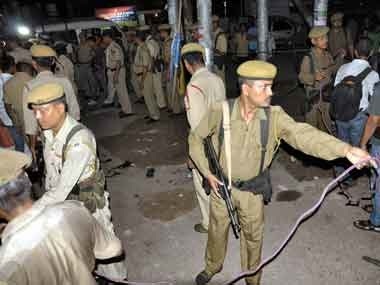
Chennai, Mar 12: Four alleged Hindutva extremists hurled two crude bombs packed in tiffin boxes at the office of a Tamil TV news channel Puthiya Thalaimurai in Chennai at around 3 am on Wednesday, according to reports.

The entire incident was caught on CCTV camera, according to Zee News. The footage showed four men on two bikes hurling two bombs at the office. No one was injured in the attack, said the report.
police

According to PTI, A Hindu Ilaignar Sena worker has taken responsibility for the attack and has surrendered to the police.

Firstpost contacted the CEO of New Generation Media Corporation (Puthiyathalaimurai Group) RBU Shyam Kumar who said that around 3.15 am four men on two bikes went by the office and almost three minutes later came back to hurl the boxes in the office premise.

"Earlier, there have been protests against media houses in Chennai but this is the first time that a group attacked a media house," Kumar told Firstpost.

Kumar said that on Women's Day, the channel planned to air a show on the relevance of the 'thali' or the 'mangalsutra' which was criticised by the Hindu Munani groups. "It was a debate show and we were discussing the relevance of the 'thali'. With more and more women opting not to wear it, we thought it was a good topic to debate on Women's Day," Kumar added.

According to Kumar, last Sunday, a mob attacked a cameraperson and another staff from the TV channel right outside the office. The mob was approaching the office to stage a protest against the show. Kumar said the protests were staged by Hindu Munani groups. Police had arrested ten people, Kumar added.

The broadcast of the debate show has been put on hold for now, an NDTV report said.

With channels and experts debating over curbs on free speech in India, this could set a bad precedence, Kumar said. "The attack was of low intensity but the intent behind the attack was bigger than it seems and we condemn it. If this is what the state of media is in India then we should be worried," he added.

Comments

Mario
 - 
Saturday, 20 Feb 2016

Howdy I am so exciited I found your site, I really found you by accident, while I was briwsing on Aol for something else, Nonethekess I am here now and
wluld just like to say kudos for a incredible post and a alll round exciting blog
(I also love the theme/design), I don’t have time to look over it all at the minute but I have bookmarked it and also added in your RSS feeds, so when I have time I wwill be back to read much more, Please
do keep up thhe superb jo.

my site;Based
Businesses: http://www.cablenelson.com/__media__/js/netsoltrademark.php?d=www.esehi…

Add new comment

  • Coastaldigest.com reserves the right to delete or block any comments.
  • Coastaldigset.com is not responsible for its readers’ comments.
  • Comments that are abusive, incendiary or irrelevant are strictly prohibited.
  • Please use a genuine email ID and provide your name to avoid reject.
News Network
July 6,2020

Jul 6: At least 8 lakh Indians may be forced to leave Kuwait as the country's legal and legislative committee has approved a draft expat quota Bill, reported.

The Bill, which states that Indians should not exceed 15 percent of the population, was determined as constitutional by the National Assembly, local media reported.

It will soon be transferred to the respective committee so that a comprehensive plan is created.

Expats account for 30 lakh of Kuwait's 43 lakh population. Indian community constitutes the largest expat community in Kuwait, totalling 14.5 lakh.

The move comes as the number of Covid-19 cases has spiked in the country, with 49,000 cases being reported so far.

Comments

Add new comment

  • Coastaldigest.com reserves the right to delete or block any comments.
  • Coastaldigset.com is not responsible for its readers’ comments.
  • Comments that are abusive, incendiary or irrelevant are strictly prohibited.
  • Please use a genuine email ID and provide your name to avoid reject.
Agencies
May 8,2020

Washington D.C., May 8: The prime time for brain development in a child's life is the first year, where the infant spends most of the time asleep. It is the time when neural connections form and sensory memories are encoded.

However, when sleep is disrupted, as occurs more often among children with autism, brain development may be affected, too.

New research led by the University of Washington finds that sleep problems in a baby's first 12 months may not only precede an autism diagnosis but also may be associated with altered growth trajectory in a key part of the brain, the hippocampus.

The study, which was published in the American Journal of Psychiatry, researchers report that in a sample of more than 400 taken of 6- to 12-month-old infants, those who were later diagnosed with autism were more likely to have had difficulty falling asleep.

It also states that this sleep difficulty was associated with altered growth trajectories in the hippocampus.

"The hippocampus is critical for learning and memory, and changes in the size of the hippocampus have been associated with poor sleep in adults and older children.

As many as 80 per cent of the children with autism spectrum disorder have sleep problems," said Annette Estes, director of the UW Autism Center and senior author of the study.

"In our clinical experience, parents have a lot of concerns about their children's sleep, and in our work on early autism intervention, we observed that sleep problems were holding children and families back," added Estes, who is also a UW professor of speech and hearing sciences.

"It could be that altered sleep is part-and-parcel of autism for some children. One clue is that behavioural interventions to improve sleep don't work for all children with autism, even when their parents are doing everything just right. This suggests that there may be a biological component to sleep problems for some children with autism," said Estes.

To consider links among sleep, brain development, and autism, researchers at the IBIS Network looked at MRI scans of 432 infants, surveyed parents about sleep patterns, and measured cognitive functioning using a standardized assessment.

At the outset of the study, infants were classified according to their risk for developing autism: Those who were at higher risk of developing autism -- about two-thirds of the study sample -- had an older sibling who had already been diagnosed.

Infant siblings of children with autism have a 20 per cent chance of developing autism spectrum disorder -- a much higher risk than children in the general population.

In the current study, 127 of the 432 infants were identified as "low risk" at the time the MRI scans were taken because they had no family history of autism.

They later evaluated all the participants at 24 months of age to determine whether they had developed autism. Of the roughly 300 children originally considered "high familial risk," 71 were diagnosed with autism spectrum disorder at that age.

Problems with sleep were more common among the infants later diagnosed with an autism spectrum disorder, as were larger hippocampi. No other subcortical brain structures were affected, including the amygdala, which is responsible for certain emotions and aspects of memory, or the thalamus, a signal transmitter from the spinal cord to the cerebral cortex.

The authors note that while parents reported more sleep difficulties among infants who developed autism compared to those who did not, the differences were very subtle and only observed when looking at group averages across hundreds of infants.

Sleep patterns in the first years of life change rapidly as infants transition from sleeping around the clock to a more adult-like sleep/wake cycle. Until further research is completed, Estes said, it is not possible to interpret challenges with sleep as an early sign of increased risk for autism.

Comments

Add new comment

  • Coastaldigest.com reserves the right to delete or block any comments.
  • Coastaldigset.com is not responsible for its readers’ comments.
  • Comments that are abusive, incendiary or irrelevant are strictly prohibited.
  • Please use a genuine email ID and provide your name to avoid reject.
News Network
July 7,2020

Bengaluru, Jul 7: Karnataka Chief Minister B S Yediyurappa on Tuesday held a meeting with a team of officials from the Union Health Ministry in Bengaluru in view of COVID-19 pandemic.

The team of Union Health Ministry officials praised the state's COVID-19 management measures.

Arti Ahuja, Additional Secretary, Ministry of Health, EMR director Ravindran met the Chief Minister during a two-day visit to the state. The team praised the State Government's efforts to gather information and identify co-morbid figures for the control of COVID-19.

During the meeting, it was discussed that in the following days, priority should be given to prevent death from COVID-19 and to provide adequate treatment for symptomatic infections.

In addition, Central team officials suggested that the COVID-19 guidelines should be followed in containment zones.

Officials informed about the steps being taken to treat COVID infected people in the state and stated that the High Flow Oxygen System is being implemented in all district hospitals and taluk hospitals in the state.  The process will be completed by August 15.

Health Minister B. Sriramulu, Medical Education Minister K. Sudhakar, Chief Secretary to Government Vijayabhaskar and other senior officials were present during the meeting.

Comments

Add new comment

  • Coastaldigest.com reserves the right to delete or block any comments.
  • Coastaldigset.com is not responsible for its readers’ comments.
  • Comments that are abusive, incendiary or irrelevant are strictly prohibited.
  • Please use a genuine email ID and provide your name to avoid reject.