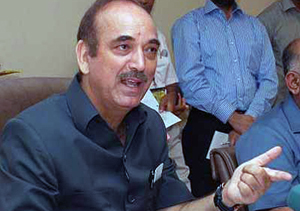
Hindutva groups demand apology from Azad for opposing ISIS and RSS

March 12, 2016

New Delhi, March 12: Congress leader Ghulam Nabi Azad today kicked a row after he sought to draw a parallel between RSS and terrorist outfit ISIS, evoking sharp responses from the Hindutva outfit and BJP, which demanded an apology from him.Ghulam-Nabi

"So, we oppose organisations like ISIS, the way we oppose RSS. If those among us in Islam too do wrong things, they are no way less than RSS," the Leader of Opposition in the Rajya Sabha said at a event organised by Jamiat Ulama-i-Hind.

Hitting back, a RSS spokesperson in Nagaur, where a crucial meeting of the organisation's functionaries is on, said such a comparison showed "intellectual bankruptcy" of Congress and its "unwillingness to deal with fundamentalist and cruel forces like ISIS".

RSS will consider legal action against Azad, he said. BJP too jumped to the defence of its ideological mentor, calling it a nationalist organisation and demanding an apology from Azad.

The party said it was "unfortunate" that Azad had made such comments and asked Congress chief Sonia Gandhi to disassociate from his remarks and take action against him if he does not withdraw them.

"RSS is a nationalist organisation. It is very unfortunate that he has said so. It shows his mental bankruptcy. He must apologise or Gandhi should take action against him," party National Secretary Shrikant Sharma said.

He said a number of Congress leaders, including Jawahar Lal Nehru and Rajiv Gandhi, had tried to repress the organisation but it has only emerged "stronger".

BJP also termed as "politically motivated" Gandhi's written message to the same event that the country was passing through a "critical phase" as those in power are "spreading hatred" by targeting secularism.

"She is speaking against what her party has always practiced. Congress divided nation along caste, religion and regional lines. She should not be preaching BJP," Sharma said, accusing the party of "supporting" anti-national elements for political reasons, a reference to the JNU row.

Comments

SYED
 - 
Saturday, 12 Mar 2016

WELL SAID GULAM AZAD....

ISIS IS FROM ISRAEL INTELLIGENCE AGENT TO DESTROY ISLAM FROM THIS WORLD AND RSS IS THE CHADDIS GROUP TO THE SAME IN INDIA TO DESTROY ISLAM FROM INDIA.....

DAY DREAMING GROUPS....

Fair talker
 - 
Saturday, 12 Mar 2016

RSS can not be nationalist, as long as they hug and obedient to CONSTITUTION.
They are Hindutva policy group. Even majority of Hinduism oppose them.

This was a banned group during Indira Gandhi.
Any way the way how they oppose other religions, it works in the favor of other religions.

Add new comment

  • Coastaldigest.com reserves the right to delete or block any comments.
  • Coastaldigset.com is not responsible for its readers’ comments.
  • Comments that are abusive, incendiary or irrelevant are strictly prohibited.
  • Please use a genuine email ID and provide your name to avoid reject.
News Network
January 17,2020

New Delhi, Jan 17: A Delhi court Friday issued fresh death warrants for February 1, 6 am against the four convicts in the Nirbhaya gang rape and murder case.

Additional Sessions Judge Satish Kumar Arora was hearing a plea by one of the four death row convicts in the case, Mukesh Kumar Singh, seeking postponement of the date of his execution scheduled for January 22.

Earlier in the day, the Tihar jail authorities sought issuance of fresh death warrants against the four convicts.

Public Prosecutor Irfan Ahmed told the court that Mukesh's mercy plea was rejected by President Ram Nath Kovind on Friday.

The 23-year-old paramedic student, referred to as Nirbhaya, was gang-raped and brutally assaulted on the intervening night of December 16-17, 2012 inside a moving bus in south Delhi by six persons before being thrown out on the road.

She died on December 29, 2012, at Mount Elizabeth Hospital in Singapore.

Comments

Add new comment

  • Coastaldigest.com reserves the right to delete or block any comments.
  • Coastaldigset.com is not responsible for its readers’ comments.
  • Comments that are abusive, incendiary or irrelevant are strictly prohibited.
  • Please use a genuine email ID and provide your name to avoid reject.
Agencies
February 5,2020

New Delhi, Feb 5: Following is the chronology of events in the 2012 Nirbhaya gang rape and murder case in which the Delhi High Court on Wednesday said the all the four convicts have to be hanged together, not separately.

- Dec 16, 2012: Paramedical student gang-raped and brutally assaulted by six men in a private bus and thrown out of the moving vehicle along with her male friend. The victims admitted to Safdarjung Hospital.

- Dec 17: Widespread protests erupt demanding stringent action.

- Police identify the accused - bus driver Ram Singh, his brother Mukesh Kumar, Vinay Sharma and Pawan Gupta.

- Dec 18: Ram Singh and three others arrested.

- Dec 20: Victim's friend testifies.

- Dec 21: A delinquent juvenile nabbed from Anand Vihar bus terminal in Delhi. Victim's friend identifies Mukesh as one of the culprits. Police conduct raids in Haryana and Bihar to nab the sixth accused, Akshay Kumar.

- Dec 21-22: Akshay arrested in Aurangabad district of Bihar and brought to Delhi. Victim records statement before the SDM in hospital.

- Dec 26: Following a cardiac arrest, victim flown to Singapore's Mount Elizabeth Hospital by the government.

- Dec 29: Victim succumbs to injuries and other medical conditions. Police add murder charge in the FIR.

- Jan 2, 2013: The then Chief Justice of India Altamas Kabir inaugurates fast track court (FTC) for speedy trial in sexual offence cases.

- Jan 3: Police file charge sheet against five adults accused of murder, gang-rape, attempt to murder, kidnapping, unnatural offences and dacoity.

- Jan 17: FTC starts proceedings against the five adult accused.

- Jan 28: Juvenile Justice Board (JJB) says minority of the juvenile accused is proved.

- Feb 2: FTC frames charges against five adult accused.

- Feb 28: JJB frames charges against the minor.

- Mar 11: Ram Singh commits suicide in Tihar Jail.

- Jul 8: FTC completes recording of testimonies of prosecution witnesses.

- Jul 11: Delhi High Court allows three international news agencies to cover the trial in the case.

- Aug 22: FTC begins hearing final arguments in trial against four adult accused.

- Aug 31: JJB convicts the minor for gang-rape and murder and awards three-year term at probation home.

- Sep 3: FTC concludes trial. Reserves verdict.

- Sep 10: Court convicts Mukesh, Vinay, Akshay, Pawan of 13 offences including gang-rape, unnatural offence and murder of the girl and attempt to murder her male friend.

- Sep 13: Court awards death penalty to all 4 convicts.

- Sep 23: HC begins hearing the convicts' death sentence reference sent to it by the trial court.

- Jan 3, 2014: HC reserves verdict on convicts' appeals.

- Mar 13: HC upholds death penalty to the 4 convicts.

- Mar 15: SC stays execution of 2 convicts, Mukesh and Pawan, after they file appeals. Later, stays execution of other convicts also.

- Apr 15: SC directs police to produce the dying declaration of the victim.

- Feb 3, 2017: SC says it would hear afresh the aspect of awarding death penalty to the convicts.

- Mar 27: SC reserves verdict on their appeals.

- May 5: SC upholds death penalty to four convicts, says the case falls under the category of 'rarest of rare' and the offence created "tsunami of shock".

- Nov 8: Mukesh, one of the four death row convicts in the case, moves SC seeking review of its verdict upholding the capital punishment awarded to him.

- Dec 12: Delhi Police opposes Mukesh's plea in SC.

- Dec 15: Convicts Vinay Sharma and Pawan Kumar Gupta move SC for review of its verdict.

- May 4, 2018: SC reserves order on review plea of Vinay and Pawan.

- Jul 9: SC dismisses review pleas of three convicts.

- Feb, 2019: Victim's parents move Delhi court for issuance of death warrants of the four convicts

- Dec 10, 2019: Akshay moves plea in SC seeking review of his death penalty.

- Dec 13: Victim's mother moves SC opposing review plea of convict

- Dec 18: SC dismisses Akshay's review plea.

- Delhi govt seeks death warrants for execution of death sentence to the 4 convicts

- Delhi court directs Tihar authorities to issue notice to convicts to avail their remaining legal remedies.

- Dec 19: Delhi HC dismisses plea of Pawan Kumar Gupta claiming he was a juvenile at the time of the offence.

- Jan 6, 2020: Delhi court dismisses complaint filed by Pawan's father seeking FIR against sole witness

- Jan 7: Delhi court orders 4 convicts to be hanged on January 22 at 7 am in Tihar jail.

- Jan 14: SC rejects curative petition of Vinay and Mukesh Kumar.

Mukesh files mercy petition before President

- Jan 17: President Ram Nath Kovind rejects mercy plea of Mukesh.

- Trial court issues death warrants again with execution date as February 1, 6 am.

- Jan 25: Mukesh moves SC against rejection of mercy plea.

- Jan 28: SC hears arguments, reserves verdict

- Jan 29: Convict Akshya Kumar approaches SC with curative petition

- SC rejects plea of Mukesh challenging rejection of his mercy plea.

- Jan 30: SC dismisses curative plea of Akshay Kumar Singh.

- Jan 31: SC dismisses plea filed by Pawan seeking review of its order rejecting his juvenility claim.

- Delhi court again postpones execution of the black warrants till further order.

- Feb 1: Centre moves HC against the trial court order.

- Feb 2: HC reserves judgement on Centre's plea.

- Feb 5: HC dismisses Centre plea against trial court order; says all 4 convicts have to be hanged together. It directs the convicts to pursue all legal remedies within a week, failing which the authorities ordered to take action in accordance with law.


Comments

Add new comment

  • Coastaldigest.com reserves the right to delete or block any comments.
  • Coastaldigset.com is not responsible for its readers’ comments.
  • Comments that are abusive, incendiary or irrelevant are strictly prohibited.
  • Please use a genuine email ID and provide your name to avoid reject.
Agencies
January 20,2020

New Delhi, Jan 20: The BJP has got a brand new President in the form of JP Nadda. At around 2.30 pm, the announcement was made, bringing an end to the Amit Shah era in BJP. The party's Working President Jagat Prakash Nadda won unopposed, sparking celebrations outside the BJP headquarters here on Monday. 

Amit Shah himself was among the people who proposed Nadda's name along with Nitin Gadkari and Rajnath Singh. Soon after his annointment, BJP election returning officer Radha Mohan Singh told the media, "I announce JP Nadda as the new BJP President." Shah was also seen hugging Nadda.

The nomination process for the post of the BJP President began at 10 am and went on till 12.30 pm. For the next hour, the filed nomination paper, which was just one, was examined. Party members waitied till 2.30 pm for the candidate to withdraw if he wished to. It was after this that Nadda was declared as the man who would step into the shoes of Amit Shah.

Many in the BJP believe that although Nadda is the BJP chief now, Shah would still make all macro-level decisions like pre poll alliances or top organisational appointments. Nadda would be in charge of monitoring the day-to-day needs of the organisation. BJP sources say that Amit Shah himself wanted an arrangement like this one and personally wanted Nadda to take over. as he helped Shah formulate legislations like Triple Talaq and Citizenship Amendment Act.

The party constitution mandates completion of election of at least 50 per cent of state Presidents for the election of national President to happen. In the last few days, the BJP has completed the election of a slew of state Presidents like in West Bengal, Nagaland among others.

The process of election of the national BJP President is quite elaborate and has been described in detail in the party constitution, which says that the national president shall be elected by an electoral college, comprising members of the national council and the state councils.

"Any 20 members of the electoral college of a state can jointly propose the name of a person, who has been an active member for four terms and has 15 years of membership, for the post of national president. Such joint proposal should come from not less than five states where elections have been completed for the national council. The consent of the candidate is necessary," it says.

Who is JP Nadda?

Jagat Prakash Nadda, 59, who has his roots in the Rashtriya Swayamsevak Sangh (RSS) and its affiliates, was appointed the Bharatiya Janata Party (BJP) national President on Monday, replacing his 'mentor' and Union Home Minister Amit Shah.

Former environment, health and law minister from Himachal Pradesh, which has just four of the Lok Sabha's 543 seats, Nadda has tried to carve out his own space in national politics with his low profile and astute organisational skills, believe his party leaders.

He rose through the ranks from the Akhil Bharatiya Vidyarthi Parishad (ABVP), the student wing of the RSS, from where he has managed to build inroads from university to the state politics.

Nadda has been active on the national political scene since 2010 when he was picked by then BJP chief Nitin Gadkari to join his new team. He was made the party's national general secretary.

Born on December 2, 1960, Nadda did his graduation from Patna and holds a post-graduate degree in political science and Bachelor of Legislative Law (LL.B) from Himachal Pradesh University in Shimla.

Starting his political career as a student leader of the ABVP in 1978, Nadda had also worked both with Gadkari and Shah even in the party's youth wing -- the Bharatiya Yuva Morcha -- from 1991 to 1994.

His wife Mallika Nadda, who teaches history at the Himachal Pradesh University and is currently posted in university's campus in Delhi, was an ABVP activist too, and its national general secretary from 1988 to 1999.

In the previous BJP government (2007-12) in the state, Nadda was forced to resign as Forest Minister in 2010 owing to differences between him and then chief minister Prem Kumar Dhumal.

He was elected to the Rajya Sabha in 2012.

Nadda won his first Assembly election from Bilaspur (Sadar) in Himachal in 1993. In 1998, he again won from that seat and became the state Health Minister.

He lost the Assembly elections in 2003, but again won in 2007 and was appointed the Forest Minister in the Himachal Pradesh.

Nadda, as a forest minister, was the brain behind opening forest police stations to check forest crimes, launching community-driven plantation, setting up forest ponds and the massive plantation of deodars to boost the depleting green cover of the 'Queen of Hills', as Shimla was fondly called by the British.

A close confidant of Prime Minister Narendra Modi, Nadda was among those who were mentioned as likely aspirants to the BJP top post after Rajnath Singh was inducted into the Central government as the Home Minister in 2014.

Later, Nadda was inducted into the union cabinet in its first expansion in 2014 as the Health Minister.

Hailing Nadda's appointment, Chief Minister Jai Ram Thakur told IANS it is a proud moment that a leader belonging to a small state in the national politics is today the leader of the country's biggest national party.

His father N.L. Nadda, who was a Vice-Chancellor of the Ranchi University, resides in Bilaspur town.

Comments

Add new comment

  • Coastaldigest.com reserves the right to delete or block any comments.
  • Coastaldigset.com is not responsible for its readers’ comments.
  • Comments that are abusive, incendiary or irrelevant are strictly prohibited.
  • Please use a genuine email ID and provide your name to avoid reject.