


Hindutva groups demand apology from Azad for opposing ISIS and RSS

March 12, 2016

New Delhi, March 12: Congress leader Ghulam Nabi Azad today kicked a row after he sought to draw a parallel between RSS and terrorist outfit ISIS, evoking sharp responses from the Hindutva outfit and BJP, which demanded an apology from him.Ghulam-Nabi
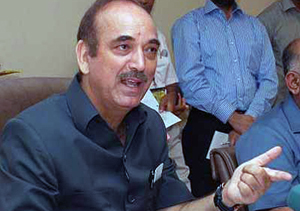
"So, we oppose organisations like ISIS, the way we oppose RSS. If those among us in Islam too do wrong things, they are no way less than RSS," the Leader of Opposition in the Rajya Sabha said at a event organised by Jamiat Ulama-i-Hind.

Hitting back, a RSS spokesperson in Nagaur, where a crucial meeting of the organisation's functionaries is on, said such a comparison showed "intellectual bankruptcy" of Congress and its "unwillingness to deal with fundamentalist and cruel forces like ISIS".

RSS will consider legal action against Azad, he said. BJP too jumped to the defence of its ideological mentor, calling it a nationalist organisation and demanding an apology from Azad.

The party said it was "unfortunate" that Azad had made such comments and asked Congress chief Sonia Gandhi to disassociate from his remarks and take action against him if he does not withdraw them.

"RSS is a nationalist organisation. It is very unfortunate that he has said so. It shows his mental bankruptcy. He must apologise or Gandhi should take action against him," party National Secretary Shrikant Sharma said.

He said a number of Congress leaders, including Jawahar Lal Nehru and Rajiv Gandhi, had tried to repress the organisation but it has only emerged "stronger".

BJP also termed as "politically motivated" Gandhi's written message to the same event that the country was passing through a "critical phase" as those in power are "spreading hatred" by targeting secularism.

"She is speaking against what her party has always practiced. Congress divided nation along caste, religion and regional lines. She should not be preaching BJP," Sharma said, accusing the party of "supporting" anti-national elements for political reasons, a reference to the JNU row.

Comments

SYED
 - 
Saturday, 12 Mar 2016

WELL SAID GULAM AZAD....

ISIS IS FROM ISRAEL INTELLIGENCE AGENT TO DESTROY ISLAM FROM THIS WORLD AND RSS IS THE CHADDIS GROUP TO THE SAME IN INDIA TO DESTROY ISLAM FROM INDIA.....

DAY DREAMING GROUPS....

Fair talker
 - 
Saturday, 12 Mar 2016

RSS can not be nationalist, as long as they hug and obedient to CONSTITUTION.
They are Hindutva policy group. Even majority of Hinduism oppose them.

This was a banned group during Indira Gandhi.
Any way the way how they oppose other religions, it works in the favor of other religions.

Add new comment

  • Coastaldigest.com reserves the right to delete or block any comments.
  • Coastaldigset.com is not responsible for its readers’ comments.
  • Comments that are abusive, incendiary or irrelevant are strictly prohibited.
  • Please use a genuine email ID and provide your name to avoid reject.
News Network
January 12,2020

Kolkata, Jan 12: Prime Minister Narendra Modi on Sunday announced that Kolkata Port Trust will be renamed as Syama Prasad Mukherjee Port.

Addressing the gathering at the inauguration of 150th anniversary celebrations of Kolkata Port Trust, he said: "I announce the renaming of the Kolkata Port Trust to Dr Shyama Prasad Mukherjee Port. He is a living legend who was a leader for development and fought on the forefront for the idea of One Nation, One Constitution."

"This port represents industrial, spiritual and self-sufficiency aspirations of India. Today, when the port is celebrating its 150th anniversary, it is our responsibility to make it a powerful symbol of New India," Modi said.

The Prime Minister said that the Bharatiya Jana Sangh founder had set the stone for industrialization in India. "Chittaranjan Locomotive Factory, Hindustan Aircraft Factory, Damodar Valley Corporation and several others saw active participation from him," he said.

The Prime Minister also felicitated the two oldest pensioners of the Kolkata Port Trust, Nagina Bhagat and Naresh Chandra Chakraborty.

Comments

Add new comment

  • Coastaldigest.com reserves the right to delete or block any comments.
  • Coastaldigset.com is not responsible for its readers’ comments.
  • Comments that are abusive, incendiary or irrelevant are strictly prohibited.
  • Please use a genuine email ID and provide your name to avoid reject.
News Network
April 23,2020

Washington, Apr 23: Air pollution over northern India has plummeted to a 20-year-low for this time of the year, according to satellite data published by US space agency National Aeronautics and Space Administration (NASA).
The US space agency's satellite sensors observed aerosol levels at a 20-year low post the countrywide lockdown, implemented to slow the spread of the novel coronavirus.

"We knew we would see changes in atmospheric composition in many places during the lockdown," said Pawan Gupta, a Universities Space Research Association (USRA) scientist at NASA''s Marshall Space Flight Center. "But I have never seen aerosol values so low in the Indo-Gangetic Plain at this time of year," added Mr Gupta.

Acting Assistant Secretary of State for South and Central Asia Alice G Wells tweeted, "These images from NASA were taken each spring starting in 2016 and show a 20-year low in airborne particle levels over India. When India and the world are ready to work and travel again, let's not forget that collaborative action can result in cleaner air."

The data published with maps show aerosol optical depth (AOD) in 2020 compared to the average for 2016-2019. Aerosol optical depth is a measure of how light is absorbed or reflected by airborne particles as it travels through the atmosphere.

If aerosols are concentrated near the surface, an optical depth of 1 or above indicates very hazy conditions. An optical depth, or thickness, of less than 0.1 over the entire atmospheric vertical column is considered "clean." The data were retrieved by the Moderate Resolution Imaging Spectroradiometer (MODIS) on NASA's Terra satellite.

In the first few days of the lockdown, it was difficult to observe a change in the pollution signature. "We saw an aerosol decrease in the first week of the shutdown, but that was due to a combination of rain and the lockdown," said Mr Gupta.

Around March 27, heavy rain poured over vast areas of northern India and helped clear the air of aerosols. Aerosol concentrations usually increase again after such heavy precipitation.

"After the rainfall, I was really impressed that aerosol levels did not go up and return to normal. We saw a gradual decrease and things have been staying at the level we might expect without anthropogenic emissions," Mr Gupta said.

On March 25, the Indian government placed its 1.3 billion citizens under a strict lockdown to reduce the spread of COVID-19. The countrywide mandate decreased activity at factories and severely reduced car, bus, truck and airplane traffic. Every year, aerosols from anthropogenic (human-made) sources contribute to unhealthy levels of air pollution in many Indian cities.

Aerosols are tiny solid and liquid particles suspended in the air that reduce visibility and can damage the human lungs and heart.

In southern India though, the story is a little hazier. Satellite data show aerosol levels have not yet decreased to the same extent. In fact, levels seem to be slightly higher than in the past four years. The reasons are unclear but could be related to recent weather patterns, agricultural fires, winds or other factors.

"This a model scientific experiment," Robert Levy, program leader for NASA's MODIS aerosol products, said about the lockdown and its effects on pollution.

"We have a unique opportunity to learn how the atmosphere reacts to sharp and sudden reductions in emissions from certain sectors. This can help us separate how natural and human sources of aerosols affect the atmosphere," Mr Levy added.

Comments

Add new comment

  • Coastaldigest.com reserves the right to delete or block any comments.
  • Coastaldigset.com is not responsible for its readers’ comments.
  • Comments that are abusive, incendiary or irrelevant are strictly prohibited.
  • Please use a genuine email ID and provide your name to avoid reject.
News Network
June 20,2020

New Delhi, Jun 20: The government-imposed upper and lower limits on airfares may be extended beyond August 24 depending upon how the situation turns out, Aviation Secretary P S Kharola said on Saturday.

The government resumed domestic passenger flights from May 25 after nearly two months of suspension to combat the coronavirus outbreak, but placed lower and upper limits on airfares depending upon the flight duration.

It had said on May 21 that these limits would be in place for a period of three months.

"Depending on how the situation turns out, the fare band may have to adjusted beyond that (August 24) also. But right now, it is only for three months," Kharola said at a press conference here.

International passenger flights continue to remain suspended in the country.

However, the government started Vande Bharat Mission on May 6 to help stranded people reach their destinations through special flights.

Aviation Minister Hardeep Singh Puri said at the conference that during phase 3 and phase 4 of the mission, private domestic airlines have been approved to operate 750 international flights to repatriate people stranded amid the coronavirus pandemic.

Comments

Add new comment

  • Coastaldigest.com reserves the right to delete or block any comments.
  • Coastaldigset.com is not responsible for its readers’ comments.
  • Comments that are abusive, incendiary or irrelevant are strictly prohibited.
  • Please use a genuine email ID and provide your name to avoid reject.