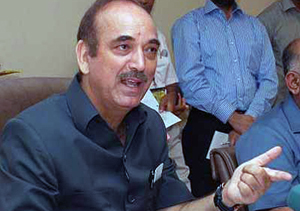
Hindutva groups demand apology from Azad for opposing ISIS and RSS

March 12, 2016

New Delhi, March 12: Congress leader Ghulam Nabi Azad today kicked a row after he sought to draw a parallel between RSS and terrorist outfit ISIS, evoking sharp responses from the Hindutva outfit and BJP, which demanded an apology from him.Ghulam-Nabi

"So, we oppose organisations like ISIS, the way we oppose RSS. If those among us in Islam too do wrong things, they are no way less than RSS," the Leader of Opposition in the Rajya Sabha said at a event organised by Jamiat Ulama-i-Hind.

Hitting back, a RSS spokesperson in Nagaur, where a crucial meeting of the organisation's functionaries is on, said such a comparison showed "intellectual bankruptcy" of Congress and its "unwillingness to deal with fundamentalist and cruel forces like ISIS".

RSS will consider legal action against Azad, he said. BJP too jumped to the defence of its ideological mentor, calling it a nationalist organisation and demanding an apology from Azad.

The party said it was "unfortunate" that Azad had made such comments and asked Congress chief Sonia Gandhi to disassociate from his remarks and take action against him if he does not withdraw them.

"RSS is a nationalist organisation. It is very unfortunate that he has said so. It shows his mental bankruptcy. He must apologise or Gandhi should take action against him," party National Secretary Shrikant Sharma said.

He said a number of Congress leaders, including Jawahar Lal Nehru and Rajiv Gandhi, had tried to repress the organisation but it has only emerged "stronger".

BJP also termed as "politically motivated" Gandhi's written message to the same event that the country was passing through a "critical phase" as those in power are "spreading hatred" by targeting secularism.

"She is speaking against what her party has always practiced. Congress divided nation along caste, religion and regional lines. She should not be preaching BJP," Sharma said, accusing the party of "supporting" anti-national elements for political reasons, a reference to the JNU row.

Comments

SYED
 - 
Saturday, 12 Mar 2016

WELL SAID GULAM AZAD....

ISIS IS FROM ISRAEL INTELLIGENCE AGENT TO DESTROY ISLAM FROM THIS WORLD AND RSS IS THE CHADDIS GROUP TO THE SAME IN INDIA TO DESTROY ISLAM FROM INDIA.....

DAY DREAMING GROUPS....

Fair talker
 - 
Saturday, 12 Mar 2016

RSS can not be nationalist, as long as they hug and obedient to CONSTITUTION.
They are Hindutva policy group. Even majority of Hinduism oppose them.

This was a banned group during Indira Gandhi.
Any way the way how they oppose other religions, it works in the favor of other religions.

Add new comment

  • Coastaldigest.com reserves the right to delete or block any comments.
  • Coastaldigset.com is not responsible for its readers’ comments.
  • Comments that are abusive, incendiary or irrelevant are strictly prohibited.
  • Please use a genuine email ID and provide your name to avoid reject.
News Network
June 20,2020

New Delhi, Jun 20: Diesel price on Saturday hit a record high after rates were hiked by 61 paise per litre while petrol price was up 51 paise, taking the cumulative increase in rates in two weeks to Rs 8.28 and Rs 7.62 respectively.

Petrol price in Delhi was hiked to Rs 78.88 per litre from Rs 78.37, while diesel rates were increased to Rs 77.67 a litre from Rs 77.06, according to a price notification of state oil marketing companies.

Rates have been increased across the country and vary from state to state depending on the incidence of local sales tax or VAT.

The 14th daily increase in rates since oil companies on June 7 restarted revising prices in line with costs after ending an 82-day hiatus in rate revision, has taken diesel prices to new high. Petrol price too is at a two-year high.

Prior to the current rally, diesel rate had touched a peak of Rs 75.69 per litre in Delhi on October 16, 2018.

The highest-ever petrol price was on October 4, 2018, when rates soared to Rs 84 a litre in Delhi.

When rates had peaked in October 2018, the government had cut excise duty on petrol and diesel by Rs 1.50 per litre each. State-owned oil companies were asked to absorb another Re 1 a litre to help cut retail rates by Rs 2.50 a litre.

Oil companies had quickly recouped the Re 1 and the government in July 2019 raised excise duty by Rs 2 a litre.

The 82-day freeze in rates this year was imposed in mid-March soon after the government hiked excise duty on petrol and diesel to shore up additional finances.

The government on March 14 hiked excise duty on petrol and diesel by Rs 3 per litre each and then again on May 5 by a record Rs 10 per litre in case of petrol and Rs 13 on diesel. The two hikes gave the government Rs 2 lakh crore in additional tax revenues.

Oil PSUs Indian Oil Corp (IOC), Bharat Petroleum Corp Ltd (BPCL) and Hindustan Petroleum Corp Ltd (HPCL), instead of passing on the excise duty hikes to customers, adjusted them against the fall in retail rates that was warranted because of a decline in international oil prices to two-decade lows.

International oil prices have since rebounded and oil firms are now adjusting retail rates in line with them.

In 14 hikes, petrol price has gone up by Rs 7.62 per litre and diesel by Rs 8.28 a litre.

Comments

Add new comment

  • Coastaldigest.com reserves the right to delete or block any comments.
  • Coastaldigset.com is not responsible for its readers’ comments.
  • Comments that are abusive, incendiary or irrelevant are strictly prohibited.
  • Please use a genuine email ID and provide your name to avoid reject.
Agencies
May 17,2020

New Delhi, May 17: Following the COVID-19-induced economic disruptions, up to 135 million jobs could be lost and 120 million people might be pushed back into poverty in India, all of which will have a hit on consumer income, spending and savings, says a report.

According to a new report by international management consulting firm Arthur D Little, the worst of COVID-19's impact will be felt by India's most vulnerable in terms of job loss, poverty increase and reduced per-capita income, which in turn will result in a steep decline in the Gross Domestic Product (GDP).

"Given the continued rise of COVID-19 cases, we believe that a W-shaped recovery is the most likely scenario for India. This implies a GDP contraction of 10.8 per cent in FY 2020-21 and GDP growth of 0.8 per cent in FY 2021-22," the report said.

India's COVID-19 tally has crossed 90,000 and the nationwide death toll has touched nearly 2,800 so far.

The report titled "India: Surmounting the economic challenges posed by COVID-19: A 10-point programme to revive and power India's post-COVID economy" said the 'collateral damage' of the forecasted GDP slowdown, will be felt most acutely in employment, poverty alleviation, per-capita income and overall nominal GDP.

"Unemployment may rise to 35 per cent from 7.6 per cent resulting in 136 million jobs lost and a total of 174 million unemployed. Poverty alleviation will receive a set-back, significantly changing the fortunes of many, putting 120 million people into poverty and 40 million into abject poverty," the report said.

"India is headed towards a W-shaped economic recovery with a potential GDP contraction of 10.8 per cent in FY21. An opportunity loss of USD 1 trillion is staring India in its face," said Barnik Chitran Maitra, lead author of the report and Managing Partner & CEO of Arthur D Little, India and South Asia.

Maitra further said "for its USD 5 trillion vision, a radical economic approach is needed, centred on an immediate stimulus and structural reforms. The Prime Minister's visionary 'Atma Nirbhar Bharat Abhiyan' is a good start to this new approach."

The report lauded the steps taken by the government and the Reserve Bank of India, but said a far more assertive approach may be required given the magnitude of the adverse economic output.

The report suggested a 10-point programme to accelerate the recovery which include strengthening the 'safety net' significantly for the most vulnerable, enable survival of small and medium businesses, restarting the rural economy and providing targeted assistance to at-risk sectors.

It further said the government should launch "Make in India 2.0" to capture global opportunities, build 'Modern India', accelerate Digital India and Innovation, strengthen global investment corridors with the US, UAE, Saudi Arabia, Japan and the UK, debottleneck land and labour and transform banking and financial markets in a bid to secure a sustainable economic future for 1.3 billion Indians. 

Comments

Add new comment

  • Coastaldigest.com reserves the right to delete or block any comments.
  • Coastaldigset.com is not responsible for its readers’ comments.
  • Comments that are abusive, incendiary or irrelevant are strictly prohibited.
  • Please use a genuine email ID and provide your name to avoid reject.
News Network
May 17,2020

New Delhi, May 17: Spelling out the government’s fourth tranche of initiatives towards achieving Prime Minister Narendra Modi’s vision of ‘Atmanirbhar Bharat’, Union Finance Minister Nirmala Sitharaman on Saturday announced significant structural reforms in eight sectors of the economy — coal, minerals, defense production, aviation, power distribution in Union territories, space and atomic energy.

Addressing her fourth and the second-last press conference, Sitharaman said crucial sectors such as coal production and exploration, defence production and space would see an increased participation from private entities.

Coal sector:

In the realm of coal exploration, the government has decided to liberalise the entry norms for private entities, which would mean that any interested party could bid for a coal block and sell it in the open market. The minister said that the government would do away with all the eligibility conditions at the time of bidding for a coal block, except requiring an “upfront payment with a ceiling.”

Nearly 50 coal blocks would be offered to private players immediately, revealed Sitharaman.

She further said that Rs 50,000 crore would be spent by Centre in creating ‘coal evacuation’ infrastructure, which would expedite the transport of mined product to the destination.

Defence sector:

In defence production, Sitharaman revealed that the government would raise the foreign direct investment (FDI) limit in the sector from current 49 per cent to 74 per cent. Further, the government would also work towards corporatising the ordnance factory boards. “Corporatising doesn’t amount to privatization,” added Sitharaman.

In a bid to boost indigenous production of defence products and gave an impetus to Make in India, Sitharaman said that the government was in a process of notifying a list of weapons/platforms for an import ban with year-wise timelines.

These decisions would also help in reducing huge import bills, the finance minister said.

Privatisation of electricity:

In another announcement that could have an effect on electricity charges in the union territories, Union Finance Minister Nirmala Sitharaman announced on Saturday that power departments and utilities in all the centrally administered territories would be privatised.

Sitharaman said that the proposed move would lead to better service to consumers and improvement in operational and financial efficiency in distribution.

The finance minister said that decision was guided by 'sub-optimal' utilisation of performance of power distribution and supply'.

She said that the move to that effect would provide a model for emulation by other utilities across the country, in what could be an indicator of what's in the pipeline for utilities in other states as well.

Sitharaman said that the privation reform was in line with the tariff policy reforms and would help in enhancing consumer rights, promote industry and improve the overall sustainability of the sector.

Space sector:

Sitharaman also announced the opening up of the space exploration sector for private players. Till date, the government-run Indian Space Research Organisation (ISRO) has held a monopoly on all activities concerning space exploration and satellite launches.

The Indian private sector will be a co-traveller in India's space sector journey, said Sitharaman, while announcing a series of structural reforms in eight crucial areas of the economy. The Union Finance Minister was addressing her fourth press conference in as many days, as a follow-up towards realising Prime Minister Narendra Modi's vision of 'atmanirbhar Bharat', which was spelled out in his video address on May 12.

Sitharaman said that the reforms in the space sector will provide a level-playing field for private companies in satellite launches and space-based services.

She said that the private sector would be allowed to use ISRO facilities and other assets to improve their capacities. Stating that the government would provide predictable policy and regulatory environment to private players, Sitharaman also disclosed that future projects for planetary exploration and outer space travel among others would be opened up for private entities.


Comments

Add new comment

  • Coastaldigest.com reserves the right to delete or block any comments.
  • Coastaldigset.com is not responsible for its readers’ comments.
  • Comments that are abusive, incendiary or irrelevant are strictly prohibited.
  • Please use a genuine email ID and provide your name to avoid reject.