



Washington, Apr 8: When President Donald Trump began receiving his intelligence briefings in January, his team made a request: The president, they said, was a visual and auditory learner. Would the briefers please cut down on the number of words in the daily briefing book and instead use more graphics and pictures?
Similarly, after Trump entered office, his staff took President Barack Obama's Syria contingency plans and broke the intelligence down into more-digestible bites, complete with photos, according to current and former U.S. officials with knowledge of the request.
This week, it was the images - gruesome photos of a chemical weapons attack on Syrian civilians - that moved Trump, pushing the president, who ran on an "America first" platform of nonintervention, to authorize the launch of 59 Tomahawk cruise missiles at Syrian targets Thursday night.
Senior administration officials and members of Congress who spoke with Trump said the president was especially struck by two images: young, listless children being splashed with water in a frantic attempt to cleanse them of the nerve agent; and an anguished father holding his twin babies, swathed in soft white fabric, poisoned to death.
As the carnage unfolded on cable news, which the president watches throughout the day and deep into the night, Trump turned to his senior staff, talking about how "horrible" and "awful" the footage out of Syria was, said one top adviser.
"What the world saw last night was the United States commander in chief, and also a father and grandfather," Kellyanne Conway, counselor to the president, said Friday. "The world recoiled in horror at babies writhing and struggling to live. And who could avert their gaze - and that includes our very tough, very resolute, very decisive president."
Horrific images were not the only reason military action made sense for Trump. Whatever his concern for the people of Syria - a country whose refugees would not be able to enter the United States for 120 days under Trump's latest travel ban proposal - he has been eager to show a clear victory more than two months into his tumultuous young presidency.
A strike against Syria could help him demonstrate independence from Russia and its president, Vladimir Putin, whose alleged efforts to interfere in the 2016 presidential race have proved a major distraction. And Trump wants to show that he is a tougher and stronger leader than Obama, who received scathing criticism when he drew a "red line" with Syria over its use of chemical weapons and then declined to act when President Bashar Assad bounded over it.
Sen. Chris Murphy, D-Conn., on Friday questioned Trump's "24-hour pivot on Syria policy," noting that until Assad's regime launched its chemical attack, Trump had not made Syria a priority. White House press secretary Sean Spicer had told reporters last week that the United States had to accept the "political reality" of Assad's grip on power.
"There is no strategy on Syria," Murphy said. "He clearly made this decision based off an emotional reaction to the images on TV, and it should worry everyone about the quixotic nature of this administration's foreign policy and their potential disdain for the warmaking authority of the United States Congress."
Throughout the week, Trump's public remarks placed a special emphasis on the youngest victims. "When you kill innocent children, innocent babies, babies, little babies, with a chemical gas that is so lethal - people were shocked to hear what gas it was," Trump said Wednesday afternoon in the Rose Garden, where he appeared at a news conference with King Abdullah II of Jordan. "That crosses many, many lines, beyond a red line - many, many lines."
On Thursday, when a subdued Trump addressed the nation, he spoke of "beautiful babies" cruelly murdered, declaring, "No child of God should ever suffer such horror."
About 54 hours after receiving news of the attacks in his daily briefing Tuesday morning, Trump - by then at his private Mar-a-Lago estate in Florida for a summit with Chinese President Xi Jinping - gave the order to target Shayrat air base.
At 7:40 p.m. Thursday, as Trump and Xi were midway through a meal of pan-seared Dover sole with champagne sauce and dry-aged prime New York strip steak (a Trump favorite), a naval destroyer launched the first of nearly five dozen Tomahawk cruise missiles, lighting up the sky in eastern Syria.
White House aides and Trump deputies said that while the photos clearly affected Trump, he made his final decision after consulting with his advisers in a process they described as deliberative and thorough.
Over an intensive 2 1/2 days, the president's national security team convened several high-level meetings with representatives from the Pentagon, the State Department, intelligence agencies and the National Security Council.
"I don't think it was an emotional reaction at all," said Secretary of State Rex Tillerson, who was involved in the discussions. "President Trump evaluated the facts, that the attacks occurred on his watch, and [as he] reflected upon prior responses or lack of responses, he came to the conclusion that we cannot yet again turn away, turn a blind eye from what's happened."
But the process was especially - and perhaps intentionally - quick, in contrast to the style of Obama, who prided himself on making decisions based on information, not emotions, a manner his critics derided as "dithering," as former vice president Richard Cheney put it early in Obama's first term.
Trump learned of the chemical attack Tuesday morning, asked for options on how to respond Wednesday and received them Thursday, the day he authorized the strike.
He asked the Defense Department to prepare potential responses after the Pentagon assessed that the Syrian military was responsible for Tuesday's chemical strike and for chemical attacks March 25 and March 30 against civilians near Hama air base, U.S. military officials said.
U.S. Central Command has had plans for striking the Syrian government for years and has significant assets in the region, enabling a quick response once a decision was made.
The National Security Council deliberated Wednesday night, and Defense Secretary Jim Mattis and other senior officials discussed the possibilities, senior military officials said. Ultimately, aides presented Trump with three options, but the president narrowed them to two and asked aides to flesh out more details.
Senior military and White House officials said Trump selected the "proportional" choice among the options available.
Richard Fontaine, president of the Center for a New American Security, where Mattis was recently a member of the board, said the options probably included doing nothing and launching more comprehensive airstrikes involving bombers and jets.
"I suspect that they said if you are going to do something, they need to do it quickly," Fontaine said. "You need to not hand-wring about this for weeks."
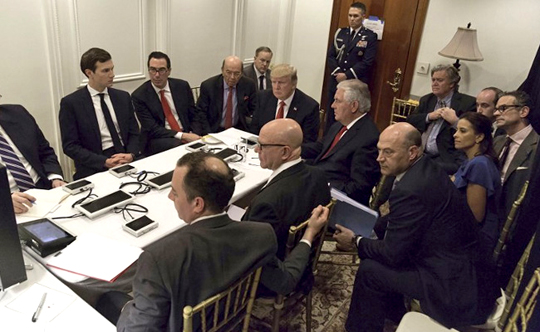
Thursday, Trump held another meeting aboard Air Force One as he flew to Palm Beach, Fla. Some officials - including national security adviser H.R. McMaster, Treasury Secretary Steven Mnuchin, Commerce Secretary Wilbur Ross, Chief of Staff Reince Priebus and senior adviser Stephen Bannon - joined him in the plane's wood-paneled conference room, with others piped in via secure videoconference from Washington as the presidential jet streaked southward.
Once on the ground in Florida, aides said, Trump gave Mattis the order to move forward. The defense secretary passed it along to Marine Gen. Joseph Dunford Jr., chairman of the Joint Chiefs of Staff, and Army Gen. Joseph Votel, chief of U.S. Central Command.
The missiles were launched about three hours later, at 3:40 a.m. local time, to minimize civilian casualties.
In the process, the president - who had championed an "America first" worldview rooted in the belief that U.S. foreign policy had become too interventionist - appeared to swing sharply in the other direction.
Thursday's strike also raised several uncomfortable, still-unanswered questions: Was Trump motivated to attack Syria in part because Obama never did? Was he driven by a need for a political victory, at home and abroad? And what is the administration's long-term strategy and goal in Syria?
It was unclear as well whether Trump fully considered the ramifications of his decision. Russia, whose president has supported Assad and whose troops operate inside Syria, reacted initially with pique, canceling a key air agreement designed to avoid military confrontations with U.S. forces in the skies, before later agreeing to restore the deal.
And even as the White House touted support for the decision in Congress and foreign capitals, administration officials acknowledged that the attack, which they described as commensurate with Assad's violation of "international norms," would not eliminate his ability to do it again.
Though Trump had often seemed to blame Obama for the situation in Syria, his remarks Thursday night from Mar-a-Lago were nonpartisan and intentionally so, a senior adviser said.
The president, this adviser added, was sending a message not only to Syria and Russia but also to China, whose president was in Palm Beach for their summit, and to North Korea that Trump and the United States will not "shirk or shrink" from conflict.
On Friday, Spicer, the press secretary, initially told reporters at Mar-a-Lago that he would offer an update on Syria in front of the news cameras. But just before he was to begin his briefing, he reversed himself: He wanted images of the president, both from the night before on Syria and the China summit Friday, to carry the day.

Comments
Add new comment