



How Communalism Divides the Nation? Dictate to Chant ‘Bharat Mata Ki Jai’ as an Example!

[email protected] (Ram Puniyani)
April 10, 2016

Today in India the gulf between religious communities is widening at a rapid pace. The ‘Hate other ideologies’ abound and are percolating down to the social levels at dangerous pace. As such India is a plural, multi-religious society, where diverse people have been living together for centuries. The Ganga Jamuna Tehjeeb, the mixed culture present in our society gets manifested in its food habits, dressing pattern, celebrations, festivals and religious traditions. These show how over a period of centuries the people of different communities have been adopting to each other in the spirit of ‘Vasudhaiv Kutumbakan’ (Whole World is my family) and ‘Love thy Neighbor’. While ethnic strife was there; the violence in the name of religions, Hindu-Muslim-Christian was conspicuous by its absence. The sectarian strife: Shaiv-Vaishnav, Shia-Sunni was there but the social scenario was by and large marked by amity. The highest points of these interactions can be seen in the traditions like Bhakti, Sufi and even the coming into fore of a new religion Sikhism and a new language: Urdu.B1sRQxkCEAARCQp
The problem begins with the British colonial period when the rulers adopt the policy of ‘divide and rule’ and in pursuing that policy they introduce communal historiography where the focus of history becomes Kings’ religion and selective picking up of points related to temple destructions, forcible conversion, taxation policies and atrocities on women, become the ground for spreading hatred. This hatred is the foundation on which violence is based. India comes to become a nation through its struggle against colonial powers and during the formation of this nation large sections of population are included in the newly forming India on the grounds of Liberty, Equality Fraternity. The Indian nationalist streams reject the British presentation of communal historiography and base their understanding on National historiography, one of the manifestations of which comes in Gandhi’s Hind Swaraj, where he talks of inclusive character of different rulers of the past, cutting across the religious boundaries.

In contrast to Gandhi-Indian nationalists, the communalists take up the divisive communal history and adopt it to suit their narrow goals of Muslim Nation or Hindu nation. The Muslim League presents the case as if India (rather sub continent) was being ruled by Muslims so British should hand over power to Muslims. Hindu Mahasabha-RSS presented the ideology of this land being a Hindu Nation from times immemorial. Here the pattern of production, hunter society, nomadic society, agricultural society with kingdoms and the then society with changes of Industrialization are glossed over and a lineage of present Hindu society with hunter-nomadic communities is presented to claim the ruler ship, as being the original inhabitants of the land. Hindu kings-Hindu society is presented as an ideal, trouble free society which gets problems due to Muslim invasion, so need to bring back Hindu nation becomes the agenda of Hindu Mahasabha-RSS.

These communal streams, the one’s vouching for Muslim nation or Hindu nation, had no interest in the problems of ‘people’, the dalits, adivasis, women or workers. Their focus was the interests of lineages of earlier rulers, the landlords, Kings in whose times the birth based hierarchies, operating at political, social and gender level were the basic hallmarks of society. They began a double ideological battle. On one hand to demonize the kings of ‘other’ religion-glorify the rulers of their own religion and two to present the birth based hierarchies in a glorified manner.

Their social reach was limited but they started spreading their version of History and promoting the hatred for other community. This was at a time when National movement was uniting the people cutting across the boundaries o religion, caste, region and gender. The communalists took up emotive issues, music before the mosque, pig-cow in their sacred place, creating nuisance when others have religious festivals and so on. The hatred forms the basis of violence and consequently polarization in the society. While we have seen the intensification of this polarization during last few decades, we have also seen a gradual rise in the intensity of hatred against some and insecurity among those who are being made the object of hate around many issues. Be it cow slaughter, temple destructions, forcible conversion, ‘our women’ being subjected to atrocity, global terror and what have you. Now a new emotive issue has been thrown up very recently, its fresh from the Bakery, so can serve a good example of understanding the anatomy of construction of object ‘Hate’ , demonization of the ‘other’.

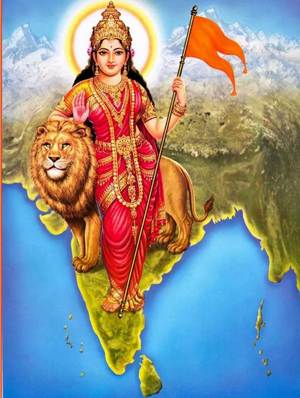
RSS Sarsanghchalak, Mohan Bhagawat (March 2016) gives a statement on his own that ‘the time has come to ask the new generation to chant ‘Bharat mata ki Jai’ ‘ (BMKJ). This acts like letting loose the cat among the pigeons. For being ‘politically correct’, he later says that nobody should be forced to chant this slogan. As if on a cue, while it was not necessary to respond to this unwarranted, communal intervention by Bhagwat, Asaduddin Owaisi supplements the game by saying that he will not chant this slogan even if a knife is put on his throat. At the same time he says that he has no problem in saying Jai Hind. In the talk shows which follow the RSS-BJP spokespersons deliberately begin the story with Owaisi, forgetting the statement by Bhagawat. In a holier than thou spirit Javed Akhatar chants the same slogan thrice to win the kudus from the sectarian and many other elements.

To take the story further, and this shows how such emotive issues are constructed, Congress-NCP, trying to play the role of B team of Hindutva, against the prevalent laws of the land, asks for suspension of Waris Pathan (Owaisi party) who refuses to chant the slogan; from Maharashtra Assembly. Communal politics of RSS combine has a good back up in these so called secular parties like Congress-NCP so to say. Then steps in Devendra Fadanvis, Maharashtra Chief Minster, one brought up on the ideology of Hindu nationalism: RSS. This gentleman has been brought up more on ‘Bunch of thoughts’ of Golwalkar rather than the values of Indian Constitution. He does not want to know about the values of Indian Constitution despite being a Chief Minster. Taking further his mentor Bhagwat’s statement he asserts that those who do not chant this slogan (BMKJ) have no right to live in India! So India of 125 Crore has now has an ideology and its soldiers are out to maul the Indian Constitution. To take the matters to the streets and community comes in RSS fellow traveler, Baba Ramdev. He picks up from Owaisi and blurts, ‘If no law would have cut the heads of those who don’t say Bharat Mata Ki Jia’

While many of these worthies now will be trying and explaining their outpourings towards and acceptable language, the damage has been done. The communal force is now equipped with one more weapon to consolidate its social and electoral base. My earlier article on the topic explains as to how BMKJ can be a voluntary for those who want to chant it and it is equally OK if someone does not chant it. With Ramdev’s statement one more emotive issue has been constructed ‘successfully’. Celebrations may be on among those who want to distract the attention from the problems of Bharat Mata of Jawaharlal Nehru (125 crore people of India), the problems of dalit students (Rohith Vemula) the problems of University autonomy, (Kanhaiya Kumar), the problems of farmers suicide, the rising prices, lack of employment generation and what have you.

It’s time that the India wakes up to realize the game of communal forces and vow not to fall prey to their machinations around such slogans or other emotive issues which are manufactured by them on regular basis and are pulling us back on the scale of Indian nationalism.

Comments

kr
 - 
Friday, 29 Jul 2016

U can see only his creation not creator

pk
 - 
Monday, 11 Apr 2016

WORSHIP THE CREATOR NOT HIS CREATION

Add new comment

  • Coastaldigest.com reserves the right to delete or block any comments.
  • Coastaldigset.com is not responsible for its readers’ comments.
  • Comments that are abusive, incendiary or irrelevant are strictly prohibited.
  • Please use a genuine email ID and provide your name to avoid reject.
Ram Puniyani
August 9,2020

Contrary to present impression that Muslims are separatists due to whom the partition of India took place, the truth is that Muslims contributed to freedom movement and upheld India’s composite culture in equal measure. The partition process, mainly due to British policy of ‘divide and rule’ well assisted by Hindu and Muslim communalists is being hidden from the popular vision in India and Muslims in general are held responsible for the same. Not only that the communal historiography introduced by British to pursue their policies has become the bedrock of communal politics and worsening of the perceptions about Muslims is in progress in India.

Yet another example of this has been a series of tweets by the bureaucrat, who is close to retirement, K. Nageshwar Rao. Contrary to the service rules he has made statements, through his tweets which are appreciative of RSS-BJP and demonise the stalwarts Muslim leaders who not only contributed to the freedom movement but also later gave valuable service in laying the foundation of Independent India. As per Rao, his tweets he accuses Maulana Azad and the other Muslim Education ministers of “deracination of Hindus”. After naming “Maulana Abul Kalam Azad — 11 years (1947-58)”; “Humayun Kabir, M C Chagla & Fakruddin Ali Ahmed — 4 years (1963-67)”; and, “Nurul Hassan — 5 years (1972-77)”, he posts: “Remaining 10 years other Leftists like VKRV Rao.”

He points out that their policies were meant to “1. Deny Hindus their knowledge, 2. Vilify Hinduism as collection of superstitions, 3. Abrahamise Education, 4. Abrahamise Media & Entertainment, 5. Shame Hindus about their identity!  and 6. Bereft of the glue of Hinduism Hindu society dies.”

Then he goes on to praise RSS-BJP for bringing the glory back to Hindus. These statements of his on one hand promote the Hate and on the other tantamount to political statement, which civil servants should not by making. CPM politburo member Brinda Karat has written a letter to Home Minister Amit Shah to take suitable action against the erring bureaucrat.

Rao begins with Maulana Abul kalam Azad. Surely Azad was one of the major leaders of freedom movement, who was also the youngest President of INC, in 1923 and later between 1940 to 1945. He opposed the partition process tooth and nail till the very last. As the Congress President in 1923 he wrote a remarkable Para, symbolizing the urge for Hindu Muslim unity, “If an angel descends from heaven and offers me Swaraj in 24 hours on condition that I give up Hindu Muslim Unity, I will refuse. Swaraj we will get sooner or later; its delay will be a loss for India, but loss of Hindu Muslim unity will be a loss for human kind”. His biographer Syeda Hamid points out “He spoke without an iota of doubt about how debacle of Indian Muslims has been the result of the colossal mistakes committed by Muslim League’s misguided leadership. He exhorted Muslims to make common cause with their Hindu, Sikh, Christian fellow countrymen.” He was the one who promoted the translation of Hindu scriptures Ramayan and Mahabharat in to Persian.

Surely Mr. Rao, neither has read Azad or read about him nor knows his contributions to making of Modern India. While today, the ideological formation to which Mr. Rao seems to be pledging his commitment is critical of all that happened during Nehru era, it was during this period when as education minister Azad was shepherding the formations of IITs, Academies of Science, Lalit kala Academies. It was during this period that the efforts to promote Indian composite culture were undertaken through various steps.

The other stalwarts who are under the hammer have been outstanding scholars and giants in their own field of education. Humayun Kabir, Nurul Hasan, Dr.Zakir Husssain gave matchless ideas and practical contributions in different fields of education. One can say that contrary to the accusations, India could match up to the Computer era, software and associate things, due to creation of large manpower in these areas mainly due to these foundations which were laid down particularly in the field of education during this period.

The charge that these ‘Muslim’ education ministers white washed the bloody Islamic rule is a blind repetition of the offshoot of communal historiography introduced by British. While Kings were ruling for power and wealth, their courts had Hindus and Muslim both officers. The jaundiced vision sees this as a bloody Islamic rule but as a matter of fact the syncretic culture and traditions developed precisely this period. It was during this period that Bhakti Traidtion with Kabir, Tukaram, Namdeo, Tulsidas flourished. It was during this period that humane values of Sufi saints reached far and wide. It was during this period that poets like Rahim and Raskhan produced their classic literature n praise of Hindu Gods.

We also need to remind ourselves that large number of Muslims participated in the freedom Movement. Two scholars Shamsul Islam and Nasir Ahmad have come out with books on the myriad such freedom fighters, to recall just a few names. Khan Abdul Gaffar Khan, Zakir Hussain, Syed Mohammad Sharfuddin Kadri, Bakht Khan, Muzzafar Ahmad, Mohammad Abdir Rahman,, Abbas Ali, Asaf Ali, Yusuf Mehrali, Maulana Mazahrul Hague.

These are just a few of the names. The movement, led by Gandhi, definitely laid the foundations where composite Indian culture and respect for all religions, others’ religion was paramount and this is what created Indian fraternity, one of the values which finds its place in the preamble of Indian Constitution.

This blaming of Education ministers who were Muslims is an add-on to the process of Islamophobia in India. So for there have been many actions of Muslim kings which are selectively presented as being bloody, now the post Independent History, where glorious contributions have been made by Muslim leaders are being used to further deepen the divisive process. We need to pay respects to builders of modern India, irrespective of their religion.

Comments

Add new comment

  • Coastaldigest.com reserves the right to delete or block any comments.
  • Coastaldigset.com is not responsible for its readers’ comments.
  • Comments that are abusive, incendiary or irrelevant are strictly prohibited.
  • Please use a genuine email ID and provide your name to avoid reject.
Ram Puniyani
March 14,2020

In the wake of Citizenship Amendment Act (CAA) UN High Commissioner, Michele Bachelet, has filed an intervention in the Supreme Court petition challenging the constitutionality of the Citizenship Amendment Act, as she is critical of CAA. Responding to her, India’s Foreign Minister S. Jai Shanker strongly rebutted her criticism, saying that the body (UNHCR) has been wrong and is blind to the problem of cross border terrorism. The issue on hand is the possibility of scores of people, mainly Muslims, being declared as stateless. The problem at hand is the massive exercise of going through the responses/documents from over 120 crore of Indian population and screening documents, which as seen in Assam, yield result which are far from truthful or necessary.

The issue of CAA has been extensively debated and despite heavy critique of the same by large number of groups and despite the biggest mass opposition ever to any move in Independent India, the Government is determined on going ahead with an exercise which is reminiscent of the dreaded regimes which are sectarian and heartless to its citizens, which have indulged in extinction of large mass of people on grounds of citizenship, race etc. The Foreign minister’s assertion is that it is a matter internal to India, where India’s sovereignty is all that matters! As far as sovereignty is concerned we should be clear that in current times any sovereign power has to consider the need to uphold the citizenship as per the principle of non-discrimination which is stipulated in Art.26 of the International Covenant on Civil and Political (ICCPR) rights.

Can such policies, which affect large number of people and are likely to affect their citizenship be purely regarded as ‘internal’? With the World turning into a global village, some global norms have been formulated during last few decades. The norms relate to Human rights and migrations have been codified. India is also signatory to many such covenants in including ICCPR, which deals with the norms for dealing with refugees from other countries. One is not talking of Chicago speech of Swami Vivekanand, which said that India’s greatness has been in giving shelter to people from different parts of the World; one is also not talking of the Tattariaya Upanishad’s ‘Atithi Devovhav’ or ‘Vasudhaiva Kutumbkam’ from Mahaupanishad today.

What are being talked about are the values and opinions of organizations which want to ensure to preserve of Human rights of all people Worldwide. In this matter India is calling United Nations body as ‘foreign party’; having no locus standi in the case as it pertains to India’s sovereignty. The truth is that since various countries are signatories to UN covenants, UN bodies have been monitoring the moves of different states and intervening at legal level as Amicus (Friend of the Court) to the courts in different countries and different global bodies. Just to mention some of these, UN and High Commissioner for Human Rights has often submitted amicus briefs in different judicial platforms. Some examples are their intervention in US Supreme Court, European Court of Human Rights, International Criminal Court, and the Inter-American Court of Human Rights. These are meant to help the Courts in areas where UN bodies have expertise.

 Expertise on this has been jointly formulated by various nations. These interventions also remind the nations as to what global norms have been evolved and what are the obligations of individual states to the values which have evolved over a period of time. Arvind Narrain draws our attention to the fact that, “commission has intervened in the European Court of Human Rights in cases involving Spain and Italy to underscore the principle of non-refoulement, which bars compulsory expulsion of illegal migrants… Similarly, the UN has intervened in the International Criminal Court in a case against the Central African Republic to explicate on the international jurisprudence on rape as a war crime.”

From time to time organizations like Amnesty International and Human Rights Watch have been monitoring the status of Human rights of different countries. This puts those countries in uncomfortable situation and is not welcome by those establishments. How should this contradiction between ‘internal matter’, ‘sovereignty’ and the norms for Human rights be resolved? This is a tough question at the time when the freedom indices and democratic ethos are sliding downwards all over the world. In India too has slid down on the scale of these norms.

In India we can look at the intervention of UN body from the angle of equality and non discrimination. Democratic spirit should encourage us to have a rethink on the matters which have been decided by the state. In the face of the greatest mass movement of Shaheen bagh, the state does need to look inwards and give a thought to international morality, the spirit of global family to state the least.

The popular perception is that when Christians were being persecuted in Kandhmal the global Christian community’s voice was not strong enough. Currently in the face of Delhi carnage many a Muslim majority countries have spoken. While Mr. Modi claims that his good relations with Muslim countries are a matter of heartburn to the parties like Congress, he needs to relook at his self gloating. Currently Iran, Malaysia, Indonesia and many Muslim majority countries have spoken against what Modi regime is unleashing in India. Bangladesh, our neighbor, has also seen various protests against the plight of Muslims in India. More than the ‘internal matter’ etc. what needs to be thought out is the moral aspect of the whole issue. We pride ourselves in treading the path of morality. What does that say in present context when while large section of local media is servile to the state, section of global media has strongly brought forward what is happening to minorities in India.   

The hope is that Indian Government wakes up to its International obligations, to the worsening of India’s image in the World due to CAA and the horrific violence witnessed in Delhi.

Comments

Add new comment

  • Coastaldigest.com reserves the right to delete or block any comments.
  • Coastaldigset.com is not responsible for its readers’ comments.
  • Comments that are abusive, incendiary or irrelevant are strictly prohibited.
  • Please use a genuine email ID and provide your name to avoid reject.
Ram Puniyani
February 22,2020

This January 2020, it is thirty years since the Kashmiri Pundits’ exodus from the Kashmir valley took place. They had suffered grave injustices, violence and humiliation prior to the migration away from the place of their social and cultural roots in Kashmir Valley. The phenomenon of this exodus had been due to the communalization of militancy in Kashmir in the decade of 1980s. While no ruling Government has applied itself enough to ‘solve’ this uprooting of pundits from their roots, there are communal elements who have been aggressively using ‘what about Kashmiri Pundits?’, every time liberal, human rights defenders talk about the plight of Muslim minority in India. This minority is now facing an overall erosion of their citizenship rights.

Time and over again in the aftermath of communal violence in particular, the human rights groups have been trying to put forward the demands for justice and rehabilitation of the victim minority. Instead of being listened to those particularly from Hindu nationalist combine, as a matter of routine shout back, where were you when Kashmiri Pundits were driven away from the Valley? In a way the tragedy being heaped on one minority is being justified in the name of suffering of Pundits and in the process violence is being normalized. This sounds as if two wrongs make a right, as if the suffering Muslim minority or those who are trying to talk in defense of minority rights have been responsible for the pain of Kashmiri Pundits.

During these three, many political formations have come to power, including BJP, Congress, third front and what have you. To begin with when the exodus took place Kashmir was under President’s rule and V. P. Singh Government was in power at the center. This Government had the external support of BJP at that time. Later BJP led NDA came to power for close to six years from 1998, under the leadership of Atal Bihari Vajpayee. Then from 2014 it is BJP, with Narerda Modi as PM, with BJP brute majority is in power. Other components of NDA are there to enjoy some spoils of power without any say in the policies being pursued by the Government. Modi is having absolute power with Amit Shah occasionally presenting Modi’s viewpoints.

Those blurting, ‘what about Kashmiri Pundits?’ are using it as a mere rhetoric to hide their communal color. The matters of Kashmir are very disturbing and cannot be attributed to be the making of Indian Muslims as it is being projected in an overt and subtle manner. Today, of course the steps taken by the Modi Government, that of abrogation of Article 370, abolition of clause 35 A, downgrading the status of Kashmir from a state to union territory have created a situation where the return of Kashmiri Pundits may have become more difficult, as the local atmosphere is more stifling and the leaders with democratic potential have been slapped with Public Safety Act, where they can be interned for long time without any answerability to the Courts. The internet had been suspended, communication being stifled in an atmosphere where democratic freedoms are curtailed which makes solution of any problem more difficult.

Kashmir has been a vexed issue where the suppression of the clause of autonomy, leading to alienation led to rise of militancy. This was duly supported by Pakistan. The entry of Al Qaeda elements, who having played their role against Russian army in 1980s entered into Kashmir and communalized the situation in Kashmir. The initial Kashmir militancy was on the grounds of Kashmiriyat. Kashmiriyat is not Islam, it is synthesis of teachings of Buddha, values of Vedant and preaching’s of Sufi Islam. The tormenting of Kashmiri Pundits begins with these elements entering Kashmir.

Also the pundits, who have been the integral part of Kashmir Valley, were urged upon by Goodwill mission to stay on, with local Muslims promising to counter the anti Pundit atmosphere. Jagmohan, the Governor, who later became a minister in NDA Government, instead of providing security to the Pundits thought, is fit to provide facilities for their mass migration. He could have intensified counter militancy and protected the vulnerable Pundit community. Why this was not done?

Today, ‘What about Kashmiri Pundits?’ needs to be given a serious thought away from the blame game or using it as a hammer to beat the ‘Muslims of India’ or human rights defenders? The previous NDA regime (2014) had thought of setting up enclosures of Pundits in the Valley. Is that a solution? Solution lies in giving justice to them. There is a need for judicial commission to identify the culprits and legal measures to reassure the Pundit community. Will they like to return if the high handed stifling atmosphere, with large number of military being present in the area? The cultural and religious spaces of Pundits need to be revived and Kashmiryat has to be made the base of any reconciliation process.

Surely, the Al Qaeda type elements do not represent the alienation of local Kashmiris, who need to be drawn into the process of dialogue for a peaceful Kashmir, which is the best guarantee for progress in this ex-state, now a Union territory. Communal amity, the hallmark of Kashmir cannot be brought in by changing the demographic composition by settling outsiders in the Valley. A true introspection is needed for this troubled area. Democracy is the only path for solving the emigration of Pundits and also of large numbers of Muslims, who also had to leave the valley due to the intimidating militancy and presence of armed forces in large numbers. One recalls Times of India report of 5th February 1992 which states that militants killed 1585 people from January 1990 to October 1992 out of which 982 were Muslims and 218 Hindus.

We have been taking a path where democratic norms are being stifled, and the promises of autonomy which were part of treaty of accession being ignored. Can it solve the problem of Pundits?

Comments

Add new comment

  • Coastaldigest.com reserves the right to delete or block any comments.
  • Coastaldigset.com is not responsible for its readers’ comments.
  • Comments that are abusive, incendiary or irrelevant are strictly prohibited.
  • Please use a genuine email ID and provide your name to avoid reject.