How long will people be fooled with ‘mandir wahi baneyenge’ slogan, Thackeray asks

Agencies
November 23, 2018

Mumbai, Nov 23: Shiv Sena chief Uddhav Thackeray Thursday said the Ram temple issue is raked up before every election and wondered for how long will people be ‘fooled’ with the ‘mandir wahi banayenge’ slogan.

Thackeray said that during his visit to Ayodhya on November 25, he would “seek an answer” as to how many more elections will people be fooled with the slogan.

The Sena chief collected soil from Shivneri fort in Junnar tehsil of Pune district, where Maratha warrior king Chhatrapati Shivaji Maharaj was born. He told reporters that he will carry the soil to Ayodhya during his visit on Sunday.

Thackeray had announced during the Shiv Sena’s Dussehra rally in Mumbai that he will visit Ayodhya on 25 November and “question” Prime Minister Narendra Modi on the issue of the construction of the Ram temple.

“The soil where Chhatrapati Shivaji Maharaj was born carries with it sentiments of all Hindus and collecting these sentiments will speed up the process of the construction of Ram temple,” he said.

“The issue of Ram temple is raked up before every election. I will seek an answer as to for how many more elections will the people be fooled with the slogan Mandir wahi banayenge,” he said.

The slogan is used by Hindutva groups, who aim to build a Ram temple on the site of the demolished Babri Masjid in Ayodhya.

Asked if permissions were granted for his public rally in Ayodhya, Thackeray said his original programme includes visit to the site to seek Lord Ram’s blessings, as announced in the rally.

“Seers there had expressed their desire that I should visit the site, so I will take their blessings and also take part in the evening aarti on the banks of the Sarayu river,” he said.

In a bid to intensify his party’s campaign for the Ram temple in Ayodhya, Thackeray has given a new slogan– ‘Pehle mandir, fir sarkaar’ (first the temple, then the government).

A Sena functionary said a special train has been booked to ferry Shiv Sena members to Ayodhya for Thackeray’s visit.

Women party workers and Yuva Sena cadres have been asked not to come to Ayodhya for want of accommodation, he said.

Comments

zahoor ahmed,K…
 - 
Saturday, 24 Nov 2018

 Jab tak beakoof is desh me rahenge. aap bi kuch kam nahi.

Add new comment

  • Coastaldigest.com reserves the right to delete or block any comments.
  • Coastaldigset.com is not responsible for its readers’ comments.
  • Comments that are abusive, incendiary or irrelevant are strictly prohibited.
  • Please use a genuine email ID and provide your name to avoid reject.
News Network
January 31,2020

New Delhi, Jan 31: Substantial competition and low tariff rates by telecom operators since 2016 have led to a financial stress in the sector, the Economic Survey said on Friday.

The data price in the country came down by over 99 per cent during 2016-2019, making it among the lowest tariff in the world, according to the survey.

"Since 2016, the sector has witnessed substantial competition and price cutting by the telecom service providers (TSPs), creating financial stress in the sector. As a result, the sector is experiencing consolidation. While some operators have filed for bankruptcy, others have merged, in their quest to improve viability," the survey report said.

In April-June 2019, the price of data was Rs 7.7 per gigabyte (GB) as compared to Rs 200 per GB in June 2016, it added.

"The Average Revenue Per User (ARPU) for GSM based mobile services has also gone down substantially from Rs 126 in June 2016 to Rs 74.30 in June 2019," the survey said.

The tariff war started in the market with entry of new telecom operator Reliance Jio in September 2016.

"BSNL and MTNL are also affected by the tariff war that has impacted their cash flow resulting in mounting losses," the survey said.

The financial health of the public sector telecom firms plummeted to a level where they have been finding hard to pay employees salaries in time.

The government has drawn up a plan to revive these PSUs which is still in works.

The revival plan consists of several measures, including reduction of staff cost through voluntary retirement scheme, allotment of spectrum for 4G services, monetisation of land and building, tower and fibre assets of BSNL and MTNL, debt restructuring through sovereign guarantee bonds and ''in-principle'' approval for merger of BSNL and MTNL.

The survey said that the wireless telephony now constitutes 98.27 per cent of all subscriptions whereas share of landline telephones now stands at only 1.73 per cent where market share is dominated by private sector players.

"The overall tele-density in India stands at 90.45 per cent, the rural tele-density being 57.35 per cent and urban teledensity being 160.71 per cent at the end of September 2019. The private sector dominates with a share of 88.81 per cent (106.06 crore connections) at the end of September, 2019 while the share of public sector was 11.19 per cent (13.36 crore connections)," the survey said.

The lower price of data has also lead in surge of broadband connections and average consumption of the internet.

Total broadband connections increased by about ten times, from 6.1 crore in 2014 to 59.46 crore in June 2019, the survey said.

The number of internet subscribers (both broadband and narrowband put together) stood at 66.53 crore at the end of June 2019 as compared to 25.16 crore in 2014.

The number of mobile internet subscribers was 64.36 lakh at the end of June 2019 while the number of wireline internet subscribers was 2.17 crore.

"India is now the global leader in monthly data consumption, with average consumption per subscriber per month increasing 157 times from 62 MB in 2014 to 9.8 GB in June 2019. The cost of data has also reduced substantially, enabling affordable internet access for millions of citizens," the survey said.

Comments

Add new comment

  • Coastaldigest.com reserves the right to delete or block any comments.
  • Coastaldigset.com is not responsible for its readers’ comments.
  • Comments that are abusive, incendiary or irrelevant are strictly prohibited.
  • Please use a genuine email ID and provide your name to avoid reject.
coastaldigest.com web desk
August 1,2020

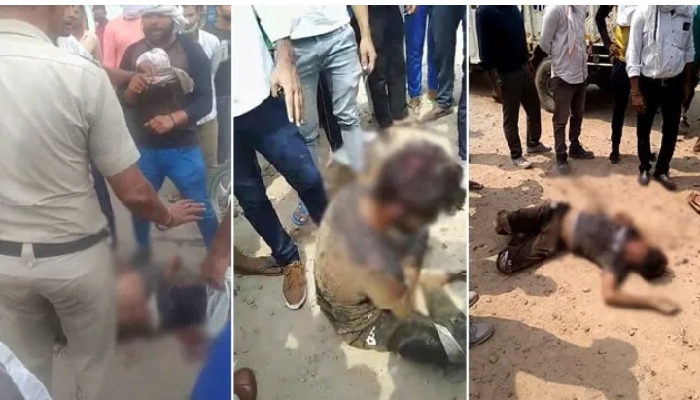
New Delhi, July 1: In a terrific incident with chilling echoes of the 2015 Dadri mob lynching, a Muslim man, who was carrying meat, was savagely attacked by a mob belonging to a saffron outfit in the presence of in BJP ruled Haryana on the eve of Eid al-Adha. 

The incident occurred at around 9 a.m. on Friday, July 31 at Badshahpur village in Haryana’s Gurgaon, when Lukman was transporting meat in a pic-kup truck. 

The attack was captured on mobile phones by onlookers and the video clips of the incident are now spreading on social media. 

A group of saffronite cow vigilantes chased the truck for about 8 km managed waylay it. Lukman, who was driving the truck was pulled out and brutally assaulted on the suspicion that he was transporting cow meat.

Just like Dadri, the police were faster at sending the meat to a lab for testing than catching any one of the suspects. One of the assailants - Pradeep Yadav- has been arrested. 

After being beating to an inch of his life, Lukman was bundled into the pick-up truck and taken back to Gurgaon's Badshahpur village where the goons started thrashing him again.

This is when the police stepped in and stopped them - only to find the assailants fearless enough to even take on them.

Lukman was taken to a hospital and the police filed a case against "unidentified individuals" even though the video of the incident recorded by witnesses shows the faces of the assailants.

The owner of the vehicles said that the meat was buffalo and he has been in the business for 50 years.

The police have so far refused to give a statement on record on the incident and explain their inaction as seen on video.

Comments

Add new comment

  • Coastaldigest.com reserves the right to delete or block any comments.
  • Coastaldigset.com is not responsible for its readers’ comments.
  • Comments that are abusive, incendiary or irrelevant are strictly prohibited.
  • Please use a genuine email ID and provide your name to avoid reject.
News Network
May 29,2020

Washington, May 29: US President Donald Trump while speaking with reporters at the White House on Thursday said that he is more liked in India than the media in his own country --the United States.

"I know. And they like me in India. I think they like me in India certainly more than the media likes me in this country, " Trump told reporters at his Oval office.

"And I like Modi (Prime Minister Narendra Modi). I like your prime minister a lot. He's a great gentleman. A great gentleman," he added further while briefing the reporters.

But when asked over ties between India and China, the US President said, "They have a big conflict going with India and China. Two countries with 1.4 billion people. Two countries with very powerful militaries. And India is not happy, and probably China is not happy."

Reiterating his offer to mediate between India and China on the border issue, Trump said that he spoke to Prime Minister Narendra Modi, who is not in "good mood" about the ongoing situation with Beijing.

However, informed sources from the Ministry of External Affairs told ANI on Friday that there has been no recent contact between Prime Minister Modi and the US President. The last conversation between them took place on April 4, 2020, on the subject of hydroxychloroquine.

Asked about his Wednesday's tweet regarding his offer to mediate between India and China, Trump said, "I would do that. If they (China and India) thought it would help." However, Trump did not clarify when did he speak to Modi.

Trump on Wednesday tweeted that he is "ready, willing and able to mediate" between India and China."We have informed both India and China that the United States is ready, willing and able to mediate or arbitrate their now raging border dispute," the US President said.

In response to Trump's mediation offer, India said on Thursday that it is engaged with the Chinese side to resolve the border issue peacefully.

India's Ministry of External Affairs spokesperson Anurag Srivastava said that the two sides have established mechanisms both at military and diplomatic levels to resolve situations that may arise in border areas peacefully through dialogue and "continue to remain engaged through these channels."

Indian and Chinese field commanders have been holding talks on de-escalating the tensions.

China has also struck a conciliatory tone on the border issue with India, saying the two countries pose no threat to each other and should resolve their differences through communication, while not allowing them to overshadow bilateral relations.

"We should never let differences overshadow our relations. We should resolve differences through communication. China and India should be good neighbours of harmonious coexistence and good partners to move forward hand in hand," said Chinese Ambassador to India, Sun Weidong, on Wednesday.

The tensions escalated between India and China following a number of confrontations between soldiers of both armies.

Troops of India and China were engaged in two face-offs in Eastern Ladakh and North Sikkim along the disputed Line of Actual Control (LAC), where troops from both sides suffered injuries early this month.

Studies over the anti-malarial drug, which is believed to cure the highly contagious coronavirus, have shown side-effects, according to the Centers for Disease Control and Prevention and the World Health Organisation. But Trump continues to defend his decision to take hydroxychloroquine saying he believes that it gives an additional level of safety.

Comments

Add new comment

  • Coastaldigest.com reserves the right to delete or block any comments.
  • Coastaldigset.com is not responsible for its readers’ comments.
  • Comments that are abusive, incendiary or irrelevant are strictly prohibited.
  • Please use a genuine email ID and provide your name to avoid reject.