



Huge rallies in Turkey mark failed 2016 coup

Agencies
July 16, 2017

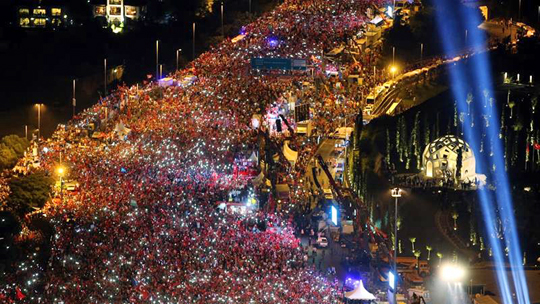
Turkey, Jul 16: Tens of thousands of people gathered at a massive rally in Istanbul, marking one year since the defeat of the coup aimed at ousting President Recep Tayyip Erdogan from power.
Turkey

Joining the crowd gathered on Saturday at the Bosphorus Bridge, now known as the July 15 Martyr's Bridge, Erdogan threatened to "chop off the heads" of those involved in the coup.

"First of all we will chop off the heads of those traitors," Erdogan said as reaffirmed previous comments to sign any bill passed restoring capital punishment.

"We are a state governed by rule of law. If it comes to me after parliament, I will sign it," he said. Restoring the death penalty would effectively end Ankara's European Union membership ambitions.

Erdogan also praised the "people's faith" in facing up the armed coup plotters.

Erdogan arrived from the capital Ankara on his official plane accompanied by an F-16 fighter jet, news agency reported.

The authorities declared July 15 an annual national holiday of "democracy and unity", billing the foiling of the putsch as a historic victory of Turkish democracy.

"It's one year since the darkest night was turned into an epic," Prime Minister Binali Yildirim told a special session of parliament that kicked off a day of celebrations set to last until dawn.

He said the night of July 15 was a "second War of Independence" after the war that led to the creation of the modern Turkish state in the ruins of the Ottoman Empire in 1923.

About 249 people, not including the plotters, were killed when a disgruntled faction of the army sent tanks into the streets and war planes into the sky in a bid to overthrow Erdogan.

But they were thwarted within hours as the authorities regrouped and people poured into the streets in support of Erdogan, who blamed followers of his ally-turned-nemesis, the US-based preacher Fethullah Gulen.

Tens of thousands carried the Turkish flag while others brandished pictures of the "martyrs" who died defeating the coup bid as a sea of people stretched from the bridge.

People chanted "we are soldiers of Tayyip [Erdogan]" and called for the reinstatement of the death penalty for the coup plotters, with some even brandishing nooses.

At 2100 GMT, people across Turkey took part in "democracy watches", rallies commemorating how people poured out into the streets.

'Post-coup purge'

In the wake of the failed coup bid, authorities embarked on the biggest purge in Turkey's history, arresting 50,000 people and sacking almost three times as many. Erdogan also shored up his position by winning a referendum on enhancing his powers earlier this year.

In the latest dismissals, another 7,563 police, soldiers and other state employees were fired late on Friday under the state of emergency that has been in place since July 20 last year.

Turkey's opposition put political disputes aside on the night of the putsch.

Erdogan, who was present at the session, gazed down stonily from the VIP balcony.

Erdogan later returned to Ankara and, at 2300 GMT, gave a speech in parliament to mark the time the building was bombed last year.

Al Jazeera's Sinem Koseoglu, reporting from Ankara, said Erdogan, in his speech in front of the parliament, said the fight against the treason will continue.

"In front of the parliament, the president emphasised its importance. He also said they will continue efforts to clean the institution of the Gulen group within the state," she said.

"Erdogan also named the coup plotters as traitors, saying the fight against treason will conitnue."

The coup bid also frayed ties between the United States and European Union with NATO member Turkey, which accused its allies of failing to show solidarity.

Gulen has always denied involvement and in a new statement Friday said the accusations were "baseless, politically motivated slanders" and slammed a "witch hunt" of Erdogan's critics.

Comments

hussain
 - 
Tuesday, 18 Jul 2017

very funny , promoter of shirk became promoter of peace. ))

Add new comment

  • Coastaldigest.com reserves the right to delete or block any comments.
  • Coastaldigset.com is not responsible for its readers’ comments.
  • Comments that are abusive, incendiary or irrelevant are strictly prohibited.
  • Please use a genuine email ID and provide your name to avoid reject.
Agencies
May 19,2020

Ramallah, May 19: India has given USD 2 million in aid to the United Nations Relief and Works Agency working for the welfare of Palestinian refugees in support of its core programmes and services, including education and health, amidst the coronavirus crisis.

India had increased its annual contribution to the UNRWA from USD 1.25 million in 2016 to USD 5 million in 2019. It pledged another USD 5 million for 2020 which opens its way to become a member of the agency's advisory commission, according to official sources.

The United Nations Relief and Works Agency (UNRWA) applauded India's financial support to keep its basic services operating, especially under the challenges posed by the COVID-19 pandemic.

The contribution was presented to the UN agency by the Representative of India (ROI) to the State of Palestine, Sunil Kumar.

"On behalf of the agency, I would like to express my deep appreciation to the Government of India for advancing part of its contribution, which will help UNRWA address cash flow challenges," Marc Lassouaoui, chief of the Donor Relations at the agency said.

"The continued determination and commitment of India in support of the Palestine refugees is commendable, in particular under the current circumstances brought on us by COVID-19," he said.

"On behalf of the Government of India, I would like to express my appreciation for the commendable work and endeavours carried out by the UNRWA. We believe that our contribution will support the agency's activities in providing the needed assistance to Palestinian refugees, and assist in achieving their full human development potential," Kumar said.

India's contribution will support the agency's "dire" financial situation due to the funding gaps that risk its core services to the Palestinian refugees in the fields of education and health.

About 3.1 million Palestine refugees depend on health services provided by the UNRWA. At the same time, the agency's schools educate 526,000 students every year, of which half are female.

The agency was created in December 1949 by the UN to support the relief and human development of Palestinian refugees.

The UNRWA definition of “refugee” covers Palestinians who fled or were expelled from their homes during the 1948 War.

Meanwhile, India is preparing medical supplies for the Palestinians to help them in their fight against the coronavirus which is likely to reach the Palestine soon, the Indian mission in the West Bank said in a statement.

Prime Minister Narendra Modi last month spoke to Palestinian President Mahmoud Abbas over phone and discussed the challenges posed by the COVID-19 pandemic. He appreciated efforts being made by the Palestinian Authority (PA) to protect its population and assured all possible support from India.

External Affairs Minister S Jaishankar later talked to his Palestinian counterpart Riad Malki and reiterated India's commitment to support Palestine in its battle against the global pandemic.

So far, 554 COVID-19 cases have been detected in the West Bank under PA and east Jerusalem, with two casualties.

Twenty people were found infected with the virus in Gaza, of which 14 are said to have recovered.

Separately, 17 agreements have been signed under an India-Palestine development partnership between the two sides in the fields of agriculture, health care, information technology, youth affairs, consular affairs, women empowerment and media in the past five years.

New Delhi is to provide an assistance of around USD 72 million through these agreements in projects like the post-2014 war reconstruction efforts in Gaza, construction of five schools, setting up a centre of excellence for information and communication technologies at Al-Quds University and developing a satellite centre in Ramallah.

Comments

Add new comment

  • Coastaldigest.com reserves the right to delete or block any comments.
  • Coastaldigset.com is not responsible for its readers’ comments.
  • Comments that are abusive, incendiary or irrelevant are strictly prohibited.
  • Please use a genuine email ID and provide your name to avoid reject.
Agencies
May 7,2020

Dubai, May 7: Indians in the UAE have voiced scepticism about a "massive" operation announced by New Delhi to bring home some of the hundreds of thousands of nationals stranded by coronavirus restrictions.

"It is just propaganda," said Ishan, an Indian expatriate in Dubai, one of seven emirates in the UAE and long a magnet for foreign workers.

He was reacting to his government's announcement this week that it would deploy passenger jets and naval ships to bring home citizens stuck in a host of countries.

India's consulate in Dubai said it received about 200,000 requests from nationals seeking repatriation -- mostly workers who have lost their jobs in the pandemic.

One vessel was heading to the UAE, India's government said, while two flights were scheduled to depart the UAE for India on Thursday.

But the plans drew scorn from Ishan, who was a manager at a luxury services company before he was made redundant last month.

"It's like throwing a dog a bone," the 35-year-old complained on Wednesday, dismissing the Indian government's efforts as a drop in the ocean.

"Let's say they repatriate 400 people on the first day, and about 5,000 people in 10 days, what difference has it made?"

India banned all incoming commercial flights in late March as it imposed one of the world's strictest lockdowns to tackle the spread of coronavirus.

The UAE is home to a 3.3-million-strong Indian community, who make up around 30 per cent of the Gulf state's population.

To the anger of some Indian expatriates, the evacuees will have to pay for their passage home and spend two weeks in quarantine on arrival.

"We are upset over the failure of our government," Ishan said. "What about the people with no money? How are you helping them?"

The Indian consulate could not be reached for comment.

Ibrahim Khalil, head of the Kerala Muslim Cultural Center in Dubai, said the consulate had asked him to select 100 Indian nationals for repatriation.

"We are planning to pay for the tickets of those who cannot afford it," he said, adding that the elderly, pregnant and those suffering from illnesses were a priority.

But one Indian woman, eight months pregnant in the neighbouring emirate of Sharjah, was not one of the lucky ones chosen to go back home in one of Thursday's planned departures.

"We called them but nobody would pick up," the 26-year-old, who requested anonymity, told AFP.

She arrived in the UAE a few months ago to visit her husband, who lives in a shared apartment with another family to save money.

"We have no insurance here and the medical expenses are too costly," said the woman, who was anxious to leave to give birth at home.

"I just hope that I am chosen to go back to India. I don't know why I haven't been considered."

Comments

Add new comment

  • Coastaldigest.com reserves the right to delete or block any comments.
  • Coastaldigset.com is not responsible for its readers’ comments.
  • Comments that are abusive, incendiary or irrelevant are strictly prohibited.
  • Please use a genuine email ID and provide your name to avoid reject.
News Network
July 23,2020

Beirut, Jul 23: The pandemic will exact a heavy toll on Arab countries, causing an economic contraction of 5.7% this year, pushing millions into poverty and compounding the suffering of those affected by armed conflict, a U.N. report said Thursday.

The U.N.'s Economic and Social Commission for Western Asia expects some Arab economies to shrink by up to 13%, amounting to an overall loss for the region of $152 billion.

Another 14.3 million people are expected to be pushed into poverty, raising the total number to 115 million — a quarter of the total Arab population, it said. More than 55 million people in the region relied on humanitarian aid before the COVID-19 crisis, including 26 million who were forcibly displaced.

Arab countries moved quickly to contain the virus in March by imposing stay-at-home orders, restricting travel and banning large gatherings, including religious pilgrimages.

Arab countries as a whole have reported more than 830,000 cases and at least 14,717 deaths. That equates to an infection rate of 1.9 per 1,000 people and 17.6 deaths per 1,000 cases, less than half the global average of 42.6 deaths, according to the U.N.

But the restrictions exacted a heavy economic toll, and authorities have been forced to ease them in recent weeks. That has led to a surge in cases in some countries, including Lebanon, Iraq and the Palestinian territories.

Wealthy Gulf countries were hit by the pandemic at a time of low oil prices, putting added strain on already overstretched budgets. Middle-income countries like Jordan and Egypt have seen tourism vanish overnight and a drop in remittances from citizens working abroad.

War-torn Libya and Syria have thus far reported relatively small outbreaks. But in Yemen, where five years of civil war had already generated the world's worst humanitarian crisis, the virus is running rampant in the government-controlled south while rebels in the north conceal its toll.

Rola Dashti, the head of the U.N. commission, said Arab countries need to “turn this crisis into an opportunity” and address longstanding issues, including weak public institutions, economic inequality and over-reliance on fossil fuels.

“We need to invest in survival, survival of people and survival of businesses,” she said.

Comments

Add new comment

  • Coastaldigest.com reserves the right to delete or block any comments.
  • Coastaldigset.com is not responsible for its readers’ comments.
  • Comments that are abusive, incendiary or irrelevant are strictly prohibited.
  • Please use a genuine email ID and provide your name to avoid reject.