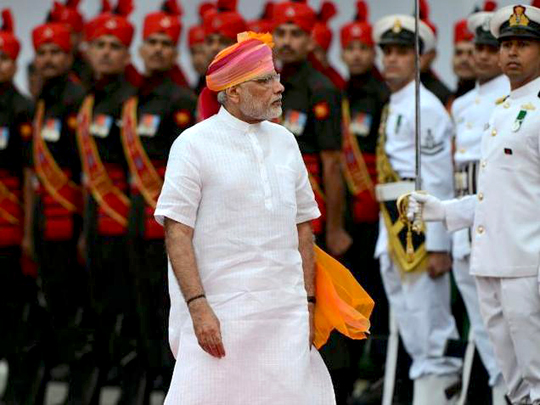
I-Day lie exposed: Village mentioned by PM Modi still without power!

August 18, 2016

Lucknow, Aug 18: Nagla Fatela village in Uttar Pradesh's Hathras district, which found mention in Prime Minister Narendra Modi's Independence Day speech as being “electrified” 70 years after freedom, is still “powerless”.

modi

According to the UP Power Corporation officials here, Nagla Fatela did have power lines, but they were meant only for supplying power for irrigation and running the tubewells and not lighting homes. Some residents, however, had electrified their homes through illegal connections, the officials said. They said that the village was being supplied power for irrigation purposes for the last 25 years.

The corporation sources here said that the work of installing transformers, poles and wires, which was taken up under the Deen Dayal Upadhyaya Village Electrification Project, had almost been completed in the village, but power was yet to be supplied.

A resident of the village said power lines had been installed almost a year ago. The residents also said that the village where the people were shown watching TV during the prime minister's speech in a post on social media by a Union minister was not theirs.

Sources said that power officials rushed to the village to conduct a survey after Modi mentioned the village in his speech. “We are expecting supply of power within a few days,” said a senior official.

Modi, during his I-Day speech, said that Nagla Fatela village was three hours drive from Delhi, but it took 70 years for power to reach the village.

Comments

Manku Thimma
 - 
Thursday, 18 Aug 2016

I really do not understand why these media people are exposing that man's lies day by day? Who world knows he is a liar. Once in a week he speaks truth also. make it a news saying man with 56 inch chest finally spoke a truth!

UMMAR
 - 
Thursday, 18 Aug 2016

modhiji good for publicity then nothing

fekuu jii... ab ki baar fekuuu sarkaar...

Sameer
 - 
Thursday, 18 Aug 2016

Fekna mera kaam hey sun'na ulluon k kaam hey..

Shuaib
 - 
Thursday, 18 Aug 2016

fekna mera janma sidh adhikar hai!

Add new comment

  • Coastaldigest.com reserves the right to delete or block any comments.
  • Coastaldigset.com is not responsible for its readers’ comments.
  • Comments that are abusive, incendiary or irrelevant are strictly prohibited.
  • Please use a genuine email ID and provide your name to avoid reject.
Agencies
May 8,2020

Washington D.C., May 8: The prime time for brain development in a child's life is the first year, where the infant spends most of the time asleep. It is the time when neural connections form and sensory memories are encoded.

However, when sleep is disrupted, as occurs more often among children with autism, brain development may be affected, too.

New research led by the University of Washington finds that sleep problems in a baby's first 12 months may not only precede an autism diagnosis but also may be associated with altered growth trajectory in a key part of the brain, the hippocampus.

The study, which was published in the American Journal of Psychiatry, researchers report that in a sample of more than 400 taken of 6- to 12-month-old infants, those who were later diagnosed with autism were more likely to have had difficulty falling asleep.

It also states that this sleep difficulty was associated with altered growth trajectories in the hippocampus.

"The hippocampus is critical for learning and memory, and changes in the size of the hippocampus have been associated with poor sleep in adults and older children.

As many as 80 per cent of the children with autism spectrum disorder have sleep problems," said Annette Estes, director of the UW Autism Center and senior author of the study.

"In our clinical experience, parents have a lot of concerns about their children's sleep, and in our work on early autism intervention, we observed that sleep problems were holding children and families back," added Estes, who is also a UW professor of speech and hearing sciences.

"It could be that altered sleep is part-and-parcel of autism for some children. One clue is that behavioural interventions to improve sleep don't work for all children with autism, even when their parents are doing everything just right. This suggests that there may be a biological component to sleep problems for some children with autism," said Estes.

To consider links among sleep, brain development, and autism, researchers at the IBIS Network looked at MRI scans of 432 infants, surveyed parents about sleep patterns, and measured cognitive functioning using a standardized assessment.

At the outset of the study, infants were classified according to their risk for developing autism: Those who were at higher risk of developing autism -- about two-thirds of the study sample -- had an older sibling who had already been diagnosed.

Infant siblings of children with autism have a 20 per cent chance of developing autism spectrum disorder -- a much higher risk than children in the general population.

In the current study, 127 of the 432 infants were identified as "low risk" at the time the MRI scans were taken because they had no family history of autism.

They later evaluated all the participants at 24 months of age to determine whether they had developed autism. Of the roughly 300 children originally considered "high familial risk," 71 were diagnosed with autism spectrum disorder at that age.

Problems with sleep were more common among the infants later diagnosed with an autism spectrum disorder, as were larger hippocampi. No other subcortical brain structures were affected, including the amygdala, which is responsible for certain emotions and aspects of memory, or the thalamus, a signal transmitter from the spinal cord to the cerebral cortex.

The authors note that while parents reported more sleep difficulties among infants who developed autism compared to those who did not, the differences were very subtle and only observed when looking at group averages across hundreds of infants.

Sleep patterns in the first years of life change rapidly as infants transition from sleeping around the clock to a more adult-like sleep/wake cycle. Until further research is completed, Estes said, it is not possible to interpret challenges with sleep as an early sign of increased risk for autism.


Comments

Add new comment

  • Coastaldigest.com reserves the right to delete or block any comments.
  • Coastaldigset.com is not responsible for its readers’ comments.
  • Comments that are abusive, incendiary or irrelevant are strictly prohibited.
  • Please use a genuine email ID and provide your name to avoid reject.
News Network
January 5,2020

Bengaluru, Jan 5: Former Deputy Chief Minister G Parameshwara has said the Karnataka Congress has unanimously decided to appeal to the party high command regarding the appointment of KPCC President and Congress Legislature Party (CLP) leader in the state.

Speaking to reporters, the Congress leader said, "We have decided to gather the opinion of senior leaders regarding the selection of Karnataka Pradesh Congress Committee (KPCC) president and opposition leaders. We will appeal to the high command regarding the same. The party will decide its next course of action."

He made these remarks after a meeting of senior party leaders was held at Parameshwara's residence here on Saturday.

Adding that the Congress leaders discussed the current political scenario in the state, Parameshwara said: "We held a meeting to reiterate that we are not confused and we all are together."

"There has been no personal discussion on who should be the president," he said.

Earlier, KPCC president Dinesh Gundu Rao and former Chief Minister Siddaramaiah had tendered resignation from their respective posts owning moral responsibility for the party's poor performance in the recent by-polls.

Comments

Add new comment

  • Coastaldigest.com reserves the right to delete or block any comments.
  • Coastaldigset.com is not responsible for its readers’ comments.
  • Comments that are abusive, incendiary or irrelevant are strictly prohibited.
  • Please use a genuine email ID and provide your name to avoid reject.
News Network
July 10,2020

Bengaluru, Jul 10: With 2,313 more people testing positive for coronavirus in Karnataka in the last 24 hours, its overall tally of patients rose to 33,418 on Friday, health officials said.

57 patients died in Karnataka in the last 24 hours, with majority (27) of them from Bengaluru, taking the state''s death toll to 543, the officials added.

Bengaluru accounted for 1,447 or 63 per cent of the new COVID-19 cases, spiking its tally to 15,329, out of which 11,687 are active cases.

The city alone accounts for 46 per cent of all the cases in the state.

As many as 45 deaths had Severe Acute Respiratory Infection (SARI) as a common symptom.

Among the new cases, excluding Bengaluru, Dakshina Kannada accounted for 139 infections, followed by Vijayapura (89), Ballari (66), Kalaburagi (58), Yadgir and Mysuru (51 each) among others.

On Friday, a record 1,003 patients got discharged, 601 of them in Bengaluru alone with the total number of discharges rising up to 13,836.

Until now, Karnataka has tested 7.79 lakh samples for Covid, out of which 7.28 lakh tested negative.

Despite the record number of discharges, patients in ICU rose to 472.

Of the 33,418 cases, 19,035 are active in the state.

Comments

Add new comment

  • Coastaldigest.com reserves the right to delete or block any comments.
  • Coastaldigset.com is not responsible for its readers’ comments.
  • Comments that are abusive, incendiary or irrelevant are strictly prohibited.
  • Please use a genuine email ID and provide your name to avoid reject.