I-T unearths Rs 871 crore scam in Rajkot bank

January 9, 2017

New Delhi, Jan 9: The income tax (I-T) department has detected huge alleged discrepancies in the transactions of a Rajkotbased cooperative bank where Rs 871 crore deposits were made, over 4,500 new accounts opened and more than five dozen accounts having same mobile number initiated, making it one of the biggest cases of black fund generation post November 8.

rajkotThe department's Ahmedabad probe wing has now initiated action under tax laws and has sought full details from the bank after it conducted survey operations against it sometime back and found large irregularities.

Officials said the department's investigation till now has found that cash deposits of Rs 871 crore, majorly using the old notes of Rs 500 and Rs 1000, was made in this bank between November 9-December 30 last year while Rs 108 crore was withdrawn during the same period in a highly suspicious manner not commensurate with the bank's activities during the same period in 2015 or at other times.

The sleuths have identified at least 25 high value cash deposits post demonetization where Rs 30 crore monies have been transacted in an alleged suspicious and unsatisfactory manner and in accounts with purported weak KYC norms in place. An I-T analysis report prepared in this regard states that Rs 10 crore funds were deposited in a number of "dormant" accounts post the currency scrap, including in that of a petroleum firm where Rs 2.53 crore was deposited.

What has startled the taxman has been the fact that a total of "4,551 new accounts were opened in the bank post demonetization as against the average 5,000 of such accounts usually opened in the full year while 62 of these were opened using one mobile number." It was detected, they said, that there were blatant discrepancies in the pay-in slips filled to make the deposits as none of them had PAN numbers quoted, many had no signatures of the depositor even as none had any documents to reflect the source of these amounts.

"It was found that the son of bank's ex-director has received Rs 1 crore through cash deposits in 30 bank accounts. All the pay-in slips were filled by the same person. "Also, the mother of the vice-chairman of the bank has received 64 lakh of cash deposits which have ultimately been transferred to a jeweller," the report alleged and added the funds moved through RTGS and other banking transfer channels.

Comments

Skazi
 - 
Monday, 9 Jan 2017

Shaji, even the role of notorious BJP leaders can not be ruled out ....

Let the justice prevail, and INDIA be CLEAN ....

shaji
 - 
Monday, 9 Jan 2017

I hope investigation will lead to involvement of anti social, anti national and terrorist organisation in this huge currency deal.

Add new comment

  • Coastaldigest.com reserves the right to delete or block any comments.
  • Coastaldigset.com is not responsible for its readers’ comments.
  • Comments that are abusive, incendiary or irrelevant are strictly prohibited.
  • Please use a genuine email ID and provide your name to avoid reject.
News Network
January 24,2020

Bengaluru, Jan 24: On the last day of his four-day trip to Davos, Switzerland, to attend the World Economic Forum, chief minister BS Yediyurappa urged the global business community to invest in cities other than Bengaluru in the state.

On Thursday, while extending an invitation to entrepreneurs to participate in the Global Investors Meet in November in Bengaluru, Yediyurappa highlighted the “conducive investment climate” in the state vis-a-vis others by pointing to its 7% growth rate which is much higher than the national average of below 5%.

He also pointed to the state’s rich history and the fact that it is home to a number of desi MNCs such as Infosys, Biocon Wipro and Dynamatics. “At the same time, the state has one of the lowest unemployment rates compared to the national average,” Yediyurappa said.

In his address to heads of businesses, industries minister Jagadish Shettar also urged investors to consider Tier 2 and 3 cities for investment. “Land banks have been created in Tier 2 and 3 cities and regional connectivity has improved. Let us strive to place Karnataka on a highgrowth path,” Shettar said.

Lending a “helping hand”, Union minister Piyush Goyal, in his address, appealed to the community to invest in Karnataka, which “has a robust and congenial industrial atmosphere”, but also urged them to spread “tentacles” to all parts of the country.

Comments

Add new comment

  • Coastaldigest.com reserves the right to delete or block any comments.
  • Coastaldigset.com is not responsible for its readers’ comments.
  • Comments that are abusive, incendiary or irrelevant are strictly prohibited.
  • Please use a genuine email ID and provide your name to avoid reject.
Agencies
May 8,2020

Washington D.C., May 8: The prime time for brain development in a child's life is the first year, where the infant spends most of the time asleep. It is the time when neural connections form and sensory memories are encoded.

However, when sleep is disrupted, as occurs more often among children with autism, brain development may be affected, too.

New research led by the University of Washington finds that sleep problems in a baby's first 12 months may not only precede an autism diagnosis but also may be associated with altered growth trajectory in a key part of the brain, the hippocampus.

The study, which was published in the American Journal of Psychiatry, researchers report that in a sample of more than 400 taken of 6- to 12-month-old infants, those who were later diagnosed with autism were more likely to have had difficulty falling asleep.

It also states that this sleep difficulty was associated with altered growth trajectories in the hippocampus.

"The hippocampus is critical for learning and memory, and changes in the size of the hippocampus have been associated with poor sleep in adults and older children.

As many as 80 per cent of the children with autism spectrum disorder have sleep problems," said Annette Estes, director of the UW Autism Center and senior author of the study.

"In our clinical experience, parents have a lot of concerns about their children's sleep, and in our work on early autism intervention, we observed that sleep problems were holding children and families back," added Estes, who is also a UW professor of speech and hearing sciences.

"It could be that altered sleep is part-and-parcel of autism for some children. One clue is that behavioural interventions to improve sleep don't work for all children with autism, even when their parents are doing everything just right. This suggests that there may be a biological component to sleep problems for some children with autism," said Estes.

To consider links among sleep, brain development, and autism, researchers at the IBIS Network looked at MRI scans of 432 infants, surveyed parents about sleep patterns, and measured cognitive functioning using a standardized assessment.

At the outset of the study, infants were classified according to their risk for developing autism: Those who were at higher risk of developing autism -- about two-thirds of the study sample -- had an older sibling who had already been diagnosed.

Infant siblings of children with autism have a 20 per cent chance of developing autism spectrum disorder -- a much higher risk than children in the general population.

In the current study, 127 of the 432 infants were identified as "low risk" at the time the MRI scans were taken because they had no family history of autism.

They later evaluated all the participants at 24 months of age to determine whether they had developed autism. Of the roughly 300 children originally considered "high familial risk," 71 were diagnosed with autism spectrum disorder at that age.

Problems with sleep were more common among the infants later diagnosed with an autism spectrum disorder, as were larger hippocampi. No other subcortical brain structures were affected, including the amygdala, which is responsible for certain emotions and aspects of memory, or the thalamus, a signal transmitter from the spinal cord to the cerebral cortex.

The authors note that while parents reported more sleep difficulties among infants who developed autism compared to those who did not, the differences were very subtle and only observed when looking at group averages across hundreds of infants.

Sleep patterns in the first years of life change rapidly as infants transition from sleeping around the clock to a more adult-like sleep/wake cycle. Until further research is completed, Estes said, it is not possible to interpret challenges with sleep as an early sign of increased risk for autism.

Comments

Add new comment

  • Coastaldigest.com reserves the right to delete or block any comments.
  • Coastaldigset.com is not responsible for its readers’ comments.
  • Comments that are abusive, incendiary or irrelevant are strictly prohibited.
  • Please use a genuine email ID and provide your name to avoid reject.
coastaldigest.com news network
July 30,2020

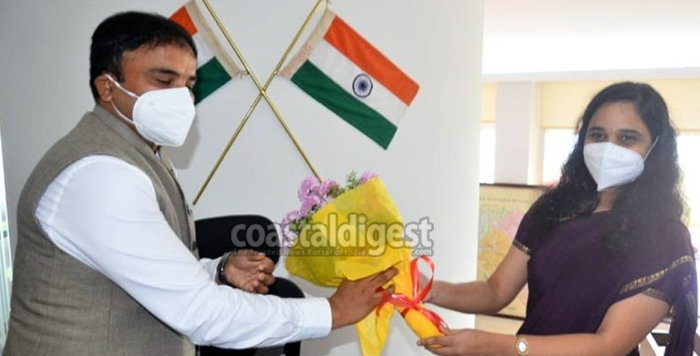
Mangaluru, July 30: Medical doctor turned IAS officer K V Rajendra assumed charge as the 130th deputy commissioner of Dakshina Kannada district here today.

The 2013 batch Karnataka cadre officer succeeds Sindhu B Rupesh, who was transferred as Director of Electronic Delivery of Citizen Services (EDCS), Bengaluru. The outgoing DC welcomed the new DC in the presence of staff. 

Dr Rajendra said that he expects cooperation from all stakeholders in administering the district, amidst the mounting Covid-19 cases.

Rajendra, an alumnus of JJM Medical College, Davanagere, was serving as the CEO of Belagavi zilla panchayat before being posted as DC of this coastal district. 

Having served as assistant commissioner of Puttur sub-division for nearly a year from December 2015, Dr Rajendra, hails from Thirthahalli in Shivamogga district, had his probationary training in Bidar. He posted as CEO of Ballari ZP where he worked for nearly three till 21, 2019.

He also had a brief stint as assistant secretary in the department of fertiliser with the ministry of chemicals and fertilisers.

Sindhu who was the CEO of Udupi zilla panchayat had succeeded Sasikanth Senthil, who resigned from the Indian Administrative Service on September 6, 2019. She had taken charge on September 7, 2019.

Comments

Add new comment

  • Coastaldigest.com reserves the right to delete or block any comments.
  • Coastaldigset.com is not responsible for its readers’ comments.
  • Comments that are abusive, incendiary or irrelevant are strictly prohibited.
  • Please use a genuine email ID and provide your name to avoid reject.