



I will quit, says Mayawati after her speech was cut short in Rajya Sabha

Agencies
July 18, 2017

New Delhi, Jul 18: An angry BSP supremo Mayawati on Tuesday said she will quit from the Rajya Sabha after the Chair asked her to restrict her impromptu speech on anti-Dalit violence in Saharanpur in Uttar Pradesh.mayawati
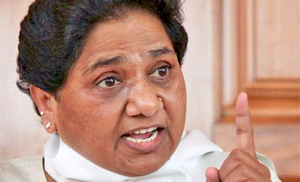
“I will resign from Rajya Sabha today,” a visibly anguished Mayawati shot back when Deputy Chairman P.J. Kurien asked her to wrap up her speech as she had exceeded the three minutes given to her to make her submission.

Ms. Mayawati, whose term in the Upper House is till April next year, argued with Mr. Kurien saying how can she be prevented from raising the issue about her ‘samaj’ (community) and the Dalits. “I have not finished. You cannot do this.”

“I have no moral right to be in the House if I am not allowed to put across my views on atrocities being committed against Dalits,” she said.

'Discussion after notice only'

Mr. Kurien said she can only call for a discussion after giving a notice under rule 267 that seeks adjournment of proceedings to take up an issue and not make a speech to initiate a discussion.

A discussion can begin only after the Chair, on the advise of the government, accepts the notice and agrees for a discussion.

Mr. Kurien rose from his seat in an attempt to calm her down but Ms. Mayawati refused to agree saying she has no right to be in the House if she cannot protect the rights of her community.

“I am going to resign from the house,” she said and walked out of the House in a huff.

He party colleagues led by Satish Mishra followed her but were back in the House soon to raise slogans against the alleged anti-Dalit policies of the government.

Minister of State for Parliamentary Affairs Mukhtar Abbas Naqvi said Mayawati was challeging the Chair. “She should apologise. She has threatened the Chair,” he said.

BSP members immediately rushed into the Well shouting .

“Dalit virodhi yeh sarkar nahi chalegi, nahi chalegi” (anti-dalit government will not be tolerated).

Leader of the Opposition Ghulam Nabi Azad briefly prevailed over them to allow him to make his submission.

Mr. Azad said the government at an all-party meeting before the start of the monsoon session had agreed to discuss any issue that the Opposition wants to raise in the house.

“Promise was made to us in the presence of the Prime Minister. You are going against that,” Mr. Azad said.

He said the Opposition led by Congress has given notices to discuss crisis facing farmers, anti-Dalit violence and lynching of minorities.

Responding to the barbs of the treasury benches to respect the people’s mandate, Mr. Azad said the government has got a mandate to protect the Dalits and minorities and for development.

“You didnt get a mandate to massacre minorities and Dalits,” he said adding the Congress was staging a walkout of the House in protest. Congress members then walked out of the House.

Soon thereafter, BSP members were back in the Well shouting anti-government slogans.

Sitaram Yechury (CPI-M) said the government policies were pushing farmers to suicide.

Mr. Naqvi said the government was ready for discussion on any issue and the opposition should give a notice.

Mr. Kurien said the government was agreeing to having a discussion, so the opposition members should return to their seats and start it.

“Shouting slogan is no soluition. We can discuss. The Chair is ready to allow discussion on all subjects. Let us start,” he said. But the opposition members remained unrelenting, forcing him to adjourn the proceedings till 1200 hours.

Earlier, Ms. Mayawati while elaborating on the incidents in Saharanpur, said the Dalits had agreed to the district administration’s order not to take out any procession or install a statue of Bhim Rao Ambedkar on April 14. But the followers of Maharana Pratap however took out a procession on May 5, she said.

Before she could complete, Kurien asked her to sit and called the next speaker, saying “you cannot monopolise”, angering Ms. Mayawati.

 

Comments

Add new comment

  • Coastaldigest.com reserves the right to delete or block any comments.
  • Coastaldigset.com is not responsible for its readers’ comments.
  • Comments that are abusive, incendiary or irrelevant are strictly prohibited.
  • Please use a genuine email ID and provide your name to avoid reject.
News Network
January 22,2020

Jan 22: India's ranking in the latest global Democracy Index has dropped 10 places to the 51st spot out of 167 owing to violent protests and threats to civil liberties challenging freedoms across the country.

Prime Minister Narendra Modi's government has been criticized by rights groups and western governments after shutting off the internet and mobile phone networks and detaining opposition politicians in Kashmir.

Modi’s government has also responded harshly to ongoing protests against a controversial, religion-based citizenship law. Muslims have said their neighborhoods have been targeted, while the central government has attempted to ban protests and urged TV news channels not to broadcast “anti-national” content. Some leaders in Modi’s ruling party called for “revenge” against protesters. India’s score in 2019 was its worst ranking since the EIU’s records began in 2006, and has fallen gradually since Modi was elected in 2014.

The Economist Intelligence Unit’s 2019 Democracy Index, which provides an annual comparative analysis of political systems across 165 countries and two territories, said the past year was the bleakest for democracies since the research firm began compiling the list in 2006.

“The 2019 result is even worse than that recorded in 2010, in the wake of the global economic and financial crisis,” the research group said in releasing the report on Wednesday.

The average global score slipped to 5.44 out of a possible 10 -- from 5.48 in 2018 -- driven mainly by “sharp regressions” in Latin America, Sub-Saharan Africa, the Middle East and North Africa. Apart from coup-prone Thailand, which improved its score after holding an election last year, there were also notable declines in Asia after a tumultuous period of protests and new measures restricting freedom across the region’s democracies.

Asia Declines

Hong Kong, meanwhile, fell three places to rank 75th out of 167 as more than seven months of violent and disruptive protests rocked the Asian financial hub. An aggressive police response early in the unrest, when protests were mostly peaceful, led to a “marked decline in confidence in government -- the main factor behind the decline in the territory’s score in our 2019 index,” the group said.

In Singapore, which ranked alongside Hong Kong at 75th, a new “fake news” law led to a deteriorating score on civil liberties.

“The government claims that the law was enacted simply to prevent the dissemination of false news, but it threatens freedom of expression in Singapore, as it can be used to curtail political debate and silence critics of the government,” EIU analysts said.

China’s score fell to just 2.26 in the EIU’s ranking, placing it near the bottom of the list at 153, as discrimination against minorities, repression and surveillance of the population intensified. Still, in China “the majority of the population is unconvinced that democracy would benefit the economy, and support for democratic ideals is absent,” the EIU said.

Comments

Add new comment

  • Coastaldigest.com reserves the right to delete or block any comments.
  • Coastaldigset.com is not responsible for its readers’ comments.
  • Comments that are abusive, incendiary or irrelevant are strictly prohibited.
  • Please use a genuine email ID and provide your name to avoid reject.
News Network
March 10,2020

Mar 10: Indian energy tycoon Mukesh Ambani is no longer Asia’s richest man, relinquishing the title to Jack Ma after oil prices collapsed along with global stocks.

The rout, exacerbated by mounting fears that the spread of the novel coronavirus will thrust the world into a recession, erased $5.8 billion from Ambani’s net worth on Monday and pushed him to No. 2 on the list of Asia’s richest people, according to the Bloomberg Billionaires Index. Ma, the Alibaba Group Holding Ltd. founder who relinquished the No. 1 ranking in mid-2018, is back on top with a $44.5 billion fortune, about $2.6 billion more than Ambani.

Oil plunged the most in 29 years on Monday as Saudi Arabia and Russia vowed to pump more in a struggle for market share. The slump comes just as the coronavirus is spurring the first decline in demand in more than a decade. That raises questions about whether Ambani’s flagship Reliance Industries Ltd. will be able to cut net debt to zero by early 2021, as he has pledged. The plan hinges on a proposal to sell a stake in the group’s oil and petrochemicals division to Saudi Arabian Oil Co., the world’s biggest crude producer.

While the coronavirus has curtailed some of tech giant Alibaba’s businesses, the damage has been mitigated by increased demand for its cloud computing services and mobile apps.

Reliance Industries, by comparison, has no such silver lining. The Indian conglomerate’s shares plunged 12% on Monday, the most since 2009, extending this year’s decline to 26%. Alibaba’s American depositary receipts have slipped 6.8% so far in 2020.

Ma reclaims crown after Reliance shares were pummeled in 2020.

Few of the world’s billionaires fared well in Monday’s collapse as the S&P 500 Index and Dow Jones Industrial Average each plunged more than 7.5%, the most since the 2008 financial crisis, threatening to end the longest bull market in history. But no one did worse than those whose fortunes are underpinned by oil. Wildcatter Harold Hamm’s fortune was cut almost in half to $2.4 billion and fellow oil magnate Jeff Hildebrand lost $3 billion, bumping both from Bloomberg’s 500-member wealth ranking.

In a pivot toward new businesses such as telecommunications, technology and retail, Ambani’s Reliance Industries has piled on billions of dollars of debt over the years.

It spent almost $50 billion -- most of it funded by borrowings -- to build Reliance Jio Infocomm Ltd., which became India’s No. 1 wireless carrier within about three years of its debut. As the mobile venture took off, Ambani also unveiled plans for an e-commerce empire to rival Amazon.com Inc. in India.

Addressing concerns over the liabilities, Ambani pledged in August to cut the group’s net debt to zero from about $21 billion as of last March. The Aramco deal is crucial to that plan for which Reliance Industries has valued its oil-to-chemicals division at $75 billion including debt, implying a $15 billion valuation for the 20% stake that’s for sale.

Signs of a potential delay to that deal unnerved some investors, hammering the stock since it touched a record high on Dec. 19.

Reliance Industries expected the Aramco transaction to be completed by March, but people familiar with the matter said in February that talks were still ongoing to bridge differences between the two parties over the deal’s structure.

Adding to the uncertainty, Indian Prime Minister Narendra Modi’s administration has petitioned a court to halt the proposed stake sale, threatening a key source of funds needed to pare net debt.

But Ambani, 62, may soon bounce back from the setback, said Harish H.V., managing partner at ECube Investment Advisors in Bengaluru, India.

“The game isn’t over,” he said. “Ambani has successfully built a robust business model which would keep him in the game. Moreover, his telecom business will start yielding results in coming years.”

Comments

SmR
 - 
Tuesday, 10 Mar 2020

The curses of the bank depositors savings which vanished with collapsing economy and fraudlent seems to have gradully affecting riches of Ambani's.


AU
 - 
Tuesday, 10 Mar 2020

in Holy Quran Allah says; but they plan and Allah plans, and Allah is the best planners..(Surah Al Anfal 8:30)

Add new comment

  • Coastaldigest.com reserves the right to delete or block any comments.
  • Coastaldigset.com is not responsible for its readers’ comments.
  • Comments that are abusive, incendiary or irrelevant are strictly prohibited.
  • Please use a genuine email ID and provide your name to avoid reject.
Agencies
June 25,2020

New Delhi, Jun 25: The Congress on Thursday asked Prime Minister Narendra Modi why has not India gained anything from the "strange bonhomie" which it claimed he shared with China.

Seeking to turn the tables on the ruling party, Congress spokesperson Pawan Khera said the BJP also shared bonhomie with the Communist Party of China (CPC) with several party-level exchanges taking place in the past.

He sought to know whether India's borders have become safe after these exchanges in the last many years.

The Congress leader asked what has the country gained out of these exchange delegations and why are the borders insecure despite the bonds that the two ruling parties of India and China share with each other.

"There is a strange kind of bonhomie between Narendra Modi and China, a two decade old bonhomie. Why doesn't the country get the benefit of that bonhomie," he asked at a virtual press conference.

Khera said all that the Congress will continue to question is about the political will that just does not get visible when it comes to China.

"Whatever is happening on the border today, is it despite the bonhomie which you have with China, or is it because of the bonhomie which you have with China. The country needs to know," he asked.

"We do want to ask you, if as president of the party, Rajnath Singh, Nitin Gadkari and Amit Shah have been sending delegations,  strengthening the bonds between the Communist Party of China and the BJP. What has the country gained out of these bonds? Why are the borders insecure despite these bonds that you have," he also asked.

The ruling has hit out at the Congress for signing an MoU with China's Communist Party and has questioned its "bond" with the ruling party in China.

Khera also asked what role did the India Foundation, an organisation run by National Security Adviser Ajit Doval's son has in strengthening the bonds with China.

"Why does India Foundation keep visiting these countries? Who do they meet? What's the outcome? What's the role of NSA Ajit Doval's son- Shaurya Doval? He keeps attending these meetings through India Foundation? These are important questions in the light of what is happening," he asked.

Khera said the prime minister is showing "red eyes" to those who are asking him questions instead of showing them to the enemy.

"It is time to stand with the Army and show red eyes to China," he said.

The Congress leader said questions will be asked to Modi especially when there are definitive reports, satellite images of incursions in the Ladakh region of India by the Chinese.

He alleged that China laps up the comment of Modi and uses it across the world that the Indian prime minister says that China is in its own territory and Galwan is theirs.

"After a lot of pressure, PMO contradicted what the prime minister said. This kind of a goof up is unpardonable," he alleged.

Comments

Add new comment

  • Coastaldigest.com reserves the right to delete or block any comments.
  • Coastaldigset.com is not responsible for its readers’ comments.
  • Comments that are abusive, incendiary or irrelevant are strictly prohibited.
  • Please use a genuine email ID and provide your name to avoid reject.