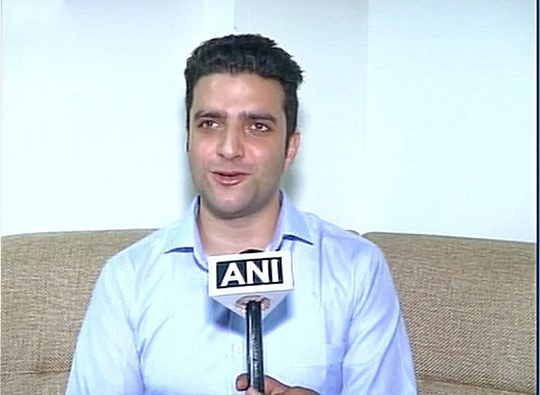
IAS 2nd topper Kashmir's Khan turned failure into opportunity

May 10, 2016

Srinagar, May 10: He saw an opportunity in failure and today Athar Aamir-ul-Shafi Khan is all smiles after securing second rank in the prestigious civil services examination, 2015.

ias copy

23-year-old Khan made it to the coveted Indian Administrative Service (IAS) in his second attempt.

"I had appeared last year but my ranking was down and, therefore, I was offered Indian Railway Traffic Service (IRTS). I joined but IAS was my first love and I planned to to do both -- join the training and appear again."

Hailing from Devipora-Mattan village in Anantnag district, 60 km south of Srinagar, Khan, son of a school teacher, says he became interested in joining IAS after Shah Faesal from the Kashmir Valley topped civil services examination in 2009.

"I did not have a great exposure to coaching classes but I was confident that I can do it. Extensive reading and complete dedication made me realise my dream," he said.

Besides this, he said, he always wanted to be of use to the society by being "with the people" and doing something "for the people".

Khan, who did his 11th and 12th from prestigious Tyndale Biscoe School in Srinagar, said he had made it to the IIT but did not join as he was offered a B-Tech course when he wanted to pursue BE. "This also acted as a catalyst for me to appear for the civil services and I qualified last year.

"I met Mr Shah Faesal and took his advice on whether I should join the services. We had a long discussion and after that we arrived at a conclusion that I should join as well as appear again.

"So here I am....happy at the decision. I have already given IAS as my first choice and Jammu and Kashmir as my cadre preference. I believe that there is a lot of scope for me to do something for my people in the state," says Khan, who is at present undergoing training at Lucknow for IRTS.

Meanwhile, an elated Mohammed Shafi Khan, who teaches economics at the Government Higher Secondary school in Anantnag, has a steady stream of visitors coming to congratulate him on his son's success.

"I am a proud father today. The best moment in a father's life is when he is known by his children and today my son has given me this happiness," an excited Khan Sr said.

Expressing the hope that his son's success will inspire the young generation to try and make it big in life and not let failure overwhelm them, Khan said, "It gives me immense pleasure that my son did it against all odds. He was undergoing training at Lucknow for his IRTS and simultaneously he was preparing for the civil services exam again.

"His hard work has paid rich dividends. Allah has listened to our prayers," he said.

Comments

Aslam Sheikh
 - 
Wednesday, 11 May 2016

Congrats brother, May Allah bless you!!

Add new comment

  • Coastaldigest.com reserves the right to delete or block any comments.
  • Coastaldigset.com is not responsible for its readers’ comments.
  • Comments that are abusive, incendiary or irrelevant are strictly prohibited.
  • Please use a genuine email ID and provide your name to avoid reject.
Ram Puniyani
March 14,2020

In the wake of Citizenship Amendment Act (CAA) UN High Commissioner, Michele Bachelet, has filed an intervention in the Supreme Court petition challenging the constitutionality of the Citizenship Amendment Act, as she is critical of CAA. Responding to her, India’s Foreign Minister S. Jai Shanker strongly rebutted her criticism, saying that the body (UNHCR) has been wrong and is blind to the problem of cross border terrorism. The issue on hand is the possibility of scores of people, mainly Muslims, being declared as stateless. The problem at hand is the massive exercise of going through the responses/documents from over 120 crore of Indian population and screening documents, which as seen in Assam, yield result which are far from truthful or necessary.

The issue of CAA has been extensively debated and despite heavy critique of the same by large number of groups and despite the biggest mass opposition ever to any move in Independent India, the Government is determined on going ahead with an exercise which is reminiscent of the dreaded regimes which are sectarian and heartless to its citizens, which have indulged in extinction of large mass of people on grounds of citizenship, race etc. The Foreign minister’s assertion is that it is a matter internal to India, where India’s sovereignty is all that matters! As far as sovereignty is concerned we should be clear that in current times any sovereign power has to consider the need to uphold the citizenship as per the principle of non-discrimination which is stipulated in Art.26 of the International Covenant on Civil and Political (ICCPR) rights.

Can such policies, which affect large number of people and are likely to affect their citizenship be purely regarded as ‘internal’? With the World turning into a global village, some global norms have been formulated during last few decades. The norms relate to Human rights and migrations have been codified. India is also signatory to many such covenants in including ICCPR, which deals with the norms for dealing with refugees from other countries. One is not talking of Chicago speech of Swami Vivekanand, which said that India’s greatness has been in giving shelter to people from different parts of the World; one is also not talking of the Tattariaya Upanishad’s ‘Atithi Devovhav’ or ‘Vasudhaiva Kutumbkam’ from Mahaupanishad today.

What are being talked about are the values and opinions of organizations which want to ensure to preserve of Human rights of all people Worldwide. In this matter India is calling United Nations body as ‘foreign party’; having no locus standi in the case as it pertains to India’s sovereignty. The truth is that since various countries are signatories to UN covenants, UN bodies have been monitoring the moves of different states and intervening at legal level as Amicus (Friend of the Court) to the courts in different countries and different global bodies. Just to mention some of these, UN and High Commissioner for Human Rights has often submitted amicus briefs in different judicial platforms. Some examples are their intervention in US Supreme Court, European Court of Human Rights, International Criminal Court, and the Inter-American Court of Human Rights. These are meant to help the Courts in areas where UN bodies have expertise.

 Expertise on this has been jointly formulated by various nations. These interventions also remind the nations as to what global norms have been evolved and what are the obligations of individual states to the values which have evolved over a period of time. Arvind Narrain draws our attention to the fact that, “commission has intervened in the European Court of Human Rights in cases involving Spain and Italy to underscore the principle of non-refoulement, which bars compulsory expulsion of illegal migrants… Similarly, the UN has intervened in the International Criminal Court in a case against the Central African Republic to explicate on the international jurisprudence on rape as a war crime.”

From time to time organizations like Amnesty International and Human Rights Watch have been monitoring the status of Human rights of different countries. This puts those countries in uncomfortable situation and is not welcome by those establishments. How should this contradiction between ‘internal matter’, ‘sovereignty’ and the norms for Human rights be resolved? This is a tough question at the time when the freedom indices and democratic ethos are sliding downwards all over the world. In India too has slid down on the scale of these norms.

In India we can look at the intervention of UN body from the angle of equality and non discrimination. Democratic spirit should encourage us to have a rethink on the matters which have been decided by the state. In the face of the greatest mass movement of Shaheen bagh, the state does need to look inwards and give a thought to international morality, the spirit of global family to state the least.

The popular perception is that when Christians were being persecuted in Kandhmal the global Christian community’s voice was not strong enough. Currently in the face of Delhi carnage many a Muslim majority countries have spoken. While Mr. Modi claims that his good relations with Muslim countries are a matter of heartburn to the parties like Congress, he needs to relook at his self gloating. Currently Iran, Malaysia, Indonesia and many Muslim majority countries have spoken against what Modi regime is unleashing in India. Bangladesh, our neighbor, has also seen various protests against the plight of Muslims in India. More than the ‘internal matter’ etc. what needs to be thought out is the moral aspect of the whole issue. We pride ourselves in treading the path of morality. What does that say in present context when while large section of local media is servile to the state, section of global media has strongly brought forward what is happening to minorities in India.   

The hope is that Indian Government wakes up to its International obligations, to the worsening of India’s image in the World due to CAA and the horrific violence witnessed in Delhi.


Comments

Add new comment

  • Coastaldigest.com reserves the right to delete or block any comments.
  • Coastaldigset.com is not responsible for its readers’ comments.
  • Comments that are abusive, incendiary or irrelevant are strictly prohibited.
  • Please use a genuine email ID and provide your name to avoid reject.
coastaldigest.com news network
May 20,2020

Mangaluru/Udupi, May 20: Islamic scholars belonging to different schools of thoughts including two prominent Qadis have issued special guidelines asking all Muslims in the region to offer prayers and celebrate Eid al-Fitr at home this year in keeping with the extended covid-19 lockdown.

Eid al-Fitr which marks the end of the month-long dawn-to-sunset fasting of Ramadan is rather a ‘humanitarian event’ than a fiesta. This year Eid is likely to be observed in coastal Karnataka on May 23 or May 24 depending on sighting of the new moon.  

Amid the Covid-19 pandemic, the Muslims are preparing for — and reconciling itself to — a most unusual Eid bereft of all the usual trappings like huge prayer congregations, ceaseless shopping, social visits and the inviting warmth of an Eid Mubarak embrace.

In their separate messages, Udupi Qadi Bekal Ibrahim Musliyar and Mangaluru Qadi Twaqa Ahmed Musliyar have urged Muslims to refrain from all kinds of public gatherings during Eid. Noting that Muslims in the region have followed all the advisories in issued by the government to contain the spread of coronavirus in the blessed month of Ramadan, they have urged them to follow the guidelines during Eid too.

On social media groups, messages like “no new clothes, just wear your best clothes” are being circulated among family and friends, urging people to fill the festive void with the spirit of giving. The suggestions range from paying a needy child’s school fee or someone’s rent to helping a lockdown-hit trader revive his business.

Following guidelines are issued by the top clerics ahead Eid

1) There will be no Eid prayer in mosques or Eid-gahs. Hence, Muslims should offer Eid al-Fitr prayer in their homes with family members.

2) Distributing Zakat al-Fitr among needy is mandatory. However necessary safety measures should be taken while going out such as wearing masks and maintaining physical distance. As there is lockdown from 7 p.m. to 7 a.m. every day, Zakat al-Fitr can be distributed a day before Eid or on the day of Eid before evening. 

3) Women, children and elderly people should not step out of the houses.

4) Avoid visiting graveyards or other places.

5) All mosques are closed due to lockdown. Hence, observe Eid in a simple way and set an example for the society. 

6) Strictly follow all the guidelines issued by the state and central governments

Comments

Add new comment

  • Coastaldigest.com reserves the right to delete or block any comments.
  • Coastaldigset.com is not responsible for its readers’ comments.
  • Comments that are abusive, incendiary or irrelevant are strictly prohibited.
  • Please use a genuine email ID and provide your name to avoid reject.
News Network
May 12,2020

Bengaluru, May 12: Last week, a 28-year-old, eight-months pregnant woman, was found murdered at her house, in Diburahalli. The woman was hacked to death with a machete during the day and was discovered only after her family members returned home, later in the day. After the alleged murder, the accused tried to destroy the evidence, by cleaning the crime scene, and wiping the bloodstains off the walls and floors.

The victim was a homemaker and her husband is employed in the railway department. The police suspected that the murder was a result of someone known to the woman and family, and were soon proved right. The woman was murdered by her own brother-in-law, frustrated with her for allegedly not taking care of his mother and other family members properly.

The victim has been identified as Jyothi, and the accused is her husband’s brother Hareesh Babu, 38. “Jyothi and the accused are alleged to have had differences for the past few years. Their fights kept escalating over the years. She had also informed her family and her husband about the regular fights with the brother-in-law. The accused had been advised by the family, to back off from Jyothi. Owing to his violent streak, Babu’s wife had deserted him and their son. Since his wife’s departure, he had started troubling his brother’s wife and was regularly picked a fight with her.

He complained that Jyothi neglected to take care of his mother and other family members. Investigations reveal these as false allegations, and in fact, Babu’s son was being raised by Jyothi,” said an officer on part of investigations.

Last week, when the victim was resting at home, the accused returned home at around 10.30 am and picked up a fight with her. The fight escalated and Babu ended up hacking her to death with a machete. The victim’s father Nagaraj, at the time of filing a complaint, mentioned Babu’s regular fights with Jyothi and suspected his role in the murder of his pregnant daughter.

The accused, after killing her, had gone to the farm and pretended to not knowing about the the happenings back home. Based on the complainant’s suspicion, the police picked up Babu. After a thorough interrogation, Babu reportedly confessed to the murder of his sister-in-law. The machete, which was used for Jyothi’s murder, was also recovered by the police team.

A case of murder under section 302 of the Indian Penal Code has been registered and further investigations are underway.

Comments

abdullah
 - 
Tuesday, 12 May 2020

Put this case in fast track and hang him immediately.  No mercy should be shown on such inhumans.

Add new comment

  • Coastaldigest.com reserves the right to delete or block any comments.
  • Coastaldigset.com is not responsible for its readers’ comments.
  • Comments that are abusive, incendiary or irrelevant are strictly prohibited.
  • Please use a genuine email ID and provide your name to avoid reject.