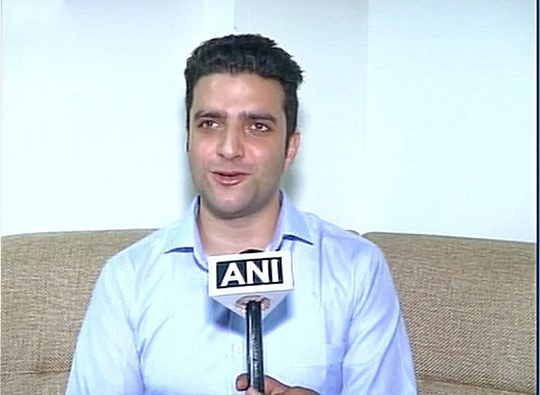
IAS 2nd topper Kashmir's Khan turned failure into opportunity

May 10, 2016

Srinagar, May 10: He saw an opportunity in failure and today Athar Aamir-ul-Shafi Khan is all smiles after securing second rank in the prestigious civil services examination, 2015.

ias copy

23-year-old Khan made it to the coveted Indian Administrative Service (IAS) in his second attempt.

"I had appeared last year but my ranking was down and, therefore, I was offered Indian Railway Traffic Service (IRTS). I joined but IAS was my first love and I planned to to do both -- join the training and appear again."

Hailing from Devipora-Mattan village in Anantnag district, 60 km south of Srinagar, Khan, son of a school teacher, says he became interested in joining IAS after Shah Faesal from the Kashmir Valley topped civil services examination in 2009.

"I did not have a great exposure to coaching classes but I was confident that I can do it. Extensive reading and complete dedication made me realise my dream," he said.

Besides this, he said, he always wanted to be of use to the society by being "with the people" and doing something "for the people".

Khan, who did his 11th and 12th from prestigious Tyndale Biscoe School in Srinagar, said he had made it to the IIT but did not join as he was offered a B-Tech course when he wanted to pursue BE. "This also acted as a catalyst for me to appear for the civil services and I qualified last year.

"I met Mr Shah Faesal and took his advice on whether I should join the services. We had a long discussion and after that we arrived at a conclusion that I should join as well as appear again.

"So here I am....happy at the decision. I have already given IAS as my first choice and Jammu and Kashmir as my cadre preference. I believe that there is a lot of scope for me to do something for my people in the state," says Khan, who is at present undergoing training at Lucknow for IRTS.

Meanwhile, an elated Mohammed Shafi Khan, who teaches economics at the Government Higher Secondary school in Anantnag, has a steady stream of visitors coming to congratulate him on his son's success.

"I am a proud father today. The best moment in a father's life is when he is known by his children and today my son has given me this happiness," an excited Khan Sr said.

Expressing the hope that his son's success will inspire the young generation to try and make it big in life and not let failure overwhelm them, Khan said, "It gives me immense pleasure that my son did it against all odds. He was undergoing training at Lucknow for his IRTS and simultaneously he was preparing for the civil services exam again.

"His hard work has paid rich dividends. Allah has listened to our prayers," he said.

Comments

Aslam Sheikh
 - 
Wednesday, 11 May 2016

Congrats brother, May Allah bless you!!

Add new comment

  • Coastaldigest.com reserves the right to delete or block any comments.
  • Coastaldigset.com is not responsible for its readers’ comments.
  • Comments that are abusive, incendiary or irrelevant are strictly prohibited.
  • Please use a genuine email ID and provide your name to avoid reject.
Agencies
February 20,2020

India ranked 77th on a sustainability index that takes into account per capita carbon emissions and ability of children in a nation to live healthy lives and secures 131st spot on a flourishing ranking that measures the best chance at survival and well-being for children, according to a UN-backed report.

The report was released on Wednesday by a commission of over 40 child and adolescent health experts from around the world. It was commissioned by the World Health Organization (WHO), UN Children's Fund (UNICEF) and The Lancet medical journal.

In the report assessing the capacity of 180 countries to ensure that their youngsters can survive and thrive, India ranks 77th on the Sustainability Index and 131 on the Flourishing Index, it said.

Flourishing is the geometric mean of Surviving and Thriving. For Surviving, the authors selected maternal survival, survival in children younger than 5 years old, suicide, access to maternal and child health services, basic hygiene and sanitation, and lack of extreme poverty.

For Thriving, the domains were educational achievement, growth and nutrition, reproductive freedom, and protection from violence.

Under the Sustainability Index, the authors noted that promoting today's national conditions for children to survive and thrive must not come at the cost of eroding future global conditions for children's ability to flourish.

The Sustainability Index ranks countries on excess carbon emissions compared with the 2030 target. This provides a convenient and available proxy for a country's contribution to sustainability in future.

The report noted that under realistic assumptions about possible trajectories towards sustainable greenhouse gas emissions, models predict that global carbon emissions need to be reduced from 39·7 giga­ tonnes to 22·8 gigatonnes per year by 2030 to maintain even a 66 per cent chance of keeping global warming below 1·5°C.

It said that the world's survival depended on children being able to flourish, but no country is doing enough to give them a sustainable future.

"No country in the world is currently providing the conditions we need to support every child to grow up and have a healthy future," said Anthony Costello, Professor of Global Health and Sustainability at University College London, one of the lead authors of the report.

"Especially, they're under immediate threat from climate change and from commercial marketing, which has grown hugely in the last decade," said Costello – former WHO Director of Mother, Child and Adolescent health.

Norway leads the table for survival, health, education and nutrition rates - followed by South Korea and the Netherlands. Central African Republic, Chad and Somalia come at the bottom.

However, when taking into account per capita CO2 emissions, these top countries trail behind, with Norway 156th, the Republic of Korea 166th and the Netherlands 160th.

Each of the three emits 210 per cent more CO2 per capita than their 2030 target, the data shows, while the US, Australia, and Saudi Arabia are among the 10 worst emitters. The lowest emitters are Burundi, Chad and Somalia.

According to the report, the only countries on track to beat CO2 emission per capita targets by 2030, while also performing fairly – within the top 70 – on child flourishing measures are: Albania, Armenia, Grenada, Jordan, Moldova, Sri Lanka, Tunisia, Uruguay and Vietnam.

"More than 2 billion people live in countries where development is hampered by humanitarian crises, conflicts, and natural disasters, problems increasingly linked with climate change," said Minister Awa Coll-Seck from Senegal, Co-Chair of the commission.

The report also highlights the distinct threat posed to children from harmful marketing.

Evidence suggests that children in some countries see as many as 30,000 advertisements on television alone in a single year, while youth exposure to vaping (e-cigarettes) advertisements increased by more than 250 per cent in the US over two years, reaching more than 24 million young people.

Studies in Australia, Canada, Mexico, New Zealand and the US – among many others – have shown that self-regulation has not hampered commercial ability to advertise to children.

Children's exposure to commercial marketing of junk food and sugary beverages is associated with purchase of unhealthy foods and overweight and obesity, linking predatory marketing to the alarming rise in childhood obesity, it said.

The number of obese children and adolescents increased from 11 million in 1975 to 124 million in 2016 – an 11-fold increase, with dire individual and societal costs, the report said.

To protect children, the authors call for a new global movement driven by and for children.

Specific recommendations include stopping CO2 emissions with the utmost urgency, to ensure children have a future on this planet; placing children and adolescents at the centre of global efforts to achieve sustainable development, the report said.

New policies and investment in all sectors to work towards child health and rights; incorporating children's voices into policy decisions and tightening national regulation of harmful commercial marketing, supported by a new Optional Protocol to the UN Convention on the Rights of the Child, it said.


Comments

Add new comment

  • Coastaldigest.com reserves the right to delete or block any comments.
  • Coastaldigset.com is not responsible for its readers’ comments.
  • Comments that are abusive, incendiary or irrelevant are strictly prohibited.
  • Please use a genuine email ID and provide your name to avoid reject.
News Network
March 31,2020

Bengaluru, Mar 31: Bengaluru Central Crime Branch on Tuesday seized as many as 1,000 fake N95 masks amid the ongoing coronavirus pandemic.

However, the police are yet to make arrests in the case.

Investigation in the case is underway and more details in this regard are awaited.

Recently, Noida Sub-Divisional Magistrate with a team from the Health department busted a fake sanitiser and mask factory.

Notably, the Central government recently had brought masks and hand sanitisers under the Essential Commodities Act up to June 30 as the novel coronavirus pandemic led to shortages and black marketing of these items.

Any person found guilty under the Act may be punished with imprisonment up to seven years or fine or both and can be detained for a maximum of six months.

Comments

Add new comment

  • Coastaldigest.com reserves the right to delete or block any comments.
  • Coastaldigset.com is not responsible for its readers’ comments.
  • Comments that are abusive, incendiary or irrelevant are strictly prohibited.
  • Please use a genuine email ID and provide your name to avoid reject.
News Network
June 10,2020

Bengaluru, June 10: The Department of Primary and Secondary Education of Government of Karnataka today ordered a ban on online classes for children from KG to class 5.

The decision was taken following a report based on the report submitted by director NIMHANS, recommending online classes only above the age of 6 years and also following the complaints from several parents about online classes conducted by private schools even for kindergarten kids.

Briefing the media soon after the meeting with department officials, S Suresh Kumar, primary and secondary education minister said, "We have taken two major decisions today. The online classes for LKG, UKG and primary classes should be stopped immediately."

Even collecting fees in the name of online classes should be stopped, said the minister. "We have already issued a circular about it insisting that schools not collect fees in the name of online classes and also requesting schools not to increase fees for the 2020-21 academic year considering financial constraints of several people due to the COVID-19 pandemic," said the minister.

The department, however, also discussed how to engage children during this period as there was no clarity over the reopening of schools for the 2020-21 academic year. "We have constituted a committee to prepare guidelines on how to engage students and increase their knowledge. The committee is headed by Prof. MK Sridhar," he said.

Before taking this decision, the department had three rounds of discussions with various experts, including Prof. MK Sridhar, Prof. VP Niranjanaradhya, Dr John Vijay Sagar and other departments, including the home and health departments.

Comments

Add new comment

  • Coastaldigest.com reserves the right to delete or block any comments.
  • Coastaldigset.com is not responsible for its readers’ comments.
  • Comments that are abusive, incendiary or irrelevant are strictly prohibited.
  • Please use a genuine email ID and provide your name to avoid reject.