II PU chemistry re-exam on March 29

March 23, 2016

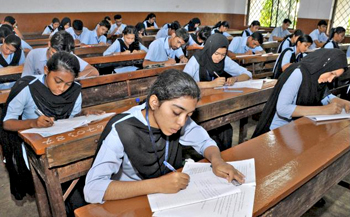
Bengaluru, Mar 23: The re-examination for students of second year PU chemistry paper that was leaked, will be held on March 29 between 9 am and 12:15 pm.

PUCThe decision by the Department of PU Education (DPUE) on Tuesday came even as nearly 200 students and parents protested outside its office in Malleswaram, opposing re-exam. The state government ordered a Criminal Investigation Department (CID)?probe into the question paper leak. Home Minister G?Parameshwara informed the Legislative Council that the probe was ordered on the request of Minister of State for Primary and Secondary Education Kimmane Rathnakar.

Rathnakar, however, ruled out re-examination for II?PU?mathematics paper, which students had complained was tough. He said the questions were in conformity with NCERT?syllabus adopted by the PU?board. Opposition members said rumours were rife that most of the II?PU?exam question papers this year had leaked.

The Malleswaram police, who had started a probe following a complaint by DPUE?on Monday night, said the leaked paper was circulated probably on WhatsApp and by email. Probe into the source of these messages would help in tracing those responsible for the leak.”

Aditya, a student waiting outside the PU department's office from 1 pm to 6.30 pm, said: “We want the re-examination to be cancelled. Why should I and other students be punished for the incompetence of the PU board. It is their responsibility to ensure that there are no leaks.”

Another protesting student spoke in the same vein. "We studied very hard and wrote the exam; these people do not have any concern for us. We do not want a re-exam,” he declared. If at all a re-exam is held, it should be for the Mathematics paper, he added. “There were 35 to 37 questions from outside the syllabus and it will impact the results in a big way,” he noted.

K N Ranganath, joint director (examinations), DPUE said: “Only a few students will be benefitted if a re-exam is not conducted. This would be an injustice to majority of the students. I am aware that students will suffer but this is required.”

Comments

M.Haneef
 - 
Wednesday, 23 Mar 2016

It is really demoralizing students who really burns their midnight oil and who prepared for exams. Government should use latest technology to prepare and safeguard the question papers till the last minutes.

It is impossible to leak the question paper without the help of PU board staff. Government should investigate this leak and punish guilty at the earliest with severe punishment to deter others in future.

finally, re-exam should not be more tough than earlier one as pupils have already exhausted preparing for one of the important milestone in their educational life. At least a little liberal evaluation will do more justice majority of the students who honestly wrote their first exams.

Add new comment

  • Coastaldigest.com reserves the right to delete or block any comments.
  • Coastaldigset.com is not responsible for its readers’ comments.
  • Comments that are abusive, incendiary or irrelevant are strictly prohibited.
  • Please use a genuine email ID and provide your name to avoid reject.
News Network
February 17,2020

Varanasi, Feb 17: For the first time, the Indian Railways has reserved a seat for a deity on a train. The national transporter, which launched its third IRCTC operated train named Kashi Mahakal Express from Varanasi to Indore, has reserved a seat for Lord Mahakal (Lord Shiva) on board.

Speaking to media, Northern Railway spokesperson Deepak Kumar said: "It is for the first time that a seat has been left reserved for a deity."

"One seat in Kashi Mahakal Express (seat number 64 in B5 coach) has been left reserved for Lord Shiva," he said.

"Even a temple has been drawn on the seat to make people aware that the seat is reserved for Lord Mahakal," he said.

IRCTC's Director, Tourism, Rajni Hasija said that the practice would continue beyond the inaugural run.

Prime Minister Narendra Modi flagged off the Kashi Mahakal Express via video conferencing from Varanasi, where he is all launched several projects worth Rs 1,250 crore during the day's visit to his parliamentary constituency.

The third IRCTC train, after the two Tejas Express trains on New Delhi-Lucknow and Mumbai-Ahmedabad routes, the Kashi Mahakal Express will connect three places -- Jyotirlinga-Omkareshwar (near Indore), Mahakaleshwar (Ujjain) and Kashi Vishwanath (at Varanasi).

Also connecting the industrial and educational hub of Indore, with Bhopal, the train will begin its commercial run from February 20.

"The Kashi Mahakal Express will operate three days in a week and it will be a bi-weekly service through the Sultanpur-Lucknow route and a weekly service via the Prayagraj route," Kumar said.

Elaborating on the two routes from which the train will pass every week, Hasija said: "Once the new train starts its regular run from this week, it will depart from Varanasi at 2.45 p.m. every Tuesday and Thursday to reach Indore at 9.40 a.m. on Wednesday and Friday.

Similarly, the train will start from Indore at 10.55 a.m. every Wednesday and Friday and will reach Varanasi at 6.00 a.m. the next day. This train will have stoppages at Ujjain, Sant Hirdaram Nagar, Bina, Jhansi, Kanpur and Sultanpur stations in both directions.

Meanwhile, in the weekly service via Prayagraj route, the Kashi Mahakal Express will depart from Varanasi at 3.15 p.m. every Sunday to reach Indore at 9.40 a.m. the next day. On the other way, it will depart from Indore at 10.55 a.m. every Monday and reach Varanasi at 5 a.m. the next day.

"This train will halt at Ujjain, Sant Hirdaram Nagar, Bina, Jhansi, Kanpur and Allahabad stations in both directions," Kumar said.

Explaining the fares of the Kashi Mahakal Express, Hasija said, "Kashi Mahakal Express will follow a dynamic fare structure like the other two Tejas Express trains."

One-way journey from Varnasi to Indore will cost Rs 1,951, inclusive of four meals.

According to the IRCTC officials, the Indore-Varanasi Kashi Mahakal Express will be the first private train that will run overnight and for a comfortable long distance journey, will feature a host of facilities. The IRCTC will serve vegetarian food, and provide housekeeping services, on-board security services and bedrolls.

The IRCTC officials said that passengers will also get complementary insurance of Rs 10 lakh.

The train will have an advance reservation period of 120 days and will only have the general and foreign tourist quotas. The current booking will be available to the passengers on the platform itself after preparation of first chart, four hours to five minutes before the scheduled departure of the train.

To facilitate travel for pilgrims, the IRCTC is also introducing special tour packages for passengers who want to see the pilgrim centres enroute. The tour options are; Mahakal Darshan (Ujjain - Omkareshwar), Bhopal-Sanchi-Bhimbetka, Malwa Jyotrilinga Darshan (Ujjain-Omkareshwar- Maheshwar- Indore) and Bhopal-Sanchi-Bhimbetka-Ujjain. Other tour options include Kashi, Ayodhya and Prayag; Kashi Darshan; Kashi, Prayag, Ayodhya; Kashi and Prayag and only Kashi.

The train has silent features like CCTV cameras, which will be monitored online around the clock from the IRCTC centres, whereas for the first time the IRCTC has brought the marshals in the train for passengers safety and also to make people aware to not smoke inside the train as it has smoke and heat sensors installed in the coaches as well as in the bathroom. For the blind passengers, the train coaches have the seat numbers written in Braille, and the catering staff will be dressed in yellow kurta-pyjamas with a rudraksh malas on their necks to promote the train's theme.


Comments

ASIF
 - 
Tuesday, 18 Feb 2020

waw.. good header with superb news..

good going !!

Althaf
 - 
Tuesday, 18 Feb 2020

If you are truthful then go to china and stay with patients of carona virus. The carona virus should not affect you as you are a vegeterian. Prove this first. 

Add new comment

  • Coastaldigest.com reserves the right to delete or block any comments.
  • Coastaldigset.com is not responsible for its readers’ comments.
  • Comments that are abusive, incendiary or irrelevant are strictly prohibited.
  • Please use a genuine email ID and provide your name to avoid reject.
Agencies
January 12,2020

New Delhi, Jan 12: In a shocking revelation, one unemployed person committed suicide every hour during 2018 when a total of 1,34,516 suicides, including 92,114 male and 42,391 female, were reported in the country, NCRB's "Suicide in India 2018" says.

The latest data, issued by the National Crime Records Bureau (NCRB), which comes under Ministry of Home Affairs, last week reveals that a total of 12,936 unemployed persons committed suicide in 2018, which accounted for 9.6 per cent of the total suicides, and were of aged below 18 years to above 60 years.

Those below 18 years include 31 males and nine females while those between 18 and 30 years comprise 1,240 male and 180 female. A total of 868 male and 95 female were aged between 30 and 45 years. A number of 237 males and 21 females were aged between 45 and 60 years while 2,431 males and 310 females were above 60 years.

Of the total suicides by unemployed persons, males are 10,687 while the females are 2,249.

The highest number of suicides - 12.3 per cent - committed by unemployed persons were in Kerala (1,585 out of 12,936 suicides), 12.2 per cent in Tamil Nadu (1,579), 9.7 per cent in Maharashtra (1,260 suicides), 8.5 per cent in Karnataka (1,094 suicides) and 7 per cent in Uttar Pradesh (902 suicides).

"Each suicide is a personal tragedy that prematurely takes the life of an individual and has a continuing ripple effect, dramatically affecting the lives of families, friends and communities. Every year, more than 1 lakh people commit suicide in our country. There are various causes of suicides like professional/career problems, sense of isolation, abuse, violence, family problems, mental disorders, addiction to alcohol, financial loss, chronic pain etc," says the NCRB adding it collects data on suicides from police recorded suicide cases.

As per the NCRB, rate of suicides has been calculated using projected population for the non-census years whereas for 2011, the population of the Population Census 2011 was used.

The NCRB data says that a total of 1,34,516 suicides were reported in the country during 2018 showing an increase of 3.6 per cent in comparison to 2017 and the rate of suicides has increased by 0.3 during 2018 over 2017.

Government servants accounted for 1.3 per cent (1,707 out of 1,34,516) of the total suicide victims as compared to 6.1 per cent (8,246 out of 1,34,516) of total victims from Private Sector Enterprises.

Employees from Public Sector Undertakings formed 1.5 per cent (2,022 out of 1,34,516) of the total suicide victims, whereas students and unemployed victims accounted for 7.6 per (10,159 victims) of total suicides. Self-employed category accounted for 9.8 per cent of total suicide victims (13,149 out of 1,34,516).

A total of 10,349 persons involved in farming sector (consisting of 5,763 farmers and cultivators and 4,586 agricultural labourers) have committed suicide during 2018, accounting for 7.7 per cent of total suicides victims (1,34,516) in the country.

A total of 11 transgenders have committed suicide in which three were daily wage earners, one each were 'professionals and salaried persons' and 'unemployed persons' while six falls under 'Other Persons'.

Comments

Add new comment

  • Coastaldigest.com reserves the right to delete or block any comments.
  • Coastaldigset.com is not responsible for its readers’ comments.
  • Comments that are abusive, incendiary or irrelevant are strictly prohibited.
  • Please use a genuine email ID and provide your name to avoid reject.
News Network
January 29,2020

Newsroom, Jan 29: Karnataka’s capital has earned the unwelcome distinction of global capital of traffic congestion. According to a report by TomTom, the Netherlands-based global provider of navigation, traffic and map products, Bengaluru beat 415 other cities across 57 countries to earn the title of world's most traffic congested city in 2019.

“Bengaluru takes the top spot this year with drivers in the southern Indian city expecting to spend an average of 71% extra travel time stuck in traffic," TomTom said in the ninth edition of its annual Traffic Index.

Three other Indian cities, namely, Mumbai, Pune and New Delhi are also ranked in the 2019 edition of TomTom’s Traffic Index of the world’s most traffic-congested cities. 

The report released on Tuesday ranks cities by the average time added to a trip. TomTom index also includes details on when congestion is heaviest and lightest, how highways compare with surface streets, and how much time drivers wasted waiting for other drivers to get out of their way.

Following closely on the heels of Bengaluru is Manila, Philippines, with the similar 71% traffic congestion. Among the top five worst traffic affected cities are Mumbai and Pune from India at the fourth and fifth place respectively, while Bogota, Colombia is on third spot.

Delhi, the national capital of India is on the 8th spot, while Moscow (Russia), Lima (Peru), Istanbul (Turkey) and Jakarta (Indonesia) are on 6th, 7th, 9th and 10th spot respectively.

Mumbai recorded a 65% traffic congestion with 9th September, 2019 being the worst day. On an average, a Mumbaikar lost 209 hours in traffic congestion. Pune has 59% traffic congestion with 2nd August, 2019 being the worst day. 193 hours are lost due to congestion. Delhi, on the other hand, has 56% traffic congestion. 23rd October, 2019 was the worst day, while 190 hours are lost in traffic congestion.

Interestingly, among all the four Indian cities, Delhi has the most number of cars. Previous studies have concluded that Delhi has the best road conditions among the Metro cities of India.

If you are wondering what exactly the percentages mean, a 53% congestion level in Bangkok, for example, means that a trip will take 53% more time than it would during Bangkok’s baseline uncongested conditions.

TomTom calculates the baseline per city by analyzing free-flow travel times of all vehicles on the entire road network – recorded 24/7, 365 days a year. The report by Dutch navigation and mapping company ranks cities by the average time added to a trip. It also includes details on when congestion is heaviest and lightest, and how much time drivers wasted waiting for other drivers to get out of their way.

Comments

Add new comment

  • Coastaldigest.com reserves the right to delete or block any comments.
  • Coastaldigset.com is not responsible for its readers’ comments.
  • Comments that are abusive, incendiary or irrelevant are strictly prohibited.
  • Please use a genuine email ID and provide your name to avoid reject.