



II PU chemistry re-exam on March 29

March 23, 2016

Bengaluru, Mar 23: The re-examination for students of second year PU chemistry paper that was leaked, will be held on March 29 between 9 am and 12:15 pm.
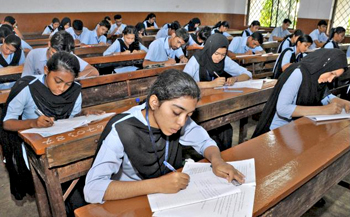
PUCThe decision by the Department of PU Education (DPUE) on Tuesday came even as nearly 200 students and parents protested outside its office in Malleswaram, opposing re-exam. The state government ordered a Criminal Investigation Department (CID)?probe into the question paper leak. Home Minister G?Parameshwara informed the Legislative Council that the probe was ordered on the request of Minister of State for Primary and Secondary Education Kimmane Rathnakar.

Rathnakar, however, ruled out re-examination for II?PU?mathematics paper, which students had complained was tough. He said the questions were in conformity with NCERT?syllabus adopted by the PU?board. Opposition members said rumours were rife that most of the II?PU?exam question papers this year had leaked.

The Malleswaram police, who had started a probe following a complaint by DPUE?on Monday night, said the leaked paper was circulated probably on WhatsApp and by email. Probe into the source of these messages would help in tracing those responsible for the leak.”

Aditya, a student waiting outside the PU department's office from 1 pm to 6.30 pm, said: “We want the re-examination to be cancelled. Why should I and other students be punished for the incompetence of the PU board. It is their responsibility to ensure that there are no leaks.”

Another protesting student spoke in the same vein. "We studied very hard and wrote the exam; these people do not have any concern for us. We do not want a re-exam,” he declared. If at all a re-exam is held, it should be for the Mathematics paper, he added. “There were 35 to 37 questions from outside the syllabus and it will impact the results in a big way,” he noted.

K N Ranganath, joint director (examinations), DPUE said: “Only a few students will be benefitted if a re-exam is not conducted. This would be an injustice to majority of the students. I am aware that students will suffer but this is required.”

Comments

M.Haneef
 - 
Wednesday, 23 Mar 2016

It is really demoralizing students who really burns their midnight oil and who prepared for exams. Government should use latest technology to prepare and safeguard the question papers till the last minutes.

It is impossible to leak the question paper without the help of PU board staff. Government should investigate this leak and punish guilty at the earliest with severe punishment to deter others in future.

finally, re-exam should not be more tough than earlier one as pupils have already exhausted preparing for one of the important milestone in their educational life. At least a little liberal evaluation will do more justice majority of the students who honestly wrote their first exams.

Add new comment

  • Coastaldigest.com reserves the right to delete or block any comments.
  • Coastaldigset.com is not responsible for its readers’ comments.
  • Comments that are abusive, incendiary or irrelevant are strictly prohibited.
  • Please use a genuine email ID and provide your name to avoid reject.
News Network
February 23,2020

The euphoria over the claim that around 3,000 tonnes of gold reserves, worth Rs 12 trillion, have been discovered in Uttar Pradesh’s Sonbhadra district could not last even 24 hours, with the Geological Survey of India (GSI) clarifying on Saturday there had been no such discovery.

The GSI, headquartered in Kolkata, rebutted the claims of the Uttar Pradesh Directorate of Geology and Mining (UPDGM), and said “miscommunication” must have led to the wrong reporting of facts.

M Sridhar, director general of the GSI, said nobody in the agency gave any such data. He said 52,806 tonnes of gold ore was found in Sonbhadra district during the exploration work in 1998-2000. From this reserve, only 160 kg of gold can be extracted.

“There must have been some miscommunication of facts because of which the gold ore deposits have been overestimated. We have written a letter to Uttar Pradesh (UPDGM), stating the facts. The GSI has not estimated such kind of vast resource of gold deposits in Sonbhadra,” Sridhar said.

ALSO READ: 2,900-tonne gold mine found in Sonbhadra, 4 times that of India's reserves

The UPDGM had said on Friday that gold deposits were found in Son Pahadi and Hardi areas of the district. Sridhar said while gold ore was found in the area during the GSI’s exploration work in 1998-2000, it had told the state government about the discovery in November last year.

Under the new regulation, which came into effect from 2015, the GSI has to inform the state government when ore deposits are discovered. Earlier, no such action was mandatory. In its report, the GSI estimated that only 3.03 gm of gold can be extracted from a tonne of ore. It also clarified that even the extraction amount was tentative and could not be established for certain.

Moreover, Sridhar said the deposits were spread across only 0.5 sq km in forest land, which made the mining of ore economically unviable. “When there are several mines nearby, we can club it into a block and then it makes sense to mine the ore. But in this case, the deposits are too small to make it viable for any company to mine it,” he said. The GSI usually prioritises its exploration work based on the needs of the Centre. While strategic minerals like tin, cobalt, lithium, beryllium, germanium, gallium, indium, tantalum, niobium, selenium, and bismuth are atop the list in GSI exploration, gold is another commodity on its priority list.

According to the World Gold Council, India has reserves of 630 tonnes of gold.

Comments

Add new comment

  • Coastaldigest.com reserves the right to delete or block any comments.
  • Coastaldigset.com is not responsible for its readers’ comments.
  • Comments that are abusive, incendiary or irrelevant are strictly prohibited.
  • Please use a genuine email ID and provide your name to avoid reject.
News Network
March 14,2020

Hyderabad, Mar 14: Telangana Public Health Director Dr Srinivas on Friday said that 34 people, who came in contact with the 76-year-old Karnataka man who died of coronavirus, have been identified in the state.

"So far, 34 people who came in contact with him have been traced and are kept under strict home isolation by the Telangana health authorities. As of now, all the contacts are stable and under active surveillance by the health teams of the Telangana government," Srinivas said.

He added that the rapid response team of the state is further searching for the persons who might have come in contact with the person who died of COVID-19.

"Telangana health authorities were alerted by the Karnataka government after the 76-year-old man's samples tested positive for coronavirus after his death. The man has visited two hospitals in Hyderabad before he died in Karnataka," Srinivas further said.

The Karnataka man, who had died a few days ago, was confirmed to have tested positive for COVID-19.

Meanwhile, Telangana Health Minister's office said that the lone coronavirus patient from the state has recovered and is going to be discharged from the hospital soon.

The development comes after 82 confirmed cases of coronavirus and two deaths related to the lethal infection have been reported in the country.

Comments

Add new comment

  • Coastaldigest.com reserves the right to delete or block any comments.
  • Coastaldigset.com is not responsible for its readers’ comments.
  • Comments that are abusive, incendiary or irrelevant are strictly prohibited.
  • Please use a genuine email ID and provide your name to avoid reject.
News Network
June 26,2020

Bengaluru, Jun 26: The National Restaurant Association of India (NRAI) on Thursday came up with a Standard Operating Procedure (SOP) for restaurants whereby among other physical distancing norms, it has suggested a 2-metre gap between tables.

Formulated in partnership with Releski, a Bengaluru based skill-tech company, the SoP suggests that in case of back-to-back seating, people sitting with their backs towards each other will have their seats divided by 'Plexiglass' divider raised up to 2 meters from the ground.

"In a typical restaurant, the improvised seating plan should have a minimum distance of 2 metres between tables. The distance of 2 metres (6 feet) between tables should measure from one edge of the table to the other table's edge," it said.

In case of loose or free seating such as in banquet style or food court style seating, a minimum 2 meters of distance should be maintained between tables.

The guidelines noted that, to encourage physical distancing, restaurants have to sacrifice their seating capacity, to promote health and safety, and also to gain trust from their patrons.

"In order to perform this, divide your restaurants under different sectors. Pull out your restaurant's floor plan and colour code different sections red and yellow. Red sections are potential areas where maximum footfall or traffic is observed. Yellow sections are areas where the footfalls are average," it said.

All the red sections are encircled or bordered by placing barricades or Q manager and will open at specific points to access the yellow section and all the opening points will have hand sanitisers and sprays, and every guest who walks from red zones to yellow zones will sanitise himself/herself to reduce the chances of contamination.

For air conditioning, the guidelines of CPWD shall be followed which inter alia emphasises that the temperature setting of all air conditioning devices should be in the range of 24-30 degree Celsius, relative humidity should be in the range of 40- 65 per cent, intake of fresh air should be as much as possible and cross ventilation should be adequate, the guidelines suggested.

The industry body has also suggested appointment of a COVID-free Ambassador who would operate as the Chief Health Officer within the restaurant team, preferably from the management team in each shift.

The ambassador's would put the new daily work routines into practice, to monitor compliance with good practice and to lead the preventative measures, adapt to health & safety recommendations and requirements of the restaurant and oversee the implementation of the norms.

Anurag Katriar, President of NRAI and CEO & Executive Director of deGustibus Hospitality, said: "Every restaurant cutting across formats is facing the harsh reality of subdued to shut business volumes in the present and the uncertainty of business environment in the future. One thing is certain that hygiene and safety will be a key differentiator in the post-pandemic restaurant operations."

Comments

Add new comment

  • Coastaldigest.com reserves the right to delete or block any comments.
  • Coastaldigset.com is not responsible for its readers’ comments.
  • Comments that are abusive, incendiary or irrelevant are strictly prohibited.
  • Please use a genuine email ID and provide your name to avoid reject.