


II PU paper leak: 3 persons including Minister's PA arrested

April 4, 2016

Bengaluru, Apr 4: A Karnataka minister's Personal Assistant and two others were arrested today in connection with Class 12 Chemistry exam question paper leak last week.pu-board
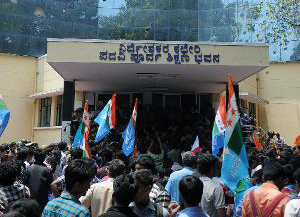
The first arrest comes four days after the leak of Pre-University Course Chemistry paper for the second time within 10 days that had affected over 1.74 lakh candidates and triggered strong protests from parents and students.

"Three persons including PA to Medical Education Minister (Sharan Prakash R Patil) have been arrested in the leak of Chemistry question paper of Class XII," Sonia Narang, DIG of CID which is probing the case, told PTI here.

The accused have been identified as Oblaraju, Manjunath and Rudrappa, and were arrested today, she said.

"Oblaraju is a government employee and PA to the minister, and Rudrappa is employed as office manager at PWD. Manjunath is a PT teacher, working at Cambridge College. He is also an LIC agent," Narang said.

Protests over cancellation of exams had turned violent as a section of agitated students pelted stones which damaged glass windows of the Department of Pre-University Education (DPUE) building. The paper leak had taken place in two different locations in Karnataka.

Earlier, the March 21 Chemistry exam was cancelled and rescheduled for March 31 after a II (second) PU science student alerted the authorities about the paper leak.

After the student blew the lid off the paper leak, the state government had handed over the investigation to CID.

The issue also had rocked the Assembly, where Opposition BJP members staged a dharna, demanding Primary and Secondary Education Minister Kimmane Ratnakar's resignation.

Under fire from all quarters, Ratnakar had said earlier that if there are any more lapses, he would resign.

Comments

Mohammed SS
 - 
Tuesday, 5 Apr 2016

it is very bad indeed, All of them have to be hanged in public, they should not be spared who play with carrier of the school children

Ramnath
 - 
Monday, 4 Apr 2016

Severe punishment should be given to these people if proved guilty

Add new comment

  • Coastaldigest.com reserves the right to delete or block any comments.
  • Coastaldigset.com is not responsible for its readers’ comments.
  • Comments that are abusive, incendiary or irrelevant are strictly prohibited.
  • Please use a genuine email ID and provide your name to avoid reject.
News Network
February 29,2020

Kochi, Feb 29: The Kerala Non-Resident Indians' Commission on Friday passed a resolution to request the Centre and Election Commission (EC) to make appropriate amendments in the Representation of Peoples Act, 1951, to ensure voting rights to the non-resident Indians working abroad. According to People’s Representation Act, 1951, None-Resident Indians (NRIs) can vote by proxy.

The Commission is a statutory body constituted for the welfare of Non-Resident Keralites working outside India.

The Centre had introduced a bill for this purpose which was passed by the Lok Sabha in 2018, but the same has since lapsed.

Therefore, the Kerala NRI Commission decided to request the Centre to consider introducing the bill in the next session of Parliament considering the interest of the NRI community at large.

The resolution was moved by commission member and NRI entrepreneur Shamsheer Vayalil, who is also a petitioner in the writ petition, filed regarding this in the Supreme Court.

"The central government may consider introducing the bill in the next session of the Parliament session considering the interest of the NRI community at large," read the resolution which will now be sent to the Ministry of Law and the Election Commission (EC).

Commission chairman Justice PD Rajan said the right to vote for NRIs is a genuine demand.

"This is the time that we step up pressure on the agencies concerned to implement this. Voting from the workplace would be a different experience for them. It would be a decisive step," he said.

This fresh development comes at a time when a petition filed in the Supreme Court on the same topic last week came before a bench headed by Justice Deepak Gupta, which considered the case and said it will be heard in April.

"We are expecting a favourable decision from the Supreme Court. We would also approach the NRI commission in other states and request them to raise the same demand," said Vayalil.

If implemented, millions of NRIs around the world would be able to exercise their franchise in the electoral processes of the nation. According to the estimate of the Ministry of External Affairs, there are about 3.10 crore NRIs.

Comments

Add new comment

  • Coastaldigest.com reserves the right to delete or block any comments.
  • Coastaldigset.com is not responsible for its readers’ comments.
  • Comments that are abusive, incendiary or irrelevant are strictly prohibited.
  • Please use a genuine email ID and provide your name to avoid reject.
News Network
July 8,2020

Bengaluru, Jul 8: In a setback to the State government, the Karnataka High Court on Wednesday stayed the initial ban and the subsequent restrictions imposed on schools against conducting online classes from pre-primary to Class X.

Prima facie the ban and embargo imposed on online education violate Articles 21 and 21A of the Constitutionon the fundamental right to education, the Court said.

A Division Bench comprising Chief Justice Abhay Shreeniwas Oka and Justice Nataraj Rangaswamy passed the interim order staying the operation of Government Orders issued on June 15 and June 27 respectively.

The Bench passed the interim order on the petitions filed by parents of children and several educational institutions questioning the legality of the ban and the restrictions imposed.

However, the Bench made it clear that this order should not be construed that the schools have right to make online education compulsory and can charge fee for offering online education. Also, the schools should not deprive students, who cannot opt for online education, the lost education when the schools reopen on regular basis.

Comments

Add new comment

  • Coastaldigest.com reserves the right to delete or block any comments.
  • Coastaldigset.com is not responsible for its readers’ comments.
  • Comments that are abusive, incendiary or irrelevant are strictly prohibited.
  • Please use a genuine email ID and provide your name to avoid reject.
News Network
January 27,2020

New Delhi, Jan 27: Non-Muslim refugees from Pakistan, Bangladesh and Afghanistan will have to provide proofs of their religious beliefs while applying for Indian citizenship under the controversial Citizenship Amendment Bill (CAA), officials said on Monday.

The applicants belonging to Hindu, Sikh, Christian, Buddhist, Jain or Parsi faiths will also have to furnish documents to prove that they entered India on or before December 31, 2014.

Those who will seek Indian citizenship under the CAA will have to provide proofs of their religious beliefs and this will be mentioned in the rules to be issued under the CAA, a government official said.

According to the CAA, members of Hindu, Sikh, Buddhist, Jain, Parsi and Christian communities who have come from Pakistan, Bangladesh and Afghanistan till December 31, 2014, due to religious persecution there will not be treated as illegal immigrants and will be given Indian citizenship.

The central government is also likely to give a relatively smaller window of just three months to those who want to apply for Indian citizenship in Assam under the CAA, another official said.

Some Assam-specific provisions are expected to be incorporated in the rules to be issued for the implementation of the CAA.

Assam chief minister Sarbananda Sonowal and his finance minister Himanta Biswa Sarma had made a request about a fortnight ago to keep a limited period window for applying under the CAA and also incorporate some other Assam-specific provisions in the CAA rules.

The move comes in view of continuing protests against the CAA in Assam that have been going on since the legislation was passed by Parliament in December last year.

There has been a growing feeling among the indigenous people of Assam that the newly enacted legislation will hurt their interests politically, culturally as well as socially.

The Assam Accord provides for detection and deportation of all illegal immigrants who have entered the country after 1971 and are living in the state, irrespective of their religion.

The protesters in Assam say that the CAA violates the provisions of the Assam Accord.

Comments

Add new comment

  • Coastaldigest.com reserves the right to delete or block any comments.
  • Coastaldigset.com is not responsible for its readers’ comments.
  • Comments that are abusive, incendiary or irrelevant are strictly prohibited.
  • Please use a genuine email ID and provide your name to avoid reject.