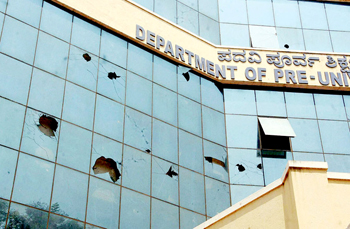
II PU paper leak: CID hunts for key suspect; results likely to be delayed

[email protected] (CD Network)
April 4, 2016

Bengaluru, Apr 4: After identifying a few people, including a couple of teachers, as suspects in the II PU Chemistry question paper leak, the Criminal Investigation Department (CID) has set out on a massive manhunt for the prime suspect.

PUThe CID sleuths have also narrowed down on a few government school teachers, engineers of Public Works Department and officials from DPUE who could be part of the racket.

However, their links could be established only after the arrest of the suspected kingpin — identified as Kiran, an LIC agent from Tumakuru, said a senior police officer. The prime suspect was identified after the CID sleuths questioned the students who received the leaked paper on WhatsApp.

The suspect is on the run and has even switched off his mobile phone, but a team is constantly monitoring his movements and will nab him soon, a CID officer said. He, however, refused to divulge more details about the suspect.

The probe so far has revealed that several lakhs rupees had exchanged hands, the officer said. CID officials have questioned over 100 suspects with alleged links to the re-exam paper leak. The police have also questioned the 40 DPUE officials who were suspended after the March 31 incident.

Results may be delayed

Meanwhile, a possible delay in the announcement of results of II PUC is expected as the Department of Pre-University Education is bogged down with worries of lecturers boycott of evaluation. Further, the evaluators have to be relieved midway through the evaluation work to allow them to join their examination centres to conduct the chemistry paper re-examination on April 12.

The evaluation of SSLC examination answer scripts is also likely to be hit as the Karnataka State High School Assistant Masters' Association after a meeting on Sunday decided to boycott evaluation

Meanwhile, Pre-University students who on Sunday wrote the offline Joint Entrance Examination (main) for entrance in undergraduate engineering programs at NITs, IIITs and other centrally funded technical institutions found the examination moderately tough.

Comments

Prem Sagar
 - 
Monday, 4 Apr 2016

get them the culprit soon and should not allow them to enter the university again.

Mohammed Sheikh
 - 
Monday, 4 Apr 2016

whose miskate.. whom to punish, dont understand india's rules sometimes.

Add new comment

  • Coastaldigest.com reserves the right to delete or block any comments.
  • Coastaldigset.com is not responsible for its readers’ comments.
  • Comments that are abusive, incendiary or irrelevant are strictly prohibited.
  • Please use a genuine email ID and provide your name to avoid reject.
Agencies
February 6,2020

Even more than three years after demonetisation and all-out efforts to make most transactions through electronic, cash is still king, as it thrives in a digital India, said fintech start-up Paytm founder Vijay Sekhar Sharma.

"While cashless economy is not possible in India, less cash economy will be in the future. Less cash is the only solution, not the elimination of cash," Sharma told IANS in an interview after unveiling an all-in-one payment gateway on Tuesday.

Asserting that it would take 5-10 years for India to make the transition to digital payments from the traditional mode of cash, Sharma, 41, said the e-payment industry benefitted more from the November 8, 2016 note ban and withdrawal of old Rs 1,000 and Rs 500 denominations.

"I think it (demonetisation) helped the industry despite lack of specific help. But the world has changed since then. It is about the scale of distribution of merchants that is what is propelling digital payments," said Sharma.

Most of the cash not only came back into circulation, but also remains as the mode of payment for the majority due to its convenience for the people used to such transactions.

Expounding Paytm's zero service charge, Sharma said the strategy is sustainable as it leads to acquiring more customers and merchants, enabling newer business opportunities.

Paytm also does not levy a service charge to small merchants for its payments services, unlike organised players like Uber.

"Though there is a monetisation model, the merchants who are small shopkeepers, become our financial services customers as they open a bank account, which is profitable."

Paytm secured a Payments Bank license from the Reserve Bank of India to offer a savings bank account, Rupay debit card and money transfer services.

"We are banking on payment services acquiring customers and merchants who avail banking, lending, insurance, wealth and software services like billing software and business ledger software services eventually," Sharma noted.

The mobile first bank services include zero balance and zero digital transaction charge accounts.

"Basically, payments, cloud, commerce and financial services are a cohort we follow. So, payments is our customer as well as merchant acquisition. If it breaks even, we are happy because other line items make more money, he affirmed.

Noting that in a market like India, one cannot price services at a premium unlike in a developed country like the US, the billionaire businessman said a consumer in a developing country would not be able to afford such a hefty charge.

Forbes ranked Sharma as India's youngest billionaire in 2017, with a net worth of $2.1 billion.

While several countries operate on the model of higher service charges, Sharma said newer business models have to be discovered in India, as customer lifecycle value is accounted for more stages than in other nations.

Asked about an upscale retailer like Zara not giving a wallet payment option during its recent end of season sale in Bengaluru, Sharma said Paytm was addressing such hiccups with its all-in-one payment solutions.

"It's an opportunity, because if the retailer has our all-in-one point of sale machine, where in they enter the amount, it shows both the Quick Response code (QR) and card payment options," he observed.

Sharma compared older swiping payment machine to feature phones and modern ones to feature-rich smartphones.

"If you notice, they look like feature phones and the modern day card machine is more a smartphone like. You can add the smatphone components, which can add the features," reiterated Sharma.

Though Paytm's all-in-one QR point of sale machine integrates the billing system, its chief executive said it was not ideal to have an independent QR feature.

Paytm has 16 million strong merchant user base, which Sharma aims to raise to 26 million base in the next one year.

Sharma has launched in this tech city an all-in-one payment gateway and Paytm Business Payments solution, which enable digital payments through multiple methods for small and medium enterprises (SMEs) and an Android point of sale machine.

With the new gateway solution, collecting digital payments through multiple methods can be achieved seamlessly while Paytm Business Payments solution enables automated vendor payments, including employee salaries and customer refunds among others.

The One97 Communications-owned Paytm aims to help SMEs streamline and digitise their business activities using its new solutions, which enhance the overall efficiency of both accepting and making payments.

Paytm has a data bank of over 200 million saved cards and bank accounts, a feature which enables partner apps to shorten transaction times and propel faster conversions while using the all-in-one payment gateway.

Complementing the two solutions, Sharma also launched an all-in-one Android point of sale machine, which can accept payments through all forms such as cards, wallets, UPI apps and even cash.

The device has a QR code that supports all contact and contactless payments, coming with integrated billing software customized solutions for different sectors such as catering, ticketing, parking and others.

The handheld Android device is equipped with an in-built printer, scanner and can also generate bills.

Valued at $16 billion, Paytm is not alone in the fiercely competitive Indian fintech space where a dozen players like PhonePe, MobiKwik, Kotak 811 and deep pocketed international giants Google Pay and Amazon Pay are in the fray.


Comments

Add new comment

  • Coastaldigest.com reserves the right to delete or block any comments.
  • Coastaldigset.com is not responsible for its readers’ comments.
  • Comments that are abusive, incendiary or irrelevant are strictly prohibited.
  • Please use a genuine email ID and provide your name to avoid reject.
News Network
July 9,2020

Bengaluru, Jul 9: The total number of Covid-19 infections in Karnataka on Thursday breached the 30,000 mark as the state reported its biggest single-day spike of over 2,200 new cases and 17 related fatalities, taking the death toll to 486, the Health department said.

The day also saw a record 957 patients getting discharged after recovery, out of which 606 were from Bengaluru Urban.

Out of the 2,228 fresh cases reported on Thursday, a whopping 1,373 were from Bengaluru Urban alone.

The previous biggest single-day spike was recorded on July 8 with 2,062 cases.

As of July 9 evening, cumulatively 31,105 Covid-19 positive cases have been confirmed in the state, which includes 486 deaths and 12,833 discharges, the Health department said in its bulletin.

It said, out of 17,782 active cases, 17,325 patients are in isolation at designated hospitals and are stable, while 457 are in ICU.

"Death rate in Karnataka is 1.49 percent, while in Bengaluru is 1.28 percent, and our target is to bring it below 1 percent," Medical Education Minister K Sudhakar told reporters.

"The reason for spike in cases in Bengaluru and other places in recent days is because during the last four months of lockdown we had controlled it very well, but as we relaxed lockdown for economic activities we did not follow certain precautionary measures like distance among other things," he said.

The Minister also conceded that there were lapses on part of the government also in terms of tracing and tracking.

"It has to be improved especially in Bengaluru and we are taking steps in this regard."

Among the 17 dead seven were from Dharwad, two each from Hassan, Kalaburagi, Mysuru, and one each from Raichur, Uttara Kannada, Tumakuru and Davangere.

The deceased include 13 men and 4 women.

The dead are all either with a history of Severe Acute Respiratory Infection (SARI) or Influenza-like illness (ILI).

Out of 2,228 fresh cases today, contacts of the majority of the cases are still under tracing.

Among the districts where the new cases were reported, Bengaluru Urban accounted for 1,373, followed by Dakshina Kannada (167), Kalaburagi (85) and Dharwad (75).

Bengaluru urban district tops the list of positive cases, with a total of 13,882 infections, followed by Kalaburagi (1,901) and Dakshina Kannada 1,701.

Among discharges Bengaluru urban tops the list with total 2,834, followed by Kalabuagi (1,392) and Udupi (1,206).

A total of 7,79,209 samples were tested so far, out of which 20,028 were tested on Thursday alone.

So far 7,28,887 samples have been reported as negative, and of them 17,568 were reported negative today.

Comments

Add new comment

  • Coastaldigest.com reserves the right to delete or block any comments.
  • Coastaldigset.com is not responsible for its readers’ comments.
  • Comments that are abusive, incendiary or irrelevant are strictly prohibited.
  • Please use a genuine email ID and provide your name to avoid reject.
coastaldigest.com news network
June 2,2020

Kasaragod, June 2: As Kerala commenced fresh academic year with online classes from Monday, a ninth-standard student at Malappuram district in North Kerala ended life allegedly owing to lack of online study facilities like television connection and a smartphone at her house.

Devika, daughter of Balakrishnan, hailing from a Dalit community at Valancherry, about 25 kilometres from Malappuram town, ended her life.

Balakrishnan told the media that he could not recharge the television connection owing to financial crunches. He was working as a daily wage worker and owing to COVID-19 and lockdown, he was not having much work these days. 

The family also did not have a smartphone or computer. The family members alleged that Devika was quite upset as she could not attend the virtual class that began on Monday. She was a student of a nearby government school.

Local police said that Devika, who was the eldest among four children of Balakrishnan, was suspected to have self-immolated using kerosene at a premise close to her house on Monday evening. The cause and provocations were still being probed only. No suicide notes were recovered yet.

Comments

Add new comment

  • Coastaldigest.com reserves the right to delete or block any comments.
  • Coastaldigset.com is not responsible for its readers’ comments.
  • Comments that are abusive, incendiary or irrelevant are strictly prohibited.
  • Please use a genuine email ID and provide your name to avoid reject.