


Impact of Gulf job crisis on Kannadigas: ISF delegation meets Dakshina Kannada DC

coastaldigest.com web desk
January 24, 2019

Mangaluru, Jan 23: A delegation led by Mohammad Shareef Jokatte, president Indian Social Forum (ISF) Karnataka Eastern Province Saudi Arabia met Dakshina Kannada Deputy Commissioner Sasikanth Senthil S on 23rd January 2019 at his office in the city. The delegation discussed various issues related to the potential rehabilitation programs that can be implemented for Non Resident Kannadigas (NRK) impacted by Gulf Country’s job market crisis.

ISF demanded swift intervention of Government of Karnataka in understanding the impact of the Gulf Job crisis on NRKs and provide suitable rehabilitation program for the affected Gulf return NRKs. Delegation further discussed about the recent promise made by District In-charge minister U T Khader about setting up the Help Desk at DC office, although no further action taken in implementing the promise.

Unlike neighbouring states Kerala and Telangana, Karnataka Government is completely unaware on the count of NRKs working in GCC and number of people impacted by the crisis.

Hence starting a registration center in at the Deputy Commissioner Office would be an ideal solution to maintain the data about Gulf returnee NRKs, delegation stressed during the discussion with Deputy Commissioner. Considering the contributions made by these Gulf NRKs to the state, appropriate rehabilitation measures will be implemented for the Gulf return NRKs, DC assured the delegation.

Indian Social Forum had earlier submitted a study report to Mr. Zameer Ahmed Minister of Minorities Welfare, Haj and Wakf Department, report was based on ground surveys, interviews and case studies conducted in Saudi Arabia and it also included set of recommendations to the Government for Gulf NRKs. Mr Shareef, Majeed, Ibrahim, Rasheed and Haneef were present in the Indian Social Forum delegation team.

Comments

Ashraf
 - 
Thursday, 24 Jan 2019

Good work social Forum 

Add new comment

  • Coastaldigest.com reserves the right to delete or block any comments.
  • Coastaldigset.com is not responsible for its readers’ comments.
  • Comments that are abusive, incendiary or irrelevant are strictly prohibited.
  • Please use a genuine email ID and provide your name to avoid reject.
coastaldigest.com news network
July 14,2020

Bengaluru, July 14: Girls outshone boys in the Second Pre-University Board examinations in Karnataka, results of which were announced on Tuesday.

As many as 6.75 lakh students had written the examination of which 4.17 lakh students passed.

Thus, the pass percentage is 61.80 per cent, Primary and Secondary Education Minister S Suresh Kumar said while announcing the results.

He said 68.73 per cent girls cleared the exam against the boys whose pass percentage was 54.77 per cent.

In terms of urban versus rural, 62.60 per cent students passed in the urban area while 58.99 per cent were from rural areas.

The three districts where the students' performance was excellent were Udupi, Dakshina Kannada and Kodagu whereas the districts where students fared badly were Chitradurga, Raichur and Vijayapura, the minister said.

Both Dakshina Kannada and Udupi have recorded 90.71 percent results. Kodagu has bagged second position with 81.53 pass percentage. Vijayapura district has recorded lowest pass percentage (54.22)

Combination wise, the pass percentage of students in science stream is 82.57 per cent, Commerce 72.60 per cent and Arts 47.90 per cent, said the Minister.

He also said of those who passed the examination, 72. 45 per cent were from English medium and 47.56 from Kannada medium.

There are 68,866 distinction scorers, 2,21,866 students who got first division and 77,455 students who passed the exam in second division, the minister added.

Comments

Add new comment

  • Coastaldigest.com reserves the right to delete or block any comments.
  • Coastaldigset.com is not responsible for its readers’ comments.
  • Comments that are abusive, incendiary or irrelevant are strictly prohibited.
  • Please use a genuine email ID and provide your name to avoid reject.
News Network
August 2,2020

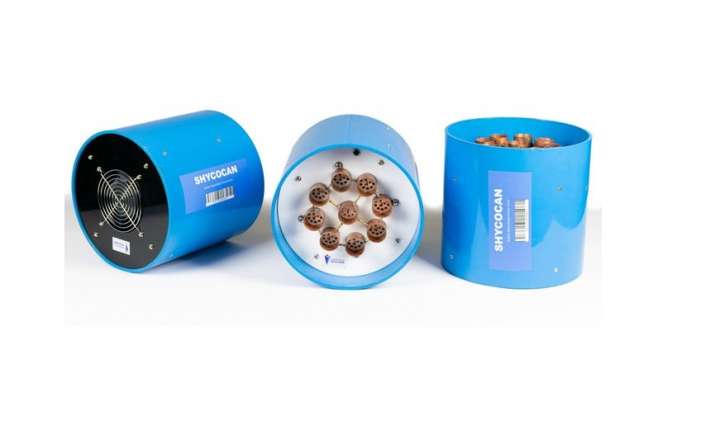
Bengaluru, Aug 2: Bengaluru based Centre for Advanced Research and Development (CARD), the research wing of organisation De scalene has come up with a device called "SHYCOCAN" (Scalene Hypercharge Corona Canon) which neutralizes the coronavirus.

Speaking to news agency Dr Rajah Vijay Kumar, Chairman, Organisation De Scalene said that the device will not kill any bacteria or fungus, however, neutralizes the coronavirus particles.

"The device was tested for its safety and efficacy and is soon going to be manufactured and marketed in the US under the Enforcement Discretion policy of USFDA and in Europe as the device is CE compliant and is CE marked," said Kumar.

He also added the device will cover a volume of 10,000 cubic feet.

The device Scalene Hypercharge Corona Canon (SHYCOCAN) is intended to be used in the residential, industrial and commercial environment and is designed for active containment by attenuation of Corona family of viruses. (Laboratories de Especialidades Immunological S.A. de C.V, Virucidal Activity concludes 99.9 per cent virus elimination), Kumar asserted.

"SHYCOCAN operates on regular 110/240V - 50/60 Hz wall socket and is a plug and play device, that delivers the necessary signals to a photon mediated electrons emitters (PMEE), that produces hypercharge high-velocity electrons by photon mediation that interacts with the negative seeking S-protein of Corona family of viruses thus reducing infectivity and prevent air and surface borne transmission of corona family of viruses," said Kumar.

The device does not use any chemicals, or any other consumables and does not produce harmful ozone gas or any other substances and is completely safe for use in any environment, he added.

"The attack mechanism of the Virus starts with the initial attachment of the virion to the host cell, it is initiated by interactions between the S-protein and its receptor on the "negative" cell membrane. The sites of receptor binding domains (RBD) within the S1 region of a coronavirus S-protein vary depending on the virus. 

The S-protein/receptor interaction is the primary determinant for a coronavirus to infect a host species and governs the tissue tropism of the virus. However, the end result is the fusion and release of the viral genome into the cytoplasm," said Kumar.

He continued saying that the counter mechanism by the device SHYCOCAN is that if negative seeking is the guidance mechanism of the S- Protein, attracted by the transmembrane potential of the host cells, then breaking this mechanism would block the Coronavirus infectivity and spread.

"The device has been in use for more than a year at the S-CARD campus, the headquarters of Scalene," said Kumar.

Comments

Add new comment

  • Coastaldigest.com reserves the right to delete or block any comments.
  • Coastaldigset.com is not responsible for its readers’ comments.
  • Comments that are abusive, incendiary or irrelevant are strictly prohibited.
  • Please use a genuine email ID and provide your name to avoid reject.
coastaldigest.com web desk
June 30,2020

Ballari, June 30: A video clip of dead bodies of covid-19 victims being disgracefully thrown into a pit said to be in Karnataka’s Ballari has gone viral on social media triggering outrage from netizens.

Ballari Deputy Commissioner SS Nakul ordered a probe. He told media persons that the veracity of the video is still under question and that it still needs to be established if the video was taken in Ballari.

In the video, a pit is seen which appears to be disinfected. The video features masked men covered in body suits bringing dead bodies from a black hearse van in black body bags one by one and throwing the dead bodies into the same pit. In all, three dead bodies are thrown into the same pit in the video.

"We have assigned an Additional Deputy Commissioner (ADC) to enquire and verify the same. We are awaiting reports. We don't know yet if it (the video) is from Ballari or not," Nakul said.

The district which has so far reported around 800 cases in the last three months has also witnessed around two dozen deaths.

Twitterati on Tuesday raised questions about the handling of the bodies. "Even dead have some respect and they deserved a decent burial," said a social activist from Ballari. Similar reactions echoed on social media and some also pointed out on how the family members who have to stay away from burials feel about it.

Covid burial protocol

According to the protocol set by the Union Health Ministry for the burial of Covid-19 patients, the patients' orifices (nose, mouth and ears) have to be sealed and the body has to be wrapped in three layers of personal protective equipment (PPE). Thereafter it should be placed in a body bag. Family members should not be allowed to accompany the body in the hearse van. Covid-19 victims have to be given a deep burial. The grave should be minimum 10-feet deep.

The grave should be disinfected with bleaching powder and the area should be cordoned off so that the general public is not in the vicinity.  The vehicle used to transport the dead body of a Covid-19 victim -- ambulance or a hearse van -- has to be disinfected for 16 hours before being used again. Most Covid-19 victims in the state have had burials in the absence of family members as they are generally in quarantine for being the primary contacts of the patient.

Comments

Add new comment

  • Coastaldigest.com reserves the right to delete or block any comments.
  • Coastaldigset.com is not responsible for its readers’ comments.
  • Comments that are abusive, incendiary or irrelevant are strictly prohibited.
  • Please use a genuine email ID and provide your name to avoid reject.