


India asks Pak to act against Jaish-e-Mohammed

January 6, 2016

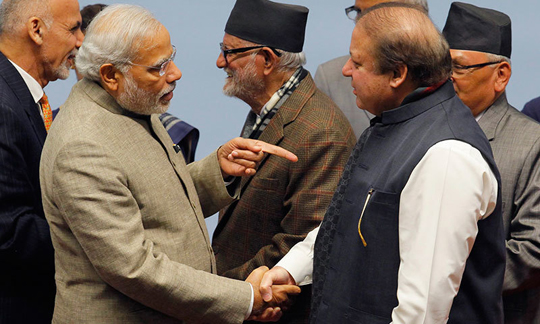
New Delhi, Jan 6: India has asked Pakistan to immediately act against the leadership of the terror organization, Jaish-e-Mohammed (JeM), beginning with the arrest of its three operatives, who were coordinating the Pathankot terror attack and were in touch with the terrorists who carried it out.
india

New Delhi also asked Islamabad to arrest Moulana Masood Azhar—the JeM founder, who has been subjected to sanctions by the US government for his links with terror networks at least since 2010, but lives free in Pakistan.

The “specific and actionable information” Prime Minister Narendra Modi’s National Security Advisor (NSA) Ajit Doval shared with his Pakistani counterpart Naseer Khan Janjua on Monday included recordings and transcripts of the calls between the terrorists, who carried out the attack on the IAF base at Pathankot and their ‘handlers’ at the control room JeM set up in Bahawalpur in Pakistan, sources in New Delhi told Deccan Herald.

The calls were intercepted by India’s intelligence agencies.

Sources said the JeM operatives, who had coordinated the attack from Pakistan, had been identified as Ashfaq Ahmad, Hafiz Abdul Shakur and Kasim Jaan.

Ashfaq is known as a close aide of Masood Azhar and is believed to have played a key role in reviving the JeM over the past couple of years.

Doval is understood to have also shared with Pakistan Prime Minister M Nawaz Sharif’s NSA the specific location of the control room set up by the JeM to coordinate the attacks.

Azhar was arrested by the Army in Kashmir in 1994, but New Delhi had to release him in 1999 in exchange of the passengers of the IC-814, which was hijacked by the terrorists and taken to Kandahar in Afghanistan.

The JeM, based in Bahawalpur in Pakistan, was designated as a Foreign Terrorist Organization by the US State Department in 2001. After Pakistan was forced to outlaw it in 2002, the outfit began using Al Rehmat Trust as a front for its operations.

The Al Rehmat Trust provided support for militant activities in Afghanistan and Pakistan, including financial and logistical support to foreign fighters operating in both countries.

In early 2009, several prominent members of Al Rehmat Trust were recruiting students for terrorist activities in Afghanistan, according to a report by the US Department of Treasury.

Comments

Shaad
 - 
Wednesday, 6 Jan 2016

How funny, it's like Pakistan ask India to take action against RSS.
Both Govt run by Terror organisation.

Add new comment

  • Coastaldigest.com reserves the right to delete or block any comments.
  • Coastaldigset.com is not responsible for its readers’ comments.
  • Comments that are abusive, incendiary or irrelevant are strictly prohibited.
  • Please use a genuine email ID and provide your name to avoid reject.
News Network
March 4,2020

Mar 4: Prime Minister Narendra Modi said on Wednesday that he has decided not to participate in any 'Holi Milan' programme as experts have advised reducing mass gatherings to avoid the spread of coronavirus.

"Experts across the world have advised reducing mass gatherings to avoid the spread of COVID19 Novel Coronavirus. Hence this year, I have decided not to participate in any 'Holi Milan' programme," the PM tweeted.

This year, Holi is on March 10.

Comments

Add new comment

  • Coastaldigest.com reserves the right to delete or block any comments.
  • Coastaldigset.com is not responsible for its readers’ comments.
  • Comments that are abusive, incendiary or irrelevant are strictly prohibited.
  • Please use a genuine email ID and provide your name to avoid reject.
Agencies
June 20,2020

New Delhi, Jun 20: After Prime Minister Narendra Modi said there are no foreign incursions into India, China has once again claimed that Galwan valley of Ladakh union territory is located on the Chinese side of the Line of Actual Control (LAC).

In an official statement on the step-by-step account of the Galwan face-off where 20 Indian soldiers were killed, China's foreign ministry spokesperson Zhao Lijian has said the Galwan valley is located on the Chinese side of the LAC in the west section of the China-India boundary.

"For many years, the Chinese border troops have been patrolling and on duty in this region," Zhao said alleging that since April this year, the Indian border troops have unilaterally and continuously built roads, bridges and other facilities at the LAC in the Galwan Valley.

China has lodged representations and protests on multiple occasions but India has gone even further to cross the LAC and make provocations, Zhao said.

By the early morning of May 6, the Indian border troops, who had crossed the LAC by night and trespassed into China's territory, built fortification and barricades, which impeded the patrol of Chinese border troops, Zhao said adding that they deliberately made provocations in an attempt to unilaterally change the status quo of control and management.

The Chinese border troops, he said, were "forced to take necessary measures to respond to the situation on the ground and strengthen management and control in the border areas."

In order to ease the situation, China and India have stayed in close communication through military and diplomatic channels, he said. "In response to the strong demand of the Chinese side, India agreed to withdraw the personnel who crossed the LAC and demolish the facilities, and so they did.

On June 6, the border troops of both countries held a commander-level meeting and reached consensus on easing the situation. The Indian side, he said, promised that they would not cross the estuary of the Galwan river to patrol and build facilities and the two sides would discuss and decide phased withdrawal of troops through the meetings between commanders on the ground.

"Shockingly, on the evening of June 15, India's front-line troops, in violation of the agreement reached at the commander-level meeting, once again crossed the Line of Actual Control for deliberate provocation when the situation in the Galwan Valley was already easing, and even violently attacked the Chinese officers and soldiers who went there for negotiation, thus triggering fierce physical conflicts and causing casualties."

"The adventurous acts of the Indian army have seriously undermined the stability of the border areas, threatened the lives of Chinese personnel, violated the agreements reached between the two countries on the border issue, and breached the basic norms governing international relations," the spokesperson said.

Beijing, he said, hopes that India will work with China, follow faithfully the important consensus reached between the two leaders, abide by the agreements reached between the two governments, and strengthen communication and coordination on properly managing the current situation through diplomatic and military channels, and jointly uphold peace and stability in the border areas.

Comments

Add new comment

  • Coastaldigest.com reserves the right to delete or block any comments.
  • Coastaldigset.com is not responsible for its readers’ comments.
  • Comments that are abusive, incendiary or irrelevant are strictly prohibited.
  • Please use a genuine email ID and provide your name to avoid reject.
News Network
June 17,2020

New Delhi, 17: Tensions on the Indo-China border have spiked to the highest since 1962 after over 20 troops, including an Indian commanding officer, were killed in the face-off in Galwan valley that has seen a six-week long standoff underway with the Peoples Liberation Army.

The Army said that the soldiers – including the Commanding Officer of 16 Bihar regiment in charge of the area – died while a `de-escalation process’ was underway. Sources said that this death toll could rise up as some soldiers are currently not accounted for after PLA troops attacked with spiked sticks and stones in the Galwan valley.

Chinese side also has casualties but the number is still not known. The Indian death toll is perhaps the worst single day loss in decades and has come at a time when thousands of troops are forward deployed in Eastern Ladakh.

ET was the first to report on May 12 about a massive troop build up in the Galwan valley, which is an old flashpoint that had seen action in the 1962 war as well.

There have been reports of casualties on the Chinese side in the clash but numbers are currently not available. Worryingly, information from the ground suggests that several Indian soldiers, including four officers, are missing and could have been taken captive by a vastly larger Chinese force. Their status is still not known.

“During the de-escalation process underway in the Galwan Valley, a violent face-off took place yesterday night with casualties. The loss of lives on the Indian side includes an officer and two soldiers. Senior military officials of the two sides are currently meeting at the venue to defuse the situation,” an Indian Army statement reads.

The Ministry of External Affairs said that the clash occurred when the Chinese side violated the LAC. “On the late-evening and night of 15th June, 2020 a violent face-off happened as a result of an attempt by the Chinese side to unilaterally change the status quo there. Both sides suffered casualties that could have been avoided had the agreement at the higher level been scrupulously followed by the Chinese side,” a statement reads.

The loss of the Commanding Officer is especially devastating and he had been directly involved in de-escalation talks with the Chinese side, including one hours before the clash took place. Sources said that the talks on Monday morning had led to an agreement for Chinese forces to withdraw from Indian territory as part of the disengagement.

According to one version, the CO had gone to the standoff point with a party of 50 men to check if the Chinese had retreated as promised. As the Indian side proceeded to demolish and burn illegal Chinese structures on its side of the LAC, including an observation post constructed on the South bank of the river, a fresh stand off took place as a large force of Chinese troops returned back.

Sources said that a Chinese force in excess of 250 quickly assembled near Patrol Point 14 and were physically stopped by Indian soldiers from entering Indian territory. Soldiers from both sides did not use firearms but the Chinese soldiers carried spiked sticks to attack.

Given the terrain of the region, a part of the standoff and clash took place in the middle of the Galwan river that is currently flowing at full spate, leading to high casualties as injured soldiers got swept away. Indian soldiers have to cross the Galwan river at atleast five points to reach PP 14, which marks the LAC.

Chinese media reports on Tuesday quoted the spokesperson from its Western Theatre Command as laying claim over the Galwan valley region and blaming the Indian side for the clash. Reports quoted Col Zhang Shuili as saying that India has violated the consensus made during Army commander level talks.

As reported, Galwan river area has a painful history with China, with Peoples Liberation Army (PLA) soldiers surrounding a freshly set up Indian Army post in July 1962, in what would be one of the early triggers to the Sino-Indian war. At an Army post that was overrun at Galwan, 33 Indian soldiers were killed and several dozen taken captive in 1962.

In the past, the Doklam crisis in 2017 saw tensions building up along the Pangong Tso lake as well with soldiers engaging in a fight with sticks and stones. However, the Eastern Ladakh standoff is of a much more serious nature, with over 6000 Chinese troops lined up with tanks and artillery, faced off with a larger Indian forces. Troop build up has also been reported across the borders in Himachal Pradesh, Uttarakhand, Sikkim and Arunachal.

Comments

Add new comment

  • Coastaldigest.com reserves the right to delete or block any comments.
  • Coastaldigset.com is not responsible for its readers’ comments.
  • Comments that are abusive, incendiary or irrelevant are strictly prohibited.
  • Please use a genuine email ID and provide your name to avoid reject.