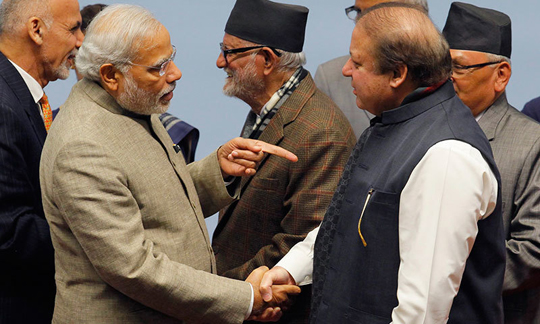
India asks Pak to act against Jaish-e-Mohammed

January 6, 2016

New Delhi, Jan 6: India has asked Pakistan to immediately act against the leadership of the terror organization, Jaish-e-Mohammed (JeM), beginning with the arrest of its three operatives, who were coordinating the Pathankot terror attack and were in touch with the terrorists who carried it out.

india

New Delhi also asked Islamabad to arrest Moulana Masood Azhar—the JeM founder, who has been subjected to sanctions by the US government for his links with terror networks at least since 2010, but lives free in Pakistan.

The “specific and actionable information” Prime Minister Narendra Modi’s National Security Advisor (NSA) Ajit Doval shared with his Pakistani counterpart Naseer Khan Janjua on Monday included recordings and transcripts of the calls between the terrorists, who carried out the attack on the IAF base at Pathankot and their ‘handlers’ at the control room JeM set up in Bahawalpur in Pakistan, sources in New Delhi told Deccan Herald.

The calls were intercepted by India’s intelligence agencies.

Sources said the JeM operatives, who had coordinated the attack from Pakistan, had been identified as Ashfaq Ahmad, Hafiz Abdul Shakur and Kasim Jaan.

Ashfaq is known as a close aide of Masood Azhar and is believed to have played a key role in reviving the JeM over the past couple of years.

Doval is understood to have also shared with Pakistan Prime Minister M Nawaz Sharif’s NSA the specific location of the control room set up by the JeM to coordinate the attacks.

Azhar was arrested by the Army in Kashmir in 1994, but New Delhi had to release him in 1999 in exchange of the passengers of the IC-814, which was hijacked by the terrorists and taken to Kandahar in Afghanistan.

The JeM, based in Bahawalpur in Pakistan, was designated as a Foreign Terrorist Organization by the US State Department in 2001. After Pakistan was forced to outlaw it in 2002, the outfit began using Al Rehmat Trust as a front for its operations.

The Al Rehmat Trust provided support for militant activities in Afghanistan and Pakistan, including financial and logistical support to foreign fighters operating in both countries.

In early 2009, several prominent members of Al Rehmat Trust were recruiting students for terrorist activities in Afghanistan, according to a report by the US Department of Treasury.

Comments

Shaad
 - 
Wednesday, 6 Jan 2016

How funny, it's like Pakistan ask India to take action against RSS.
Both Govt run by Terror organisation.

Add new comment

  • Coastaldigest.com reserves the right to delete or block any comments.
  • Coastaldigset.com is not responsible for its readers’ comments.
  • Comments that are abusive, incendiary or irrelevant are strictly prohibited.
  • Please use a genuine email ID and provide your name to avoid reject.
News Network
March 10,2020

New Delhi, Mar 10: A military transport aircraft of the Indian Air Force (IAF) brought back 58 Indians from coronavirus-hit Iran on Tuesday, official said.

The aircraft, a C-17 Globemaster, was sent to Tehran on Monday evening.

About 2,000 Indians are living in Iran, a country that has witnessed increasing numbers of coronavirus cases in the last few days.

"The IAF aircraft has landed. Mission completed. On to the next," External Affairs Minister S Jaishankar tweeted.

In an earlier tweet, he said, "First batch of 58 Indian pilgrims being brought back from Iran. IAF C-17 taken off from Tehran and expected to land soon in Hindon."

"Thanks to the efforts of our Embassy @India_in_Iran and Indian medical team there, operating under challenging conditions. Thank you @IAF_MCC. Appreciate cooperation of Iranian authorities. We are working on the return of other Indians stranded there (sic)," Jaishankar added.

The aircraft landed at Hindon airbase in Ghaziabad, from where the passengers were take to a medical facility.

According to latest reports, 237 people have died of novel coronavirus in Iran while the number of positive cases stands at around 7,000.

It is the second such evacuation by the C-17 Globemaster in the last two weeks.

On February 27, 76 Indians and 36 foreign nationals were brought back from the Chinese city of Wuhan by the aircraft of the Indian Air Force.

The C-17 Globemaster is the largest military aircraft in the IAF's inventory. The plane can carry large combat equipment, troops and humanitarian aid across long distances in all weather conditions.

Four days ago, a Mahan airline plane brought swab samples of 300 Indians from Iran to India.

Comments

Add new comment

  • Coastaldigest.com reserves the right to delete or block any comments.
  • Coastaldigset.com is not responsible for its readers’ comments.
  • Comments that are abusive, incendiary or irrelevant are strictly prohibited.
  • Please use a genuine email ID and provide your name to avoid reject.
News Network
May 6,2020

New Delhi, May 6: Around 39 crore people have received financial assistance of Rs 34,800 crore amid the COVID-19 lockdown under the Pradhan Mantri Garib Kalyan Package (PMGKP) as on May 5, the government said in a statement.

These people received the assistance, which was announced by Union Finance Minister Nirmala Sitharaman on March 26 to protect them from the impact of the lockdown due to COVID 19, via digital payment infrastructure.

The swift implementation of the free food grain and cash payment package under PMGKP is being continuously monitored by Central and state governments. Also, Fintech and digital technology have been employed for swift and efficient transfer to the beneficiary.

As per the data provided by the government, Rs 16,394 crore front-loaded towards payment of the first installment of PM-KISAN was provided to 8.19 crore beneficiaries.

Rs 10,025 crore credited to 20.05 crore (98.33 per cent) women Jan Dhan account holders as first installment and Rs 2,785 crore credited to 5.57 crore women in the second installment.

Further, Rs 1,405 crore was disbursed to about 2.82 crore old age persons, widows and disabled persons and Rs 3,492.57 crore financial support was given to 2.20 crore building and construction workers.

Moreover, foodgrain has been distributed, covering 60.33 crore beneficiaries in all 36 Union Territories and states till April and 12.39 crore beneficiaries by 22 states/UTs for May. Pulses have been distributed so far to 5.21 crore household beneficiaries out of 19.4 crore such beneficiaries.

Over 5 crore cylinders have been booked under the Pradhan Mantri Ujjwala Yojana (PMUY) and 4.82 crore free cylinders already delivered to beneficiaries.

While 9.6 lakh members of Employees' Provident Fund Organisation (EPFO) has taken benefit of online withdrawal of non-refundable advance from EPFO account amounting to Rs 2,985 crore, 24 per cent EPF contribution transferred to 44.97 lakh employees account amounting to Rs 698 crore.

In the current financial year, 5.97 crore person's man-days of work generated under MNREGA scheme and Rs 21,032 crore were released to states to liquidate pending dues of both wage and material.

Insurance scheme for health workers in government hospitals and health care centres has been operationalised by New India Assurance covering 22.12 lakh health workers.

Comments

Add new comment

  • Coastaldigest.com reserves the right to delete or block any comments.
  • Coastaldigset.com is not responsible for its readers’ comments.
  • Comments that are abusive, incendiary or irrelevant are strictly prohibited.
  • Please use a genuine email ID and provide your name to avoid reject.
News Network
April 21,2020

New Delhi, Apr 21: The historic rout in oil markets that sent US crude prices plummeting to as much as minus USD 40 a barrel is unlikely to translate into any big reduction in petrol and diesel prices in India as domestic pricing is based on different benchmark, and refineries are already filled up to brim and cannot buy US crude just yet.

With storage capacity already overflowing amid coronavirus-induced demand collapse, traders rushed to to get rid of unwanted stocks triggering the collapse of US West Texas Intermediate (WTI) crude for May delivery.

Indian Oil Corp (IOC) Chairman Sanjiv Singh said the collapse was triggered by traders unable to take deliveries of crude they had previously booked because of a demand collapse. And so they paid the seller to keep oil in their storage.

"If you look at June futures, it is trading in positive territory... around USD 20 per barrel," he said.

Low oil prices may seem good in short-term but in the long run it will hurt the oil economy as producers will have no surplus to invest in exploration and production which will lead to a drop in production, he said.

He did not comment on retail fuel prices that have been static since March 16.

Oil companies have not changed rates despite a fall in international prices as they first adjusted them against the increase that was warranted from a Rs 3 per litre hike in excise duty and close to Re 1 per litre additional cost of switching over to cleaner BS-VI grade fuel from April 1.

Petrol in Delhi is priced at Rs 69.59 a litre and diesel comes for Rs 62.29 per litre.

"The negative price has no direct impact on India or Indian oil prices, as this has taken place due to crude oil produced and traded within the US. India's prices are driven partly by another benchmark, the Brent, which is still trading at USD 25/barrel. Therefore, the retail price of fuels in India are unlikely to fall," said Amit Bhandari, Fellow, Energy and Environment Studies, Gateway House.

Also, Indian refineries are already overflowing as fuel demand has evaporated due to the unprecedented nationwide lockdown imposed to curb spread of COVID-19. So, they can't rush to buy US crude.

The refineries have already cut operating rate to half because the fuel they produce has not been sold yet.

India imports 4 million barrels/day (1.4 billion barrels/year) of oil. The country has been benefitting from the falling prices of oil for the last five years, when oil dropped from a peak of USD 110/barrel to USD 50-60/barrel last year, enabling India to invest in public service programmes.

"However, the additional USD 30 fall of this week is good for India - but there is also a downside. If oil prices are too low, the economies of oil-rich gulf countries will be hurt, threatening the job prospects of the 8 million Indians working in the Gulf countries. India is the largest recipient of foreign remittances due to these workers – very low oil prices will hurt this cash stream," Bhandari said.

He said the negative price of oil shows how much oil oversupply exists in international markets today. "Global oil consumption has fallen due to the COVID-19 pandemic that traders are willing to pay customers to get rid of the barrels they can't store. The world does not have enough storage capacity, and dumping the oil is an environmental crime."

The first half of April saw Brent crude oil prices plummet 63.6 per cent to USD 26.9 per barrel. Prices of Western Texas Intermediate (WTI), the American oil, had also fallen similarly by 63.1 per cent.

But on April 20, WTI prices turned rapidly negative because traders on the Nymex exchange rushed to offload their May futures positions a day before expiry of contracts (on April 21).

Such WTI futures are traded on the Nymex exchange with contracts settled in physical crude oil. Problem is, those who had gone long are unable to find storage facilities for the oil and had to liquidate their contracts before expiry. This caused the plunge in WTI prices.

Contrast to this, June WTI Nymex futures prices is hovering around USD 21, while Brent for June delivery is at USD 25.

Miren Lodha, Director, CRISIL Research said the demand for crude oil was declining already because of economic slowdown when the COVID-19 pandemic-driven lockdowns crushed it further.

Consequently, oil demand is expected to contract by 8-10 million barrels per day (mbpd) in 2020 assuming demand recovery begins from the third quarter of the year, he said, adding if recovery doesn't happen by then, further demand destruction could occur.

On the supply side, producers reining in output following a strategic deal between OPEC members, Russia and the US.

Under this agreement, OPEC+ would reduce oil production by 9.7 mbpd for May and June, but gradually ease the curb to 7.7 mbpd between July and December 2020, and to 5.8 mbpd till April 2022 to stabilise prices.

"This is expected to reduce some surplus in the market by the end of 2020," Lodha said.

Crude oil demand is expected to decline by over 20 mbpd in April alone. Typically, monthly global demand is about 100 mbpd. Given this scenario, supply curbs would have limited influence.

Consequently, Brent oil prices is expected to be in the USD 25-30 range for the second quarter while increasing marginally in the last 2 quarters of 2020.

"The gigantic inventory build-ups and lack of storage facilities would also put pressure on prices," he said, adding overall Brent could average USD 30-35 in 2020, with a strong downward bias.


Comments

Add new comment

  • Coastaldigest.com reserves the right to delete or block any comments.
  • Coastaldigset.com is not responsible for its readers’ comments.
  • Comments that are abusive, incendiary or irrelevant are strictly prohibited.
  • Please use a genuine email ID and provide your name to avoid reject.