


India asks Pak to act against Jaish-e-Mohammed

January 6, 2016

New Delhi, Jan 6: India has asked Pakistan to immediately act against the leadership of the terror organization, Jaish-e-Mohammed (JeM), beginning with the arrest of its three operatives, who were coordinating the Pathankot terror attack and were in touch with the terrorists who carried it out.
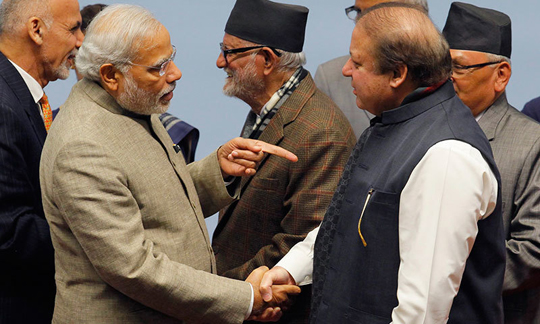
india

New Delhi also asked Islamabad to arrest Moulana Masood Azhar—the JeM founder, who has been subjected to sanctions by the US government for his links with terror networks at least since 2010, but lives free in Pakistan.

The “specific and actionable information” Prime Minister Narendra Modi’s National Security Advisor (NSA) Ajit Doval shared with his Pakistani counterpart Naseer Khan Janjua on Monday included recordings and transcripts of the calls between the terrorists, who carried out the attack on the IAF base at Pathankot and their ‘handlers’ at the control room JeM set up in Bahawalpur in Pakistan, sources in New Delhi told Deccan Herald.

The calls were intercepted by India’s intelligence agencies.

Sources said the JeM operatives, who had coordinated the attack from Pakistan, had been identified as Ashfaq Ahmad, Hafiz Abdul Shakur and Kasim Jaan.

Ashfaq is known as a close aide of Masood Azhar and is believed to have played a key role in reviving the JeM over the past couple of years.

Doval is understood to have also shared with Pakistan Prime Minister M Nawaz Sharif’s NSA the specific location of the control room set up by the JeM to coordinate the attacks.

Azhar was arrested by the Army in Kashmir in 1994, but New Delhi had to release him in 1999 in exchange of the passengers of the IC-814, which was hijacked by the terrorists and taken to Kandahar in Afghanistan.

The JeM, based in Bahawalpur in Pakistan, was designated as a Foreign Terrorist Organization by the US State Department in 2001. After Pakistan was forced to outlaw it in 2002, the outfit began using Al Rehmat Trust as a front for its operations.

The Al Rehmat Trust provided support for militant activities in Afghanistan and Pakistan, including financial and logistical support to foreign fighters operating in both countries.

In early 2009, several prominent members of Al Rehmat Trust were recruiting students for terrorist activities in Afghanistan, according to a report by the US Department of Treasury.

Comments

Shaad
 - 
Wednesday, 6 Jan 2016

How funny, it's like Pakistan ask India to take action against RSS.
Both Govt run by Terror organisation.

Add new comment

  • Coastaldigest.com reserves the right to delete or block any comments.
  • Coastaldigset.com is not responsible for its readers’ comments.
  • Comments that are abusive, incendiary or irrelevant are strictly prohibited.
  • Please use a genuine email ID and provide your name to avoid reject.
News Network
June 27,2020

New Delhi, Jun 27: Fuel prices were hiked by the oil marketing companies for the 21st day in a row on Saturday. Petrol and diesel will now cost Rs 80.38/litre and Rs 80.40/litre respectively in the national capital.

The price of petrol is increased by Rs 0.25 per litre while that of diesel by Rs 0.21 per litre.
Rates differ from state to state depending on the incidence of value-added tax (VAT).

Notably, oil marketing companies have been adjusting retail rates in line with costs after an 82-day break from rate revision amidst the COVID-19 pandemic. These firms on June 7 restarted revising prices in line with costs.

The Congress party had called the increase in the price of petrol and diesel 'unjust', 'thoughtless' and demanded from the Central government to roll back increase with immediate effect and pass on the benefit of low oil prices directly to the citizens of this country.
In an official statement, the Congress Working Committee (CWC) had said that no government should levy and impose such unacceptable strain on its people.

Before the nation entered the lockdown, the average price of petrol and diesel in Delhi was Rs 69.60 per litre and Rs 62.30 per litre respectively.

Comments

Add new comment

  • Coastaldigest.com reserves the right to delete or block any comments.
  • Coastaldigset.com is not responsible for its readers’ comments.
  • Comments that are abusive, incendiary or irrelevant are strictly prohibited.
  • Please use a genuine email ID and provide your name to avoid reject.
News Network
February 4,2020

New Delhi, Feb 4: Leader of Congress in Lok Sabha, Adhir Ranjan Chowdhury, on Tuesday attacked the BJP over Anantkumar Hegde's controversial remark on Mahatma Gandhi and termed the party as "Ravan ke aulad" (children of Ravana). "Aaj ye Mahatma Gandhi ko gaali dete hain. Ye Ravan ke aulad hain. Ram ke pujari ka ye apmaan kar rahe hain (Today, they abuse Mahatma Gandhi. They are children of Ravan. They are insulting Lord Ram's devotee)," Chowdhury said.

Later, BJP lawmakers object to Chowdhury's statement. Hegde, who is a Lok Sabha MP from Uttara Kannada, had on Saturday said that the freedom struggle led by Mahatma Gandhi was a "drama".

"None of these so-called leaders were beaten up by the cops even once. Their independence movement was one big drama. It was staged by these leaders with the approval of the British. It was not a genuine fight. It was an adjustment freedom struggle," Hegde had said while addressing a public event in Bengaluru. While several Congress leaders, including Karti Chidambaram and BK Hariprasad, have condemned Hegde's remark, BJP leaders too have distanced themselves from it.

Top leadership in BJP is unhappy with Anantkumar Hegde over his controversial remark on Mahatma Gandhi, party sources had said on Monday, adding that he has been asked to issue an unconditional apology.

Comments

Add new comment

  • Coastaldigest.com reserves the right to delete or block any comments.
  • Coastaldigset.com is not responsible for its readers’ comments.
  • Comments that are abusive, incendiary or irrelevant are strictly prohibited.
  • Please use a genuine email ID and provide your name to avoid reject.
News Network
March 27,2020

Mumbai, Mar 27: The Reserve Bank of India (RBI) on Friday lowered the key repo rate by 75 basis points to 4.4 per cent in a bid to arrest the economic slowdown amid coronavirus (COVID-19) outbreak.
The reverse repo rate now stands at 4 per cent, down by 90 basis points, said RBI Governor Shaktikanta Das adding this has been done to make it unattractive for banks to passively deposit funds with the central bank and instead lend it to the productive sectors.
The six-member monetary policy committee (MPC) met on March 24, 25 and 27 and voted 4:2 in favour of the repo rate reduction. The MPC also decided to continue with the accommodative stance as long as it is necessary to revive growth and mitigate the impact of COVID-19 on the economy while ensuring that inflation remains within the target.
"The need of the hour is to shield the economy from the pandemic," said Das. "We need to mitigate the impact of coronavirus, revive economic growth and provide financial stability."
Repo rate is the rate at which a country's central bank lends money to commercial banks, and the reverse repo rate is the rate at which it borrows from them.
The RBI Governor further said that the economic growth and inflation projection will be highly contingent depending on the duration, spread and intensity of the pandemic.
"Global economic activity has come to a near standstill as COVID-19 related lockdowns and social distancing are imposed across a widening swathe of affected countries. Expectations of a shallow recovery in 2020 from 2019's decade low in global growth have been dashed," said Das.
"The outlook is now heavily contingent upon the intensity, spread and duration of the pandemic. There is a rising probability that large parts of the global economy will slip into recession," he said.
However, the RBI has injected liquidity of Rs 2.8 lakh crore via various instruments equal to 1.4 per cent of GDP. "Along with today's measures, liquidity measures equal to 3.2 per cent of GDP. The RBI will take continuous measures to ensure liquidity in the system."
The RBI governor has said that all banking institutions can offer a three-month moratorium on all loans for a period of three months. The RBI has also allowed banks to restructure the working capital cycle for companies without worrying that these will have to be classified as a non-performing asset (NPA).
The three-month moratorium will permit banks to avoid a large onset of NPAs during the 21-day lockdown and keep their books healthy.
Das said banks and other financial institutions should do all they can to keep credit flowing to economic agents facing financial stress on account of the isolation that the virus has imposed.
"Market participants should work with regulators like the RBI and the Securities and Exchange Board of India (SEBI) to ensure the orderly functioning of markets in their role of price discovery and financial intermediation," he said.

Comments

Add new comment

  • Coastaldigest.com reserves the right to delete or block any comments.
  • Coastaldigset.com is not responsible for its readers’ comments.
  • Comments that are abusive, incendiary or irrelevant are strictly prohibited.
  • Please use a genuine email ID and provide your name to avoid reject.