


India asks Pak to act against Jaish-e-Mohammed

January 6, 2016

New Delhi, Jan 6: India has asked Pakistan to immediately act against the leadership of the terror organization, Jaish-e-Mohammed (JeM), beginning with the arrest of its three operatives, who were coordinating the Pathankot terror attack and were in touch with the terrorists who carried it out.
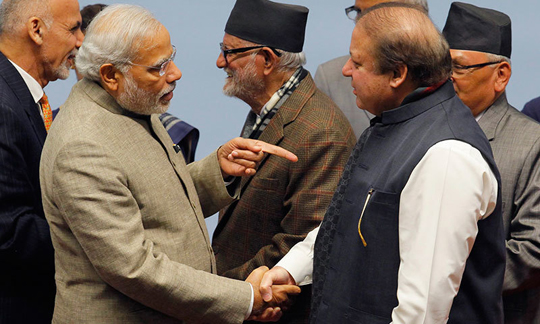
india

New Delhi also asked Islamabad to arrest Moulana Masood Azhar—the JeM founder, who has been subjected to sanctions by the US government for his links with terror networks at least since 2010, but lives free in Pakistan.

The “specific and actionable information” Prime Minister Narendra Modi’s National Security Advisor (NSA) Ajit Doval shared with his Pakistani counterpart Naseer Khan Janjua on Monday included recordings and transcripts of the calls between the terrorists, who carried out the attack on the IAF base at Pathankot and their ‘handlers’ at the control room JeM set up in Bahawalpur in Pakistan, sources in New Delhi told Deccan Herald.

The calls were intercepted by India’s intelligence agencies.

Sources said the JeM operatives, who had coordinated the attack from Pakistan, had been identified as Ashfaq Ahmad, Hafiz Abdul Shakur and Kasim Jaan.

Ashfaq is known as a close aide of Masood Azhar and is believed to have played a key role in reviving the JeM over the past couple of years.

Doval is understood to have also shared with Pakistan Prime Minister M Nawaz Sharif’s NSA the specific location of the control room set up by the JeM to coordinate the attacks.

Azhar was arrested by the Army in Kashmir in 1994, but New Delhi had to release him in 1999 in exchange of the passengers of the IC-814, which was hijacked by the terrorists and taken to Kandahar in Afghanistan.

The JeM, based in Bahawalpur in Pakistan, was designated as a Foreign Terrorist Organization by the US State Department in 2001. After Pakistan was forced to outlaw it in 2002, the outfit began using Al Rehmat Trust as a front for its operations.

The Al Rehmat Trust provided support for militant activities in Afghanistan and Pakistan, including financial and logistical support to foreign fighters operating in both countries.

In early 2009, several prominent members of Al Rehmat Trust were recruiting students for terrorist activities in Afghanistan, according to a report by the US Department of Treasury.

Comments

Shaad
 - 
Wednesday, 6 Jan 2016

How funny, it's like Pakistan ask India to take action against RSS.
Both Govt run by Terror organisation.

Add new comment

  • Coastaldigest.com reserves the right to delete or block any comments.
  • Coastaldigset.com is not responsible for its readers’ comments.
  • Comments that are abusive, incendiary or irrelevant are strictly prohibited.
  • Please use a genuine email ID and provide your name to avoid reject.
Agencies
July 7,2020

New Delhi, Jul 7: The University Grants Commission (UGC) has issued revised guidelines regarding the conduct of terminal semesters and final year exams by Universities and educational institutions. It has been suggested that exams may be completed by September in online or offline modes.

Releasing a statement, the UGC said it accepted the recommendations suggested by the expert committee. "In continuation to earlier Guidelines issued on 29.04.2020 and based on the Report of the Expert Committee, the UGC Revised Guidelines on Examination and Academic Calendar for the Universities in view of COVID-19 Pandemic were also approved by the Commission in its emergent meeting held on 6th July 2020," the statement read.

The Commission further said that while it was important to safeguard principles of health, safety and equal opportunities, it was also very important to ensure academic credibility, career opportunities and future progress of students.

"The Commission approved the recommendations of the Expert Committee regarding the conduct of terminal semester(s)/ final year(s) examinations by the universities/ institutions to be completed by the end of September 2020 in offline (pen & paper online/ blended (online + offline) mode," it added.

The UGC also said that if required it would also issue relevant details related to admissions and academic calendar in the universities and colleges. It asked the students to adopt the latest guidelines and complete the terminal semester or final year exams accordingly. 

Comments

Add new comment

  • Coastaldigest.com reserves the right to delete or block any comments.
  • Coastaldigset.com is not responsible for its readers’ comments.
  • Comments that are abusive, incendiary or irrelevant are strictly prohibited.
  • Please use a genuine email ID and provide your name to avoid reject.
Agencies
January 11,2020

Those owning a single house in joint names would continue to file their income tax returns (ITRs) in much simpler ITR-1 (Sahaj) and ITR-4 forms (Sugam) for assessment year 2020-21 with the government issuing a clarification in this regard.

The clarification has come days after the government modified the eligibility for filing the returns in ITR-1 and ITR-4, stating that those owning a property jointly, spending Rs 2 lakh on foreign travel and paying electricity bill of Rs 1 lakh in a year would not be able to file returns in the simpler forms.

They would have to file their returns with much more detailed information in other specified forms.

Following the changes in the eligibility for filing returns in the two forms, concerns were raised over it with taxpayers claiming that it will cause huge hardship for them.

"The matter has been examined and it has been decided to allow a person, who jointly owns a single house property, to file his/her return of income in ITR-1 or ITR-4 Form, as may be applicable, if he/she meets the other conditions," a Finance Ministry statement said.

"It has also been decided to allow a person, who is required to file return due to fulfilment of one or more conditions specified in the seventh proviso to section 139(1) of the Act, to file his/her return in ITR-1 Form," it added.

Tax practitioners welcomed the government’s move of going back to the previous position.

"This is a welcome clarification allowing middle class taxpayers owning a single house property to file simpler ITR forms, 1 and 4, and not the detailed ITR forms even if they own house property in joint names," said Shailesh Kumar, Director, Nangia Andersen Consulting.

It may be noted that taxpayers holding multiple house properties would have to file more detailed return forms.

In the major changes notified earlier this month by the Income-Tax department, individual taxpayers were disallowed to file return either in ITR-1 or ITR 4 if he or she was a joint-owner in house property.

In another change, those who deposited more than Rs 1 crore in bank account or spent Rs 2 lakh on foreign travel or paid Rs 1 lakh on electricity bill in a financial year were also barred from using the easy-to-fill return forms.

"By today's clarification, the government has maintained status quo. Now, the taxpayers can continue filing their returns in the same fashion in which they did last year," said Naveen Wadhwa, Deputy General Manager (DGM), Taxmann.

Comments

Add new comment

  • Coastaldigest.com reserves the right to delete or block any comments.
  • Coastaldigset.com is not responsible for its readers’ comments.
  • Comments that are abusive, incendiary or irrelevant are strictly prohibited.
  • Please use a genuine email ID and provide your name to avoid reject.
News Network
January 21,2020

Jan 21: Indian policymakers may make it easier for companies to tap foreign funding, as a prolonged cash squeeze makes it tough for firms to borrow at home.

Investors are speculating about potential steps Finance Minister Nirmala Sitharaman could unveil when she presents the nation’s budget on Feb. 1. These measures may include freeing up firms to borrow at higher rates and offering tax breaks to global funds.

“The government will need to relax local rules to make it easier for Indian companies to raise debt overseas and tide over the funding crunch in the onshore market,” said Raj Kothari, London-based head of trading at Jay Capital Ltd. “At the same time, they need to ensure that the borrowers tapping offshore markets abide with stricter corporate governance so as to avoid further defaults.”

A prolonged crisis in India’s shadow bank sector and a pile of bad loans at traditional lenders is making it expensive for Indian companies, other than the best-rated firms, to access funding. The government has tried a series of measures to spur domestic credit, including providing so-called credit enhancement and allowing tiny firms to restructure debt.

Here are some steps Sitharaman may consider to spur foreign borrowing:

• She could raise the cap of 450 basis points above Libor, which limits overall foreign debt costs for Indian companies

• This could help lower-rated firms sell bonds abroad. Indian companies rated BBB currently borrow at more than 10%, about 3.8 percentage points more than their top-rated peers;

• Sitharaman could waive the withholding tax foreign investors need to pay on holdings of rupee-denominated debt sold by Indian companies abroad

• The waiver was offered between September 2018 to March 2019, but wasn’t extended as the highest global interest rates since the financial crisis deterred Indian borrowers. Since then, the three-month Libor has dropped by about 1 percentage point

• She could permit Indian property developers and housing finance lenders to sell overseas bonds for reasons beyond affordable housing projects

• New funding lines to the real estate sector, arguably ground zero of India’s economic slowdown, could help kickstart consumption and investment as the industry is the nation’s biggest job-creator.

Comments

Add new comment

  • Coastaldigest.com reserves the right to delete or block any comments.
  • Coastaldigset.com is not responsible for its readers’ comments.
  • Comments that are abusive, incendiary or irrelevant are strictly prohibited.
  • Please use a genuine email ID and provide your name to avoid reject.