


India asks Pak to act against Jaish-e-Mohammed

January 6, 2016

New Delhi, Jan 6: India has asked Pakistan to immediately act against the leadership of the terror organization, Jaish-e-Mohammed (JeM), beginning with the arrest of its three operatives, who were coordinating the Pathankot terror attack and were in touch with the terrorists who carried it out.
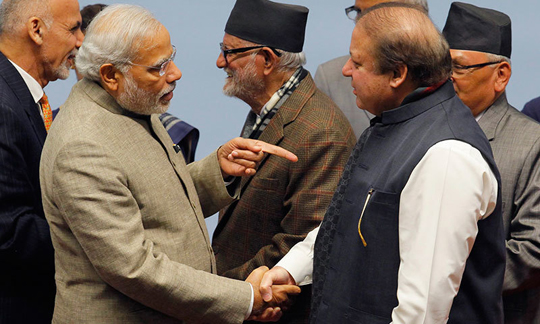
india

New Delhi also asked Islamabad to arrest Moulana Masood Azhar—the JeM founder, who has been subjected to sanctions by the US government for his links with terror networks at least since 2010, but lives free in Pakistan.

The “specific and actionable information” Prime Minister Narendra Modi’s National Security Advisor (NSA) Ajit Doval shared with his Pakistani counterpart Naseer Khan Janjua on Monday included recordings and transcripts of the calls between the terrorists, who carried out the attack on the IAF base at Pathankot and their ‘handlers’ at the control room JeM set up in Bahawalpur in Pakistan, sources in New Delhi told Deccan Herald.

The calls were intercepted by India’s intelligence agencies.

Sources said the JeM operatives, who had coordinated the attack from Pakistan, had been identified as Ashfaq Ahmad, Hafiz Abdul Shakur and Kasim Jaan.

Ashfaq is known as a close aide of Masood Azhar and is believed to have played a key role in reviving the JeM over the past couple of years.

Doval is understood to have also shared with Pakistan Prime Minister M Nawaz Sharif’s NSA the specific location of the control room set up by the JeM to coordinate the attacks.

Azhar was arrested by the Army in Kashmir in 1994, but New Delhi had to release him in 1999 in exchange of the passengers of the IC-814, which was hijacked by the terrorists and taken to Kandahar in Afghanistan.

The JeM, based in Bahawalpur in Pakistan, was designated as a Foreign Terrorist Organization by the US State Department in 2001. After Pakistan was forced to outlaw it in 2002, the outfit began using Al Rehmat Trust as a front for its operations.

The Al Rehmat Trust provided support for militant activities in Afghanistan and Pakistan, including financial and logistical support to foreign fighters operating in both countries.

In early 2009, several prominent members of Al Rehmat Trust were recruiting students for terrorist activities in Afghanistan, according to a report by the US Department of Treasury.

Comments

Shaad
 - 
Wednesday, 6 Jan 2016

How funny, it's like Pakistan ask India to take action against RSS.
Both Govt run by Terror organisation.

Add new comment

  • Coastaldigest.com reserves the right to delete or block any comments.
  • Coastaldigset.com is not responsible for its readers’ comments.
  • Comments that are abusive, incendiary or irrelevant are strictly prohibited.
  • Please use a genuine email ID and provide your name to avoid reject.
Agencies
January 5,2020

New Delhi, Jan 5: A masked mob on Sunday entered the Sabarmati Hostel on the Jawaharlal Nehru University (JNU) campus and assaulted several students and professors with sticks and rods.

"I have been brutally attacked by goons wearing masks. I am bleeding. I was brutally beaten up," JNU Students' Union (JNUSU) president Aishe Ghosh told reporters.

She has been admitted to the AIIMS here for treatment.

Several other students were also injured in the incident.

In a video of the incident, a group of goons with their faces covered can be seen assaulting students with wooden sticks and rods.

A tweet from the official handle of the JNUSU said, "Sabarmati Hostel: right now. They are beating the students who are inside. Knocking on doors with rods. People are jumping from balconies. #SOSJNU #EmergencyinJNU."

"Professors who were trying to protect us have been beaten up. These are unknown ABVP goons, not all are students, they have covered their faces, and they are moving towards the hotels near the West Gate. Stay alert. Make human chains. Protect each other. #SOSJNU #EmergencyinJNU," another tweet added.

Meanwhile, the ABVP's JNU unit claimed in a tweet: "Emergency in JNU. Leftist goons of JNU accompained with their cadre from other universities have crossed every limit. They have proceeded with unimaginable violence on ABVP activists of JNU."

Comments

Add new comment

  • Coastaldigest.com reserves the right to delete or block any comments.
  • Coastaldigset.com is not responsible for its readers’ comments.
  • Comments that are abusive, incendiary or irrelevant are strictly prohibited.
  • Please use a genuine email ID and provide your name to avoid reject.
News Network
January 1,2020

Jammu, Jan 1: As many as 160 terrorists were killed in Jammu and Kashmir this year, while 250 terrorists, including 102 of Pakistani origin, were active in the Valley, Director General of Police (DGP) Dilbag Singh said on Tuesday, noting that terror incidents and the number of local youths turning towards terrorism have decreased.

"250 terrorists have been active in Jammu and Kashmir. There is a decrease in number of active terrorists as compared to last year," Mr Singh said at the annual press conference at police headquarters in Jammu.

The DGP said that there is 30 per cent fall in terrorist incidents, less civilian killings and 36 per cent decrease in law and order incidents as compared to 2018.

"218 such (local) youths joined militant outfits in 2018 but only 139 joined in 2019," he said. Out of these new recruits only 89 have survived.

"The rest have been eliminated as their shelf life is between 24 hours to 2-3 months after joining militancy. There are hardly few old terrorists surviving, which include Jehangir Saroori and Riyaz Nayikoo", he said.

There have been only 481 law and order incidents this year as compared to 625 last year, he said.

There were 80 per cent successful anti-terror operations in which 160 terrorists, including foreigners, have been killed during the year.

Mr Singh said 102 terrorists have been arrested and 10 terrorists surrendered during the year.

He said that 102 Pakistan origin terrorists are still operating in Kashmir.

"Eleven valiant police personnel from Jammu and Kashmir besides 72 from other other security forces have been martyred," he said.

There was no collateral damage during anti-terror operation as people fully cooperated. "There was zero law and order problem this year (during anti terror operations)," he added.

The DGP said that "there has been a high degree of incidents of infiltration attempts from across the border this year and also ceasefire violations. But security forces have successfully foiled these attempted as 130 infiltrators have entered in 2019 as compared to 143 last year".

He said Jammu and Kashmir Police has set an example by handling the law and order situation in the most "exemplary" way following the abrogation of Article 370 provisions.

It was the biggest challenge faced by the force in 2019, but "we handled the most critical phase in the best way" and there was no civilian casualty during the period, he said.

Dismissing claims of minors being arrested by police in Kashmir, he said that it is being used as propaganda by some people and asserted that the J-K police has acted within the limits of law.

"We are open to scrutiny. The issue reached the Supreme Court which referred it to Jammu and Kashmir high court. The matter was inquired by the HC committee. The SC said that there is no misuse of law by law enforcement agency. J-K police has acted within the limits of law," he said.

Replying to queries on restoration of internet, the DGP said it is under consideration. "I think J-K is moving towards such a situation (on law and order front). Very soon you will hear positive announcement," Mr Singh said.

He said that though some people will try to misuse internet, "in the past, we took care of them and we will take care of such people in the future too".

Internet services in all government-run hospitals and SMS to all mobile phones will be restored from December 31 midnight in the Kashmir Valley, Jammu and Kashmir official spokesman Rohit Kansal said on Tuesday.

On December 10, some short message service (SMS) were enabled on mobile phones in order to facilitate students, scholarship applicants, traders and others. It has now been decided to fully restore the service throughout Kashmir from midnight of December 31, Kansal said.

Mobile Internet services were restored in Kargil district of Ladakh on Friday after remaining suspended for 145 days in the wake of the Centre abrogating provisions of Article 370 of the Constitution, officials said.

Internet services were suspended on August 4, a day before the Centre announced abrogation of Article 370 and division of the state into the union territories of Jammu and Kashmir, and Ladakh.

Comments

Add new comment

  • Coastaldigest.com reserves the right to delete or block any comments.
  • Coastaldigset.com is not responsible for its readers’ comments.
  • Comments that are abusive, incendiary or irrelevant are strictly prohibited.
  • Please use a genuine email ID and provide your name to avoid reject.
News Network
June 20,2020

New Delhi, Jun 20: Diesel price on Saturday hit a record high after rates were hiked by 61 paise per litre while petrol price was up 51 paise, taking the cumulative increase in rates in two weeks to Rs 8.28 and Rs 7.62 respectively.

Petrol price in Delhi was hiked to Rs 78.88 per litre from Rs 78.37, while diesel rates were increased to Rs 77.67 a litre from Rs 77.06, according to a price notification of state oil marketing companies.

Rates have been increased across the country and vary from state to state depending on the incidence of local sales tax or VAT.

The 14th daily increase in rates since oil companies on June 7 restarted revising prices in line with costs after ending an 82-day hiatus in rate revision, has taken diesel prices to new high. Petrol price too is at a two-year high.

Prior to the current rally, diesel rate had touched a peak of Rs 75.69 per litre in Delhi on October 16, 2018.

The highest-ever petrol price was on October 4, 2018, when rates soared to Rs 84 a litre in Delhi.

When rates had peaked in October 2018, the government had cut excise duty on petrol and diesel by Rs 1.50 per litre each. State-owned oil companies were asked to absorb another Re 1 a litre to help cut retail rates by Rs 2.50 a litre.

Oil companies had quickly recouped the Re 1 and the government in July 2019 raised excise duty by Rs 2 a litre.

The 82-day freeze in rates this year was imposed in mid-March soon after the government hiked excise duty on petrol and diesel to shore up additional finances.

The government on March 14 hiked excise duty on petrol and diesel by Rs 3 per litre each and then again on May 5 by a record Rs 10 per litre in case of petrol and Rs 13 on diesel. The two hikes gave the government Rs 2 lakh crore in additional tax revenues.

Oil PSUs Indian Oil Corp (IOC), Bharat Petroleum Corp Ltd (BPCL) and Hindustan Petroleum Corp Ltd (HPCL), instead of passing on the excise duty hikes to customers, adjusted them against the fall in retail rates that was warranted because of a decline in international oil prices to two-decade lows.

International oil prices have since rebounded and oil firms are now adjusting retail rates in line with them.

In 14 hikes, petrol price has gone up by Rs 7.62 per litre and diesel by Rs 8.28 a litre.

Comments

Add new comment

  • Coastaldigest.com reserves the right to delete or block any comments.
  • Coastaldigset.com is not responsible for its readers’ comments.
  • Comments that are abusive, incendiary or irrelevant are strictly prohibited.
  • Please use a genuine email ID and provide your name to avoid reject.