India asks Pak to act against Jaish-e-Mohammed

January 6, 2016

New Delhi, Jan 6: India has asked Pakistan to immediately act against the leadership of the terror organization, Jaish-e-Mohammed (JeM), beginning with the arrest of its three operatives, who were coordinating the Pathankot terror attack and were in touch with the terrorists who carried it out.
india

New Delhi also asked Islamabad to arrest Moulana Masood Azhar—the JeM founder, who has been subjected to sanctions by the US government for his links with terror networks at least since 2010, but lives free in Pakistan.

The “specific and actionable information” Prime Minister Narendra Modi’s National Security Advisor (NSA) Ajit Doval shared with his Pakistani counterpart Naseer Khan Janjua on Monday included recordings and transcripts of the calls between the terrorists, who carried out the attack on the IAF base at Pathankot and their ‘handlers’ at the control room JeM set up in Bahawalpur in Pakistan, sources in New Delhi told Deccan Herald.

The calls were intercepted by India’s intelligence agencies.

Sources said the JeM operatives, who had coordinated the attack from Pakistan, had been identified as Ashfaq Ahmad, Hafiz Abdul Shakur and Kasim Jaan.

Ashfaq is known as a close aide of Masood Azhar and is believed to have played a key role in reviving the JeM over the past couple of years.

Doval is understood to have also shared with Pakistan Prime Minister M Nawaz Sharif’s NSA the specific location of the control room set up by the JeM to coordinate the attacks.

Azhar was arrested by the Army in Kashmir in 1994, but New Delhi had to release him in 1999 in exchange of the passengers of the IC-814, which was hijacked by the terrorists and taken to Kandahar in Afghanistan.

The JeM, based in Bahawalpur in Pakistan, was designated as a Foreign Terrorist Organization by the US State Department in 2001. After Pakistan was forced to outlaw it in 2002, the outfit began using Al Rehmat Trust as a front for its operations.

The Al Rehmat Trust provided support for militant activities in Afghanistan and Pakistan, including financial and logistical support to foreign fighters operating in both countries.

In early 2009, several prominent members of Al Rehmat Trust were recruiting students for terrorist activities in Afghanistan, according to a report by the US Department of Treasury.

Comments

Shaad
 - 
Wednesday, 6 Jan 2016

How funny, it's like Pakistan ask India to take action against RSS.
Both Govt run by Terror organisation.

Add new comment

  • Coastaldigest.com reserves the right to delete or block any comments.
  • Coastaldigset.com is not responsible for its readers’ comments.
  • Comments that are abusive, incendiary or irrelevant are strictly prohibited.
  • Please use a genuine email ID and provide your name to avoid reject.
News Network
June 17,2020

New Delhi, Jun 17: Prime Minister Narendra Modi on Wednesday called for an all-party meeting to be held on June 19 to discuss the situation at the border areas with China.

The virtual conference meeting, presided by PM Modi, will be attended by presidents of various political parties in the country.

"In order to discuss the situation in the India-China border areas, Prime Minister Narendra Modi has called for an all-party meeting at 5 PM on 19th June. Presidents of various political parties would take part in this virtual meeting," a tweet by the PMO India read.

At least 20 Indian Army personnel, including a Colonel rank officer, had lost their lives in the violent face-off in the Galwan valley area of Ladakh on June 15.

The violent face-off happened on late evening and the night of June 15 in Ladakh's Galwan Valley as a result of an attempt by the Chinese troops to "unilaterally change" the status quo during de-escalation in Eastern Ladakh and the situation could have been avoided if the agreement at the higher level been scrupulously followed by the Chinese side, India said on June 16.

The Chinese side also suffered casualties, including the death of the commanding officer of the Chinese Unit involved in the violent face-off with Indian troops, sources confirmed to news agency.

Comments

Add new comment

  • Coastaldigest.com reserves the right to delete or block any comments.
  • Coastaldigset.com is not responsible for its readers’ comments.
  • Comments that are abusive, incendiary or irrelevant are strictly prohibited.
  • Please use a genuine email ID and provide your name to avoid reject.
Agencies
August 3,2020

The Drugs Controller General of India (DCGI) has given nod to the Serum Institute of India (SII) for conducting phase 2 and 3 human clinical trials of the Oxford University developed Covid-19 vaccine candidate in the country.

Government officials said that the approval for conducting phase 2 and 3 clinical trials by the SII was granted by DCGI Dr V G Somani late Sunday night after a thorough evaluation based on the recommendations of the Subject Expert Committee (SEC) on Covid-19.

"The firm has to submit safety data, evaluated by the Data Safety Monitoring Board (DSMB), to the CDSCO before proceeding to phase 3 clinical trials," a senior official said.

"As per the study design, each subject will be administered two doses four weeks apart (first dose on day one and second dose on day 29) following which the safety and immunogenicity will be assessed at predefined intervals," the official said.

As a rapid regulatory response, the expert panel at the Central Drugs Standard Control Organisation (CDSCO) on Friday, after a detailed deliberation and considering the data generated on the vaccine candidate in phase 1 and 2 of the Oxford University trial, had recommended granting permission for phase 2 and 3 clinical trials of the potential vaccine, 'Covishield', on healthy adults in India,  the officials said.

Currently, phase 2 and 3 clinical trials of the Oxford vaccine candidate is going on in the United Kingdom, phase 3 clinical trial in Brazil and phase 1 and 2 clinical trials in South Africa.

The officials said that the SII had submitted a revised proposal on Wednesday after the SEC on July 28, following deliberation over its application, had asked it to revise its protocol for the phase 2 and 3 clinical trials besides seeking some additional information.

The panel had also recommended that the clinical trial sites which have been proposed for the study be distributed across India.

According to the revised proposal by the SII, 1,600 people aged above 18 years will participate in the trials across 17 selected sites, including AIIMS-Delhi, B J Medical College in Pune, Rajendra Memorial Research Institute of Medical Sciences (RMRIMS) in Patna, Post Graduate Institute of Medical Education and Research in Chandigarh, AIIMS-Jodhpur, Nehru Hospital in Gorakhpur, Andhra Medical College in Visakhapatnam and JSS Academy of Higher Education and Research in Mysore.

"According to the application, it would conduct an observer-blind, randomised controlled study to determine the safety and immunogenicity of 'Covishield' on healthy Indian adults," the official said.

The SII, which has partnered with AstraZeneca, for manufacturing the Oxford vaccine candidate for Covid-19 had submitted its first application to the DCGI on July 25 seeking permission for conducting the phase 2 and 3 trials of the potential vaccine. 

Initial results of the first two-phases of trials of the vaccine conducted in five trial sites in the UK showed that it has an acceptable safety profile and homologous boosting increased antibody response, sources had said.

To introduce the vaccine, SII, the world's largest vaccine maker by number of doses produced and sold, has signed an agreement to manufacture the potential vaccine developed by the Jenner Institute (Oxford University) in collaboration with British-Swedish pharma company AstraZeneca. 

Comments

Add new comment

  • Coastaldigest.com reserves the right to delete or block any comments.
  • Coastaldigset.com is not responsible for its readers’ comments.
  • Comments that are abusive, incendiary or irrelevant are strictly prohibited.
  • Please use a genuine email ID and provide your name to avoid reject.
Agencies
August 3,2020

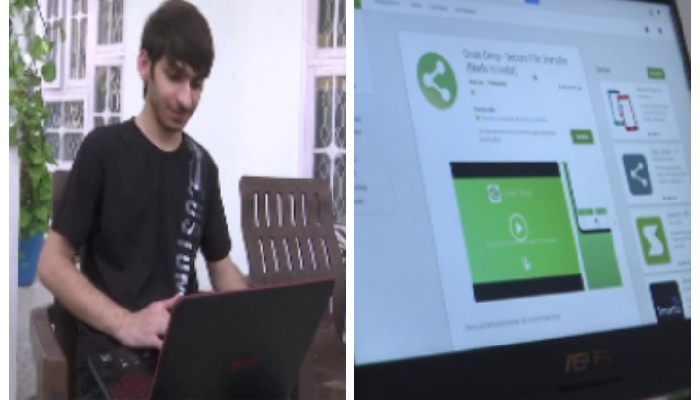
Rajouri, Aug 3: Ashfaq Mehmood Choudhary, a 17-year-old boy from Chattyear of Jammu and Kashmir's Rajouri district, has developed a file-sharing app 'Dodo Drop' which would enable users to share audios, videos, images, and texts between two devices without Internet access.

While speaking to media persons, Ashfaq Mehmood said that the 'Dodo Drop' application is an alternative to the Chinese 'SHAREit' app. "The Indian government has banned several Chinese apps due to data breaching, and among those apps was SHAREit which was used for sharing files.

Users faced a lot of problems due to the ban, and so I decided to make this file-sharing app. With 'Dodo Drop', users can share audios, videos, images, and even texts," he said.

Ashfaq said that it took him four weeks to develop the application, and it was launched on August 1 this year. The 'Dodo Drop' application has a transfer rate of up to 480 mbps, which is faster than the SHAREit app and is "quite easy" to use.

"Users can transfer data comprising photos, videos, audios, apps, texts, etc. between two devices with no Internet access. The transfers are fully encrypted and secure," he added.

"Our Prime Minister has always asserted the need for decreasing the dependency on foreign products and apps and to focus on the development of India-based apps. I tried to be part of the initiative of 'Aatmanirbhar Bharat' by developing an India-based file-sharing app. I want to develop global-standard apps for India," he added.

"We support and cooperate with him. He generates his own income by working on some projects and utilises it. We will continue to support him," said Parvez Ahmed Choudhary, Ashfaq's father.

In July, the Ministry of Electronics and Information Technology (MEITY) banned 47 apps, which were variants and cloned copies of the 59 apps banned earlier in June. These banned clones included SHAREit Lite, Tiktok Lite, Helo Lite, BIGO LIVE Lite, and VFY Lite.

The 59 apps had been banned by the Centre in June in view of the information available that they were engaged in activities which were "prejudicial to sovereignty and integrity and defence" of the country.

Almost all the apps banned had some preferential Chinese interest and the majority had parent Chinese companies.

The ban came amid border tensions with China in the Eastern Ladakh region.

Comments

Add new comment

  • Coastaldigest.com reserves the right to delete or block any comments.
  • Coastaldigset.com is not responsible for its readers’ comments.
  • Comments that are abusive, incendiary or irrelevant are strictly prohibited.
  • Please use a genuine email ID and provide your name to avoid reject.