India condemns ‘heinous and cowardly’ attack on Afghan Sikhs

Agencies
July 2, 2018

Kabul, Jul 2: India on Sunday condemned as “heinous and cowardly” the terrorist attack on a convoy of Sikhs in Afghanistan that left 20 people dead and said the incident underlined the need for united global fight against international terrorism.

A suicide bomber targeted the convoy on their way to meet Afghanistan’s president in the eastern city of Jalalabad today. Police chief Ghulam Sanaei Stanikzai told Pajhwok Afghan News that the suicide bomber detonated his explosives when the minority community members wanted to enter the governor’s house to meet President Ashraf Ghani, who was visiting the region.

“We strongly condemn the heinous and cowardly terrorist attack in #Jalalabad today evening which resulted in the death of 20 innocent Afghans, including 10 members of the Afghan Sikh Community, and injured more than 20 persons,” the Indian Embassy in Kabul tweeted.

“We convey heartfelt condolences to the families of the victims and pray for early recovery of the injured…The attack again underlines the need for united global fight against international terrorism without discrimination and accountability of those who support terrorists in any manner,” it said.

Some reports said 19 people were killed in the attack and 17 of them were from the minority Sikh and Hindu community. Avtar Singh Khalsa, a longtime leader of the Sikh community who had planned to run in the parliamentary elections set for October, was killed in the attack.

Comments

Ali
 - 
Tuesday, 3 Jul 2018

R.I.P. . . . . 


Islarahell terrorist attack in palestine  over the years and killing innocent childrens


But no condolence from INDIA


Add new comment

  • Coastaldigest.com reserves the right to delete or block any comments.
  • Coastaldigset.com is not responsible for its readers’ comments.
  • Comments that are abusive, incendiary or irrelevant are strictly prohibited.
  • Please use a genuine email ID and provide your name to avoid reject.
News Network
May 28,2020

May 28: Abdul Kareem was forced out of school and into a life of odd jobs like repairing bicycles before he finally managed to pull his family out of abject poverty transporting goods across Delhi in a mini truck.

The job, and the slim financial security that came with it, was the first stepping stone to a better life.

All that is now gone as India reels under the economic impact of its protracted coronavirus lockdown. Mr Kareem's out of a job and stranded in his village in Uttar Pradesh with his wife and two children. Their minuscule savings from his Rs 9,000 a month job have been exhausted, and the money he saved for books and school uniforms is spent.

"I don't know what the job situation will be in Delhi once we go back," Mr Kareem said. "We can't stay hungry so I will do whatever I find."

At least 49 million people across the world are expected to plunge into "extreme poverty" -- those living on less than $1.90 per day -- as a direct result of the pandemic's economic destruction and India leads that projection, with the World Bank estimating some 12 million of its citizens will be pushed to the very margins this year.

Some 122 million Indians were forced out of jobs last month alone, according to estimates from the Center for Monitoring Indian Economy, a private sector think tank. Daily wage workers and those employed by small businesses have taken the worst hit. These include hawkers, roadside vendors, workers employed in the construction industry and many who eke out a living by pushing handcarts and rickshaws.

For Prime Minister Narendra Modi, who came to power in 2014 promising to lift the poorest citizens out of poverty, the fallout from the lockdown brings with it significant political risk. He won an even larger second term majority last year on the strength of his government's popular social programs that directly targeted the poor, such as the provision of cooking gas cylinders, power and public housing. The breadth and depth of this renewed economic pain will only increase the pressure on his government as it works to steer the country's economy back on track.

"Much of the Indian government's efforts to mitigate poverty over the years could be negated in a matter of just a few months," said Ashwajit Singh, managing director of IPE Global, a development sector consultancy that advises several multinational aid agencies. Noting that he did not expect unemployment rates to improve this year, Singh said: "More people could die from hunger than the virus."

Desperate Times

Mr Singh points to a United Nations University study estimating 104 million Indians could fall below the World Bank-determined poverty line of $3.2 a day for lower-middle-income countries. This will take the proportion of people living in poverty from 60% -- or 812 million currently, to 68% or 920 million -- a situation last seen in the country more than a decade ago, he said.

A World Bank report found the country had been making significant progress and was close to losing its status as the country with the most poor citizens. The impact of PM Modi's lockdown risks reversing those gains.

The World Bank and the CMIE estimates were published in late April and early May respectively. Since then the situation has only become grimmer, with harrowing images of people making desperate attempts to reach their villages, on crowded buses, the flatbeds of trucks and even on foot or on bicycles dominating media coverage.

The Rustandy Center for Social Sector Innovation at the University of Chicago Booth School of Business analyzed the unemployment data from the CMIE, collected through surveys covering about 5,800 homes across 27 states in April.

Researchers found rural areas were the hardest hit, and the economic misery was the result of the lockdown, rather than the spread of infections in the hinterland. More than 80% of households had experienced a drop income and many won't survive much longer without aid, they wrote in a report.

The government has promised cheap credit to farmers, direct transfer of money to the poor and eased access to food security programs -- but these help people who have some documentation, which many of the poorest don't. With millions of impoverished people now in transit across the country, the food security situation is dire -- news reports are emerging of people foraging through piles of rotting fruit or eating leaves.

Shattered Economy

The economy was already growing at its slowest pace in over a decade when the virus struck. The lockdown, which came into effect on March 25, has hammered it, stalling business activity and putting a lid on consumption, pushing the economy to what may be its first full-year contraction in more than four decades.

It's dire enough to warrant the country exiting its lockdown, as it has been doing incrementally since May 4, even as its infections are surging. India is now Asia's virus hotspot with infections crossing 151,000 according to data from Johns Hopkins University.

PM Modi, who has come under criticism for the pain inflicted on the poor, has said his government will spend $265 billion or about 10% of its GDP to help Asia's third-largest economy weather the pandemic's fallout. But experts say only a part of it is direct fiscal stimulus, and probably smaller than the total damage done to the economy during the lockdown period.

"What is especially worrying is the government's response," said Reetika Khera, an economics professor at the Indian Institute of Technology in Delhi. "The epidemic will magnify existing -- and already high -- inequalities in India."

Still, the economic measures aren't going to kick in for some time and industry will likely struggle to restart because of the flight of labour from industrial hubs.

And as the harsh summer unfolds more pain lies in store in the villages now dealing with returning migrant workers.

"There are no factories or industries here, there are just hills," said Surendra Hadia Damor, who had walked nearly 100 km from Ahmedabad, Gujarat, before a voluntary organisation drove him to his village in the neighboring state of Rajasthan. "We can survive for a month or two and then try and find a job nearby -- we will see what happens."


Comments

Add new comment

  • Coastaldigest.com reserves the right to delete or block any comments.
  • Coastaldigset.com is not responsible for its readers’ comments.
  • Comments that are abusive, incendiary or irrelevant are strictly prohibited.
  • Please use a genuine email ID and provide your name to avoid reject.
News Network
February 29,2020

New Delhi, Feb 29: Amid the raging communal violence in the entire north-east Delhi earlier this week, there were people who were trying to save persons and families from the "other community" from the fury of the mobs of their own community.

Naeem Ali Pradhan, 34, from Shiv Vihar, helped at least 7-8 Hindus on the night of February 24 -- when the violence was at its peak-- escape to safer locations. Shiv Vihar is one of the worst affected areas in the violence.

According to Naeem Ali, that night mobs attacked dozens of shops on the road and later tried to enter inside the residential areas.

Suddenly, he spotted a group of youth who were looking hassled and frantically asking for directions.

"I saw them. Thye were Hindus who were trying to escape a mob looking to target them. They had lost their way inside the streets of our colony. I along with other Muslim men escorted them to the nearby Hindu locality," Naeem, who is also a member of the Aman Committee constituted by the Delhi police, told ANI.

"Several shops which were on the roads including some showrooms were attacked by a group. These Hindus were worried as a mob which was on the main road was attacking people. They asked me the address of a colony as they were unable to find their way," Naeem said.

Comments

Add new comment

  • Coastaldigest.com reserves the right to delete or block any comments.
  • Coastaldigset.com is not responsible for its readers’ comments.
  • Comments that are abusive, incendiary or irrelevant are strictly prohibited.
  • Please use a genuine email ID and provide your name to avoid reject.
Agencies
July 29,2020

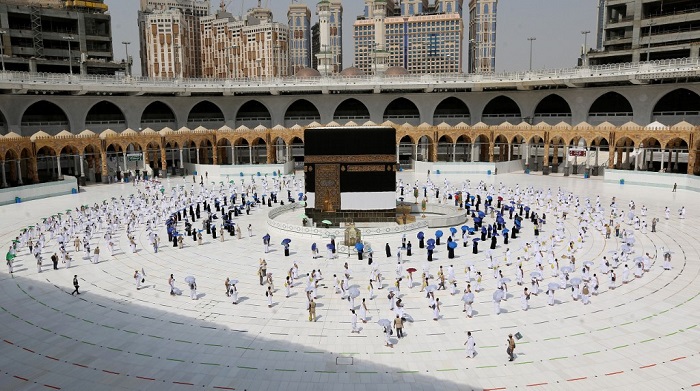
Dubai, Jul 29: Muslim pilgrims on Wednesday begin the annual Haj, downsized this year as the Saudi hosts strive to prevent a coronavirus outbreak during the five-day pilgrimage.

The Haj, one of the five pillars of Islam and a must for able-bodied Muslims at least once in their lifetime, is usually one of the world's largest religious gatherings.

But this year only up to 10,000 people already residing in the Kingdom will participate in the ritual, a tiny fraction of the 2.5 million pilgrims from around the world that attended last year.

"There are no security-related concerns in this pilgrimage, but (downsizing) is to protect pilgrims from the danger of the pandemic," said Khalid bin Qarar Al Harbi, Saudi Arabia's director of public security.

Pilgrims will be required to wear masks and observe social distancing during a series of religious rites that are completed over five days in the holy city of Makkah and its surroundings in western Saudi Arabia.

Those selected to take part in the Haj were subject to temperature checks and placed in quarantine as they began trickling into Makkah at the weekend.

State media showed health workers sanitising their luggage, and some pilgrims reported being given electronic wristbands to allow authorities to monitor their whereabouts.

Workers, clutching brooms and disinfectant, were seen cleaning the area around the Kaaba, the structure at the centre of the Grand Mosque draped in gold-embroidered cloth towards which Muslims around the world pray.

Haj authorities have cordoned off the Holy Kaaba this year, saying pilgrims will not be allowed to touch it, to limit the chances of infection.

They also reported setting up multiple health facilities, mobile clinics and ambulances to cater to the pilgrims.

Saudi authorities said only around 1,000 pilgrims residing in the Kingdom would be permitted for the Haj. Some 70 per cent of the pilgrims are foreigners residing in the Kingdom, while the rest will be Saudi citizens, authorities said.

All worshippers were required to be tested for coronavirus before arriving in the holy city of Makkah and will also have to quarantine after the pilgrimage as the number of cases in the Kingdom nears 270,000.

They were given elaborate amenity kits that include sterilised pebbles for a stoning ritual, disinfectants, masks, a prayer rug and the Ihram, a seamless white garment worn by pilgrims, according to a Haj ministry programme document.

"I did not expect, among millions of Muslims, to be blessed with approval," Emirati pilgrim Abdullah Al Kathiri said in a video released by the Saudi media ministry.

"It is an indescribable feeling... especially since it is my first pilgrimage."

The Haj ministry said non-Saudi residents of the Kingdom from around 160 countries competed in the online selection process but it did not say how many people applied.

Despite the pandemic, many pilgrims consider it safer to participate in this year's ritual without the usual colossal crowds cramming into tiny religious sites, which make it a logistical nightmare and a health hazard.

Comments

Add new comment

  • Coastaldigest.com reserves the right to delete or block any comments.
  • Coastaldigset.com is not responsible for its readers’ comments.
  • Comments that are abusive, incendiary or irrelevant are strictly prohibited.
  • Please use a genuine email ID and provide your name to avoid reject.