India Faced Attacks By Invaders, Still Has Hindu Majority: Mohan Bhagwat

Agencies
October 4, 2018

New Delhi, Oct 4: Indian civilisation is the only one that survived the onslaught of foreign invaders and is still a Hindu majority country, RSS chief Mohan Bhagwat said on Wednesday.

Mr Bhagwat was speaking at an event to launch a book on the life of former Congress president and founder of Banaras Hindu University (BHU) Madan Mohan Malviya.

Addressing the gathering, Mr Bhagwat said the Sanatana Dharma is eternal and something which is eternal is Hindutva. It survived despite the onslaught of invaders because of personalities such as Malviya.

India is the only civilisation which survived the onslaught of invaders, whereas in other regions such as Africa and Australia, it totally collapsed. The country is still a Hindu majority, Mr Bhagwat said.

He also asserted that Malviya always maintained relations with the RSS and was not averse to its ideology and said the country still needs such personalities.

Earlier in his three-day lecture series, Mr Bhagwat had said a 'Hindu Rashtra' does not mean it has no place for Muslims as this concept is inclusive of all faiths and religions.

Asserting that the RSS' philosophy is to take everyone along, he had categorically said the organisation works towards universal brotherhood and the cardinal principle of this brotherhood is unity in diversity. This thought comes from our culture, which the world calls Hindutva.

Hindutva is the essence of Indian cultural values and is aimed at fostering brotherhood among people of different faiths and views.

Comments

Fairman
 - 
Thursday, 4 Oct 2018

Dear Bhagvatjee,

First of all think deeply,   Dont think howmany left now. Think howmuch you lost and loosing continuosly.

We are not aginst Hindus. We are against your so called illogical thinking of Hindutwa.


Why aloways there is fuss. If you want follow whatever you like. Dont talk and imposing on others.

What is Hindutwa Ideology, share it.


The world has still 6billion population outside the India. Go and share your ideas there.

But Very honestly, Islam is spreading without any efforts because of its truth,

(please dont look at  Muslims, see what is ISLAM).


Dont worry, no selfish intensions. Only sharing the fact.


sanathana guru
 - 
Thursday, 4 Oct 2018

Hindu & muslim lived happly when muslim king ruled for 1000 year, that time no hindu thought that he is in danger and still they are the majority people in india, now when hindu ruler moderan FEKU came all hindu thought that they are in danger from only 14% lion..people use people to make his life luxirous in the name of religion, only in india the religion is the issue for all cause.

Add new comment

  • Coastaldigest.com reserves the right to delete or block any comments.
  • Coastaldigset.com is not responsible for its readers’ comments.
  • Comments that are abusive, incendiary or irrelevant are strictly prohibited.
  • Please use a genuine email ID and provide your name to avoid reject.
News Network
July 27,2020

Tokyo, Jul 27: Gold hit an all-time high on Monday as tit-for-tat consulate closures in China and the United States rattled investors, boosting the allure of safe-haven assets, although sentiment was mixed with tech gains supporting some Asian stocks.

MSCI's ex-Japan Asia-Pacific index rose 1.3 percent as Taiwan's TSMC, Asia's third-largest company by market capitalisation, rose almost 10 percent.

The chipmaker's gains boosted other tech stocks in the region and came after rival Intel signalled it may give up manufacturing its own components due to delays in new 7-nanometer chip technology.

Also soothing sentiment, Chinese shares eked out gains after big falls late last week, with CSI300 index rising 0.5 percent.

S&P500 futures were last up 0.4 percent in choppy trade while Japan's Nikkei fell 0.5 percent, resuming trade after a long weekend and catching up with falls in global shares late last week.

Global shares had lost steam last week after Washington ordered China's consulate in Houston to close, prompting Beijing to react in kind by closing the US consulate in Chengdu.

US Secretary of State Mike Pompeo took fresh aim at China last week, saying Washington and its allies must use "more creative and assertive ways" to press the Chinese Communist Party to change its ways.

"US President (Donald) Trump used to say China's President Xi Jinping is a great leader. But now Pompeo's wording is becoming so aggressive that markets are starting to worry about further escalation," said Norihiro Fujito, chief investment strategist at Mitsubishi Securities.

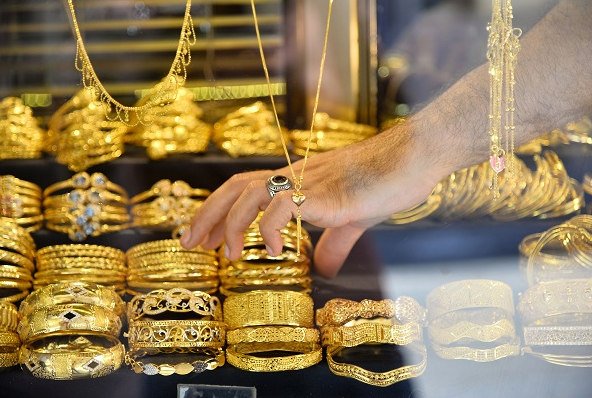
Gold rose 1.0 percent to a record high of $1,920.9 per ounce, surpassing a peak touched in September 2011, as Sino-US tensions boosted the allure of safe-haven assets, especially those not tied to any specific country.

The yellow metal is also helped by aggressive monetary easing adopted by many central banks around the world since the pandemic plunged the global economy into a recession.

Some investors fret such an unprecedented level of money-printing could eventually lead to inflation.

MORE STIMULUS

Hopes of a quick US economic recovery are fading as coronavirus infections showed few signs of slowing.

That means the economy could capitulate without fresh support from the government, with some of earlier steps such as enhanced jobless benefits due to expire this month.

Investors hope US Congress will agree on a deal before its summer recess but there are some sticking points including the size of the stimulus and enhanced unemployment benefits.

US Treasury Secretary Steve Mnuchin said the package will contain extended unemployment benefits with 70 percent "wage replacement".

Democrats, who control the House of Representatives, want enhanced benefits of $600 per week to be extended and look to much bigger stimulus compared with the Republicans' $1 trillion plan.

Investors are looking to corporate earnings from around the world for hints on the pace of recovery in the global economy.

"It looks like rising coronavirus cases are starting to slow down recovery in many countries," said Masahiro Ichikawa, senior strategist at Sumitomo Mitsui DS Asset Management.

Concerns about the US economic outlook started to weigh on the dollar, reversing its inverse correlation with the economic well-being over the past few months.

The dollar index dropped 0.3 percent to its lowest level in nearly two years.

The euro gained 0.3 percent to $1.1693, hitting a 22-month high of $1.16590 as sentiment on the common currency improved after European leaders reached a deal on a recovery fund in a major step towards more fiscal co-operation.

Against the yen, the dollar slipped 0.5 percent to 105.605 yen, a four-month low while the British pound hit a 4 1/2-month high of $1.2832.

Oil prices dipped on worries about the worsening Sino-US relations.

Brent futures fell 0.46 percent to $43.14 per barrel while US crude futures lost 0.44 percent to $41.11.

Comments

Add new comment

  • Coastaldigest.com reserves the right to delete or block any comments.
  • Coastaldigset.com is not responsible for its readers’ comments.
  • Comments that are abusive, incendiary or irrelevant are strictly prohibited.
  • Please use a genuine email ID and provide your name to avoid reject.
News Network
February 29,2020

New Delhi, Feb 29: The father of Intelligence Bureau staffer Ankit Sharma, whose body was pulled out of a drain in northeast Delhi's riot-hit Chand Bagh, complained to police that goons had assembled at the residence of former AAP counselor Tahir Hussain and were throwing petrol bombs from the rooftop.

According to the FIR which was registered on Thursday on the basis of the complaint lodged by Ankit's father Ravinder, the goons were also firing from the rooftop.

On Tuesday, Ankit returned from his office at 5 pm and then went outside to buy groceries. When he did not return, the family started looking for him and later filed a missing report, the FIR stated.

They got to know from their neighbours that a body has been recovered from a drain… later it was found to be that of Anikt, it said, adding the body had multiple stab injuries on the face, head, back, and chest.

The family has alleged in the FIR that it was Hussain and the goons at his residence who killed Ankit. In the FIR, Hussain has been accused of murder, destruction of evidence and abduction.

Soon after the FIR was registered on Thursday, the AAP suspended Tahir Hussain from the primary membership of the party till the police completed its probe.

The death toll in Delhi's communal violence rose to 42 on Friday as the situation showed some signs of returning to normalcy and clouds of smoke cleared to reveal the extent of the damage from the worst riots in the city in over three decades.

A total of 148 FIRs have been registered and 630 people have been either arrested or detained so far in connection with the communal violence, a Delhi Police spokesperson said.

Comments

Add new comment

  • Coastaldigest.com reserves the right to delete or block any comments.
  • Coastaldigset.com is not responsible for its readers’ comments.
  • Comments that are abusive, incendiary or irrelevant are strictly prohibited.
  • Please use a genuine email ID and provide your name to avoid reject.
Agencies
June 29,2020

From March through May, around 1 crore migrant workers fled India’s megacities, afraid to be unemployed, hungry and far from family during the world’s biggest anti-Covid-19 lockdown.

Now, as Asia’s third-largest economy slowly reopens, the effects of that massive relocation are rippling across the country. Urban industries don’t have enough workers to get back to capacity, and rural states worry that without the flow of remittances from the city, already poor families will be even worse off -- and a bigger strain on state coffers.

Meanwhile, migrant workers aren’t expected to return to the cities as long as the virus is spreading and work is uncertain. States are rolling out stimulus programs, but India’s economy is hurtling for its first contraction in more than 40 years, and without enough jobs, a volatile political climate gets more so.

“This will be a huge economic shock, especially for households of short-term, cyclical migrants, who tend to come from vulnerable, poor and low-caste and tribal backgrounds,” said Varun Aggarwal, a founder of India Migration Now, a research and advocacy group based in Mumbai.

In the first 15 days of India’s lockdown, domestic remittances dropped by 90%, according to Rishi Gupta, chief executive officer of Mumbai-based Fino Paytech Ltd., which operates the country’s biggest payments bank.

By the end of May, remittances were back to around 1750 rupees ($23), about half the pre-Covid average. Gupta’s not sure how soon it’ll fully recover. “Migrants are in no hurry to come back,” Gupta said. “They’re saying that they’re not thinking of going back at all.”

If workers stay in their home states long term, policymakers will have more than remittances to worry about. If consumption falls and the new surplus of labor drives wages down, Agarwal said, “there will also be a second-order shock to the local economy. Overall, not looking good.”

India announced a $277 billion stimulus package in May and followed it up with a $7 billion program aimed at creating jobs for 125 days for migrants in villages across 116 districts. Separately, local authorities are also looking for solutions.

Officials in Bihar have identified 2,500 acres of land that could be made available to investors, said Sushil Modi, deputy chief minister of Bihar, a state in east India. “We can use this crisis as an opportunity to speed up reforms,” he said.

The investors haven’t materialised yet, and in the meanwhile, state governments are relying on the national cash-for-work program that guarantees 100 days worth of wages per household.

Skilled workers don’t want to do manual labor offered through the program, and even if they did, says Amitabh Kundu of RIS, many think of it as beneath their station. “There will be an increase in social tensions,” he predicts. “Caste may again start playing a role. It’s absolute chaos.”

For skilled workers, initiatives vary:

* Uttar Pradesh, which received 3.2 million people, is compiling lists of skilled workers who need employment and trying to place them with local manufacturing and real estate industry associations. So far, the government says, it’s placed 300,000 people with construction and real estate firms.

* Bihar has placed returners in state-run infrastructure projects and hired others to stitch uniforms and make furniture for government-run schools, even as they waited in quarantine centres, said Pratyay Amrit, head of the state’s disaster management department.

* The eastern state of Odisha announced an urban wage employment program aimed at putting as many as 450,000 day labourers to work through September. Some 25,000 people have been employed, so far, under the scheme, G. Mathivathanan, principal secretary for housing and urban development said.

Attracting Investments

It’s not clear any of this will be enough to make a dent, says Ravi Srivastava, professor at New Delhi-based Institute of Human Development, adding that the states don’t have much of a track record on economic development.

“It was the failure of these states to improve governance and put development plans in place that led to the out-migration in the first place,” he said.

But officials and workers’ rights advocates see opportunity. Uttar Pradesh has established liaisons to encourage companies from the US, Japan and South Korea to establish manufacturing in the state. There and in Madhya Pradesh and Rajasthan, the government has made labour laws more friendly to employers, making it easier to hire and fire workers.

Modi, the minister from Bihar, said the migration may also give workers--historically a disenfranchised group--new power, particularly as urban centres struggle. “The way industries treated workers during the lockdown -- didn’t pay them, the living conditions were poor -- now these industries will realize the value of this force,” Modi said.

“In the days to come, labour will emerge as a force that can’t be ignored anymore,” he added. “That’s the new normal. We will work out how to ensure dignity, rights to our people who are going to work in other states.”

Bihar is due for elections by November, a vote that could be an early test of the mass migration’s political consequences. The state is currently governed by a coalition that includes Prime Minister Narendra Modi’s Bharatiya Janata Party. Amitabh Kundu, a fellow at the Research and Information System for Developing Countries, a New Delhi-based government think-tank, said migrant workers are likely to be angry voters.

“Chief ministers are telling these migrants that they will not have to go back for work,” he said. “But their capacity to do something miraculous in the next four to five months is doubtful. If they can retain even one-fourth of the migrants, I would call it a success.”


Comments

Add new comment

  • Coastaldigest.com reserves the right to delete or block any comments.
  • Coastaldigset.com is not responsible for its readers’ comments.
  • Comments that are abusive, incendiary or irrelevant are strictly prohibited.
  • Please use a genuine email ID and provide your name to avoid reject.