



India to host 10 ASEAN leaders next R-Day in major outreach to S-E Asia

Agencies
July 5, 2017

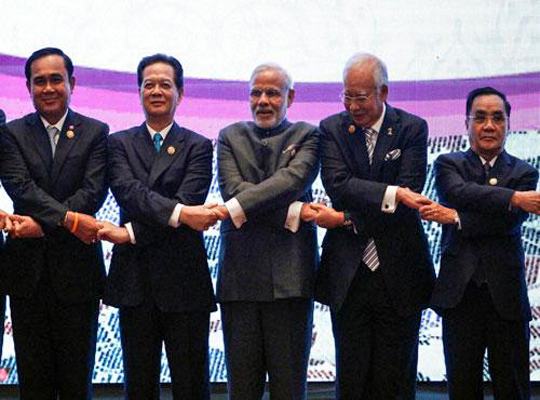
New Delhi, Jul 5: India will host heads of at least 10 South East Asian nations on its Republic Day next year, making a major outreach to a region often perceived as the “backyard” of China.
ASEAN

Though New Delhi has since long been hosting a foreign leader as the chief guest on the occasion of the Republic Day every year; this is going to be the first time when as many as 10 heads of states and governments will grace the ceremony on January 26.

New Delhi already started reaching out to the leaders of the Association of South East Asia Nations (or ASEAN) – Brunei, Indonesia, Cambodia, Lao PDR, Malaysia, Myanmar, Phillippines, Singapore, Thailand and Vietnam. Once the successor of President Pranab Mukherjee is elected by the end of this month, the Rashtrapati Bhavan will start the process of sending out the formal invitations to all the ASEAN leaders, sources told the Deccan Herald.

While President will host the South East Asian leaders on the Republic Day ceremony, Prime Minister Narendra Modi will join them in a special India-ASEAN summit, which will commemorate 25 years of New Delhi's dialogue partnership with the 10-nation bloc.

New Delhi's move to invite the ASEAN leaders to the Republic Day ceremony next year is apparently aimed at giving a fillip to implementation of its “Act East” policy for stepping up India's engagement with South East Asia where China seeks to maintain and expand its influence.

“We are making efforts on all fronts to enhance physical and digital connectivity,” External Affairs Minister Sushma Swaraj said on Tuesday. “The future focus areas of cooperation between ASEAN member states and India can be described in term of 3C’s- commerce, connectivity and culture,” she added, while speaking on the “Charting the Course for India-ASEAN relations for the next 25 Years” at an event in New Delhi. She underlined that India and ASEAN were “natural partners”.

Vietnam, Brunei, Malaysia and Phillippines are among countries which have a territorial dispute with China over the South China Sea. Some of the ASEAN nations, however, have close economic relations with China.

“The ASEAN supports India to play a greater role in the political and security domain, and create a regional rules-based region. We hope India will continue to partner our efforts for strategic security and freedom of navigation in the South China Sea on the basis of international law and legal convention,” Pham Binh Minh, Deputy Prime Minister and Foreign Minister of Vietnam, said in New Delhi on Tuesday.

New Delhi's relations with Beijing worsened in the past few months. New Delhi is upset over China's opposition to India's entry to the Nuclear Suppliers Group and its policy to shield Pakistan-based anti-India terrorists from United Nations' sanctions. New Delhi is opposed to Beijing's One-Belt-One-Road connectivity initiative, which includes an economic corridor proposed to pass through areas India claims as its own and accuses Pakistan of illegally occupying.

New Delhi suspects that China's OBOR initiative is in fact aimed at expanding the footprint of the communist country across the continents. India has already been jittery about the strategic assets China is seeking to acquire or build in Indian Ocean region.

“ASEAN and India are natural partners that share geographical, historical and civilisational ties. The cultural highway that linked the rivers Ganga, Brahmaputra, Meghna, Irrawaddy and Mekong and those who dwelt on their banks, enriched our shared civilizational ethos in a two-way process,” said Swaraj, stressing: “It is important to note that this inter-mingling happened without any ‘conquest or colonisation'.”

Beijing is upset over India's growing defence ties and strategic convergence with US and Japan in Asia-Pacific, its calls for maintaining freedom of navigation in the South China Sea and its appeal to China to resolve its maritime disputes in accordance with United Nations Conventions on Law of the Sea. Beijing was also irked by New Delhi's decision to allow Tibetan leader Dalai Lama to visit India's northeastern state Arunachal Pradesh which China claims as a part of its territory.

The current face-off between soldiers of Indian Army and Chinese People's Liberation Army at Doklam Plateau in western Bhutan further strained relations between India and China, which share a long disputed border.

India turned its “Look East” policy into more proactive “Act East” policy in 2014 to add new momentum to its engagement with the ASEAN. New Delhi is of the view that India will have to focus more on its relations with South East Asian nations if it has to emerge as a major power in Asia Pacific and counter the growing influence of China in the region.

“India has been working with ASEAN towards evolving regional security architecture in the Asia Pacific that hinges on emphasising the peaceful settlement of disputes, finding collaborative solutions to emerging and non-traditional challenges, and support for the centrality of ASEAN,” Swaraj said at another event on June 22.

When New Delhi became a dialogue partner of the ASEAN in 1992; India's total trade with all the 10 members of the bloc was worth less than $ 5 billion. But, 25 years later, the ASEAN has become India's 4th largest trading partner, accounting for 10% of its total trade. The trade volume went up to $ 76.53 billion in 2014-15, although it declined to $ 65.04 billion in 2015-16, essentially due to declining commodity prices amidst a general slowing down of the global economy. India-ASEAN trade however registered an 8 % increase in 2016-17 as compared to the previous year. India's exports to ASEAN increased by almost 20% in 2016-17. The ASEAN-India free trade agreement played a major role in giving a boost to trade in goods and services.

India elevated its relations with the ASEAN to the level of strategic partnership in 2012. The special India-ASEAN summit in January 2018 will further boost the ties, sources told the DH in New Delhi.

The choice of the chief guest for the Republic Day ceremony always reflects the foreign policy priority and strategic objective of the Government.

The first Republic Day chief guest for Modi Government was the then United States President Barack Obama. He attended the ceremony on the Rajpath in New Delhi on January 26, 2015. The then French President Francois Hollande and the Crown Prince of Abu Dhabi and de-facto ruler of the United Arab Emirates, Mohammed bin Zayed Al Nahyan, were the chief guests in Republic Day ceremonies in 2016 and 2017 respectively.

Comments

Add new comment

  • Coastaldigest.com reserves the right to delete or block any comments.
  • Coastaldigset.com is not responsible for its readers’ comments.
  • Comments that are abusive, incendiary or irrelevant are strictly prohibited.
  • Please use a genuine email ID and provide your name to avoid reject.
News Network
April 15,2020

New Delhi, Apr 15: Tablighi Jamaat leader Maulana Saad Kandhalvi has been booked for culpable homicide after some of the attendees of the religious congregation died due to coronavirus, police said on Wednesday.

Kandhalvi had organised the religious gathering at Nizamuddin Markaz last month against the social distancing protocol imposed by the Centre to curb the spread of the deadly disease.

An FIR was registered against the cleric on March 31 at Crime Branch police station on a complaint of the Station House Officer of Nizamuddin.

He was earlier booked for holding the event, police said.

“After several attendees of the Tablighi Jamaat event succumbed to coronavirus, we added IPC section 304 (culpable homicide not amounting to murder) in the FIR against the leader, a police official said.

Some foreigners who attended the event have also been booked for violation of visa norms.

In an audio message, Kandhalvi had said that he was exercising self-quarantine after several hundreds who visited the Tablighi Jamaat congregation at Nizamudddin Markaz tested positive for coronavirus.

The FIR registered against the Tablighi Jamaat event says that the Delhi Police contacted the authorities of Nizamuddin Markaz on March 21 and reminded them of the government order which prohibited any political or religious gathering of more than 50 people.

It says that despite repeated efforts, the event organisers failed to inform the health department or any other government agency about the huge gathering inside the Markaz and deliberately disobeyed government orders.

“The sub district magistrate of Defence Colony inspected the premises several times and found that around 1,300 people, including foreign nationals, were residing there without maintaining social distance. It was also found that there were no arrangements of hand sanitizers and face masks,” the FIR adds.

The Nizamudddin centre, attended by thousands, turned out to be a hotspot for spread of coronavirus not only in the national capital, but the entire country.

More than 25,500 Tablighi members and their contacts have been quarantined in the country after the Centre and the state governments conducted a "mega operation" to identify them.

At least 9,000 people participated in the religious congregation in Nizamuddin. Later, many of the attendees travelled to various parts of the country.

Comments

Add new comment

  • Coastaldigest.com reserves the right to delete or block any comments.
  • Coastaldigset.com is not responsible for its readers’ comments.
  • Comments that are abusive, incendiary or irrelevant are strictly prohibited.
  • Please use a genuine email ID and provide your name to avoid reject.
Bloomberg
July 27,2020

New Delhi, Jul 27: India’s coronavirus epidemic is now growing at the fastest in the world, increasing 20% over the last week to more than 14 lakh confirmed cases, according to Bloomberg’s Coronavirus Tracker.

Infections in the South Asian nation of 130 crore people have reached 14.3 lakh, including 32,771 deaths, India’s health ministry said, with daily cases close to a record 50,000 on Monday. India is only trailing the US and Brazil now in the number of confirmed infections, but its growth in new cases is the fastest.

Maharashtra, Tamil Nadu, Andhra Pradesh and Karnataka are among the states where the maximum number of daily cares are being reported. The world’s second-most populous country has been ramping up testing, with 515,472 samples taken on Sunday, according to the Indian Council of Medical Research.

Still, India and Brazil have some of the world’s lowest testing rates, with 11.8 tests and 11.93 tests per 1,000 people respectively, compared to the US with 152.98 tests per 1,000 and Russia with 184.34, according to Our World in Data, a project based at the University of Oxford in the UK.

Comments

Add new comment

  • Coastaldigest.com reserves the right to delete or block any comments.
  • Coastaldigset.com is not responsible for its readers’ comments.
  • Comments that are abusive, incendiary or irrelevant are strictly prohibited.
  • Please use a genuine email ID and provide your name to avoid reject.
News Network
June 19,2020

Jun 19: Ten Indian Army soldiers including four officers were released by the China’s People’s Liberation Army (PLA) on Friday capping three days of hard negotiations that followed the bloody battle at the eastern Ladakh’s Galwan valley on Monday.

The 10 jawans returned around 5.30 PM on Friday to Patrol Point 14 (PP-14) after Indian team leader Major Gen. Abhijit Bapat, the commanding officer of the Third Div made it clear to the Chinese that there couldn’t be any progress in the disengagement talks unless the soldiers were returned safely.

Asked to comment on the release of Indian soldiers, the Indian Army maintained silence. The force released a brief statement on Thursday stating that all its men were accounted for.

However, the extent of the brutal clash can be gauged from the fact that 76 Indian Army soldiers are still in the hospital out of which 58 soldiers have “minor injuries” and “should be back on duty within a week”, according to Army sources.

Return of the Indian soldiers has been the main point of negotiations for the last two days. The situation is now calmer at areas near PP-14 in the Galwan valley after the return of Indian soldiers even though large numbers of troops from both sides are still present in the area.

Meanwhile analysis of satellite images has revealed a large presence of Chinese troops in the northern banks of Pangong Tso, a disputed territory for years.

“In the past month, Chinese forces have become an overwhelming majority in the disputed areas (on the north bank of the 135 km long lake). Significant positions have been constructed between Fingers 4 and 5, including around 500 structures, fortified trenches and a new boat shed over 20 km further forward than previously. More structures appear to be under construction,” says a report published in the Strategist, the journal of the Australian Strategic Policy Institute.

“The scale and provocative nature of these new Chinese outposts is hard to overstate: 53 different forward positions have been built, including 19 that sit exactly on the ridge line separating Indian and Chinese patrols,” says the report, accompanied by satellite images showing overwhelming PLA presence.

The June 6 Corps Commander level meeting between the Indian and PLA armies did not result in a solution to the contentious muscle flexing by the Chinese on the shores of the Pangong lake. The meeting ended with the conclusion that more Lt Gen level talks between the two armies were needed to resolve such issues.

Comments

Add new comment

  • Coastaldigest.com reserves the right to delete or block any comments.
  • Coastaldigset.com is not responsible for its readers’ comments.
  • Comments that are abusive, incendiary or irrelevant are strictly prohibited.
  • Please use a genuine email ID and provide your name to avoid reject.