



India to host 10 ASEAN leaders next R-Day in major outreach to S-E Asia

Agencies
July 5, 2017

New Delhi, Jul 5: India will host heads of at least 10 South East Asian nations on its Republic Day next year, making a major outreach to a region often perceived as the “backyard” of China.
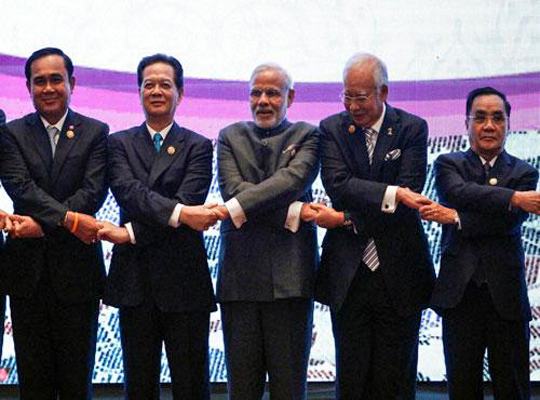
ASEAN

Though New Delhi has since long been hosting a foreign leader as the chief guest on the occasion of the Republic Day every year; this is going to be the first time when as many as 10 heads of states and governments will grace the ceremony on January 26.

New Delhi already started reaching out to the leaders of the Association of South East Asia Nations (or ASEAN) – Brunei, Indonesia, Cambodia, Lao PDR, Malaysia, Myanmar, Phillippines, Singapore, Thailand and Vietnam. Once the successor of President Pranab Mukherjee is elected by the end of this month, the Rashtrapati Bhavan will start the process of sending out the formal invitations to all the ASEAN leaders, sources told the Deccan Herald.

While President will host the South East Asian leaders on the Republic Day ceremony, Prime Minister Narendra Modi will join them in a special India-ASEAN summit, which will commemorate 25 years of New Delhi's dialogue partnership with the 10-nation bloc.

New Delhi's move to invite the ASEAN leaders to the Republic Day ceremony next year is apparently aimed at giving a fillip to implementation of its “Act East” policy for stepping up India's engagement with South East Asia where China seeks to maintain and expand its influence.

“We are making efforts on all fronts to enhance physical and digital connectivity,” External Affairs Minister Sushma Swaraj said on Tuesday. “The future focus areas of cooperation between ASEAN member states and India can be described in term of 3C’s- commerce, connectivity and culture,” she added, while speaking on the “Charting the Course for India-ASEAN relations for the next 25 Years” at an event in New Delhi. She underlined that India and ASEAN were “natural partners”.

Vietnam, Brunei, Malaysia and Phillippines are among countries which have a territorial dispute with China over the South China Sea. Some of the ASEAN nations, however, have close economic relations with China.

“The ASEAN supports India to play a greater role in the political and security domain, and create a regional rules-based region. We hope India will continue to partner our efforts for strategic security and freedom of navigation in the South China Sea on the basis of international law and legal convention,” Pham Binh Minh, Deputy Prime Minister and Foreign Minister of Vietnam, said in New Delhi on Tuesday.

New Delhi's relations with Beijing worsened in the past few months. New Delhi is upset over China's opposition to India's entry to the Nuclear Suppliers Group and its policy to shield Pakistan-based anti-India terrorists from United Nations' sanctions. New Delhi is opposed to Beijing's One-Belt-One-Road connectivity initiative, which includes an economic corridor proposed to pass through areas India claims as its own and accuses Pakistan of illegally occupying.

New Delhi suspects that China's OBOR initiative is in fact aimed at expanding the footprint of the communist country across the continents. India has already been jittery about the strategic assets China is seeking to acquire or build in Indian Ocean region.

“ASEAN and India are natural partners that share geographical, historical and civilisational ties. The cultural highway that linked the rivers Ganga, Brahmaputra, Meghna, Irrawaddy and Mekong and those who dwelt on their banks, enriched our shared civilizational ethos in a two-way process,” said Swaraj, stressing: “It is important to note that this inter-mingling happened without any ‘conquest or colonisation'.”

Beijing is upset over India's growing defence ties and strategic convergence with US and Japan in Asia-Pacific, its calls for maintaining freedom of navigation in the South China Sea and its appeal to China to resolve its maritime disputes in accordance with United Nations Conventions on Law of the Sea. Beijing was also irked by New Delhi's decision to allow Tibetan leader Dalai Lama to visit India's northeastern state Arunachal Pradesh which China claims as a part of its territory.

The current face-off between soldiers of Indian Army and Chinese People's Liberation Army at Doklam Plateau in western Bhutan further strained relations between India and China, which share a long disputed border.

India turned its “Look East” policy into more proactive “Act East” policy in 2014 to add new momentum to its engagement with the ASEAN. New Delhi is of the view that India will have to focus more on its relations with South East Asian nations if it has to emerge as a major power in Asia Pacific and counter the growing influence of China in the region.

“India has been working with ASEAN towards evolving regional security architecture in the Asia Pacific that hinges on emphasising the peaceful settlement of disputes, finding collaborative solutions to emerging and non-traditional challenges, and support for the centrality of ASEAN,” Swaraj said at another event on June 22.

When New Delhi became a dialogue partner of the ASEAN in 1992; India's total trade with all the 10 members of the bloc was worth less than $ 5 billion. But, 25 years later, the ASEAN has become India's 4th largest trading partner, accounting for 10% of its total trade. The trade volume went up to $ 76.53 billion in 2014-15, although it declined to $ 65.04 billion in 2015-16, essentially due to declining commodity prices amidst a general slowing down of the global economy. India-ASEAN trade however registered an 8 % increase in 2016-17 as compared to the previous year. India's exports to ASEAN increased by almost 20% in 2016-17. The ASEAN-India free trade agreement played a major role in giving a boost to trade in goods and services.

India elevated its relations with the ASEAN to the level of strategic partnership in 2012. The special India-ASEAN summit in January 2018 will further boost the ties, sources told the DH in New Delhi.

The choice of the chief guest for the Republic Day ceremony always reflects the foreign policy priority and strategic objective of the Government.

The first Republic Day chief guest for Modi Government was the then United States President Barack Obama. He attended the ceremony on the Rajpath in New Delhi on January 26, 2015. The then French President Francois Hollande and the Crown Prince of Abu Dhabi and de-facto ruler of the United Arab Emirates, Mohammed bin Zayed Al Nahyan, were the chief guests in Republic Day ceremonies in 2016 and 2017 respectively.

Comments

Add new comment

  • Coastaldigest.com reserves the right to delete or block any comments.
  • Coastaldigset.com is not responsible for its readers’ comments.
  • Comments that are abusive, incendiary or irrelevant are strictly prohibited.
  • Please use a genuine email ID and provide your name to avoid reject.
News Network
January 28,2020

New Delhi, Jan 28: Stepping up attack on Chief Minister Arvind Kejriwal, Union Home Minister Amit Shah on Monday dared the AAP chief to visit the anti-CAA protest site at Shaheen Bagh so that the people of Delhi can decide whom to vote for in the assembly election.

Addressing a rally in Rithala in northwest Delhi, Shah said Kejriwal and Congress leader Rahul Gandhi were against the construction of Ram temple, the scrapping of provisions of Article 370 and not bothered about the country's image and soldiers.

The opposition fears that they will upset their vote bank, he said and asked, "Are you their vote bank? Where is their vote bank?" To this, the crowd replied, "Shaheen Bagh".

The BJP leader claimed that the Delhi Police has booked Sharjeel Imam, a JNU student, on the charge of sedition for his comment of "trying to cut chicken's neck" and breaking the North East from the rest of the country.

"I want to ask Kejriwal whether he is in favour of apprehending Sharjeel Imam or not? Whether you are with the people of Shaheen Bagh or not, please tell the people of Delhi," Shah said.

Imam was one of the initial organisers of the Shaheen Bagh protest.

Hitting back at the BJP, Kejriwal alleged that the saffron party does not want to open the Shaheen Bagh stretch of the Kalindi Kunj road as it is doing "dirty politics" over it.

He said law and order in the national capital lies entirely with the Centre and "if they are saying that they need permission from me, I am giving them permission, open the road in one hour".

"I can give it to you in writing, the BJP does not want to open the route in Shaheen Bagh. The Shaheen Bagh route will remain closed till February 8 (election day) and it will open February 9," Kejriwal told reporters.

Calling Kejriwal a member of the 'tukde tukde' gang, a term used by the BJP to attack groups it accuses of working to promote violent leftists and separatism, Shah sought to return fire and said the protesters of Shaheen Bagh will not listen to his party.

"They will not listen to us. You people (AAP leaders) say that you are with Shaheen Bagh, if you have the guts then go and sit with them and let Delhi decide," Shah said.

At another election rally in Janakpuri, Shah accused Gandhi and Kejriwal of doing politics of "vote bank" on national issues and "supporting" the protest at Shaheen Bagh while instigating riots and vandalism.

"The Modi government will not spare anti-national elements," he warned.

Upon mentioning the recent Supreme Court judgment on Ayodhya, Shah was greeted with cheers and chants of 'Jai Shri Ram'.

The home minister further said that this was the first Republic Day in Jammu and Kashmir after the abrogation of Article 370 and the tricolour was unfurled there with enthusiasm and without any bloodshed.

The former BJP president also attacked the Kejriwal government for not fulfilling promises like regularising temporary employees, providing free wifi, opening new schools and colleges, constructing roads and cleaning the Yamuna.

"Kejriwal government is in power since five years but till today there is no clean drinking water in the city. There are no good schools or hospitals as claimed by him. When I visited a Delhi government school, I saw that it was operating from a building that was illegally built and falls in the list of those that to be erased," Shah said.

He claimed that Kejriwal came to power with the help of Anna Hazare's anti-corruption movement but "completely changed" later on.

"He had said that he would not take any government accommodation or vehicles and other facilities but after becoming chief minister he availed all these facilities," Shah said.

He also slammed the Delhi government for not sanctioning the prosecution of former JNU students' union leader Kanhaiya Kumar in a sedition case.

Shah said if the national capital comes under the leadership of Modi, it will become the best city in the world.

The BJP has a vision for development of Delhi and cleaning the Yamuna river will be on top of our agenda, he said.

"Yamuna river is still dirty as against his (Kejriwal) claims of cleaning the river... Modi and Yogi (Adityanath) have cleaned Ganga river as promised. We will make Yamuna Riverfront like Sabarmati riverfront in Ahmedabad," Shah said.

However, a sizeable majority of those present at the public meeting was not convinced by the claims and promises made by Shah.

Bablu Yadav, a migrant and resident of Janakpuri said, "Shah and Modi can only talk but Kejriwal knows how to perform. They keep raking up issues like Ayodhya, Kashmir, Muslims and Pakistan... what are they waiting for if they want to attack Pakistan? They are in power, so why don't they destroy it instead of telling us how wrong Pakistan is?"

Another local Deepak Shrivastava who attended the Janakpuri meeting said, "All we hear from Modi and Shah are pep talks. I am an engineer from BHU and searching for a job. This government has failed the country's youth."

"Now, they have a problem with protests in universities but it is the same youth who brought them to power in 2014. The same youth will ensure their defeat," he added.

The public meeting in Janakpuri witnessed two incidents of pick-pocketing as the thieves managed to steal Rs 37,500 in cash and a mobile phone, police said.

Comments

Indian Soul
 - 
Tuesday, 28 Jan 2020

The biggest ANti-Nationals of INDIA are criminal Modi & AMith Shah Tadi PAAR...how long you will win by EVM...one day the people of indian will teach you a lesion of your life...

Add new comment

  • Coastaldigest.com reserves the right to delete or block any comments.
  • Coastaldigset.com is not responsible for its readers’ comments.
  • Comments that are abusive, incendiary or irrelevant are strictly prohibited.
  • Please use a genuine email ID and provide your name to avoid reject.
News Network
May 24,2020

New Delhi, May 24: The Indian economy is likely to slip into recession in the third quarter of this fiscal as loss in income and jobs and cautiousness among consumers will delay recovery in consumer demand even after the pandemic, says a report.

According to Dun & Bradstreet's latest Economic Observer, the country's economic recovery will depend on the efficacy and duration of implementation of the government's stimulus package.

"The multiplier effect of the stimulus measures on the economy will depend on three key aspects i.e. the time taken for effecting the withdrawal of the lockdown, the efficacy of implementation and duration of execution of the measures announced," Dun & Bradstreet India Chief Economist Arun Singh said.

The report noted that the government's larger-than-expected stimulus package is likely to re-start economic activities.

Besides, measures taken by the Reserve Bank of India like reducing the repo rate by a further 40 basis points to 4 per cent, extending the moratorium period by three months and facilitating working capital financing will also help stimulate the momentum.

Singh said while the measures announced by the government are "positive", most of them have been directed towards strengthening the supply side of the economy, and "it is to be noted that supply needs to be matched with demand", he said.

Besides, "in the absence of cash-in-hand benefits under the government's stimulus package, demand for goods and services is expected to remain depressed", he added.

He further said the loss in income and employment opportunities, and cautiousness among consumers, will lead to a delayed recovery in consumer demand, even after the pandemic. As debt and bad loan levels increase, the banking sector might face challenges.

The report further noted that even as the monetary stimulus is expected to inject liquidity and stimulate demand for a wider section of the economy, the channelisation of funds from the financial institutions will be subjected to several constraints.

The foremost concern being increase in risk averseness, as the balance sheets of firms, households, and banks/NBFCs have weakened considerably and low demand for funds by firms as production activities have been on a standstill during the lockdown period, Singh said.

India has been under lockdown since March 25 to contain the spread of the coronavirus, resulting in supply disruptions and demand compression.

Prime Minister Narendra Modi imposed a nationwide lockdown to control the spread of coronavirus on March 25. It has been extended thrice, with some relaxations. The fourth phase of the lockdown is set to expire on May 31. 

Comments

Add new comment

  • Coastaldigest.com reserves the right to delete or block any comments.
  • Coastaldigset.com is not responsible for its readers’ comments.
  • Comments that are abusive, incendiary or irrelevant are strictly prohibited.
  • Please use a genuine email ID and provide your name to avoid reject.
Agencies
May 9,2020

New Delhi, May 9: The Supreme Court on Friday agreed to consider a plea raising the issue of mass termination and the illegal salary cut of employees in IT/ITES/BPO/KPI by their employers during the lockdown due to the spread of the coronavirus.

A bench comprising Justices Ashok Bhushan, S.K. Kaul and B.R. Gavai, taking up the matter through video conferencing, agreed to examine the issue and listed it for May 15.

The petition, argued by senior advocate Devadatt Kamat, was filed by National Information Technology Employees Sena (NITES) through advocate-on-record Amit Pai, and sought implementation of directions issued by the Centre on March 29 and similar advisories issued by several other states mandating payment of wages/salaries to the employees and also directed not to terminate them during the period of lockdown.

A directive was issued by the Union Ministry of Labour and Empowerment to all Chief Secretaries of state governments to issue advisories to public and private companies to not lay off employees or implement pay cuts during lockdown.

In the Centre for Monitoring Indian Economy (CMIE) report published on April 19, it was noted that "several companies across the country have started to terminate its employees without any reasonable cause and have started withholding their salaries. It is submitted that in such testing times, the rights of the employees ought to be protected by necessary orders/directions to the companies through the Respondents to effectively implement the lockdown and to contain the spread of the virus", said the plea.

On March 29, the Centre issued an order directing all states and Union Territories to issue orders, requiring all the employers in the industrial sector and shops and commercial establishments to pay wages on the due date without any deduction during their closure due to the lockdown.

Comments

Add new comment

  • Coastaldigest.com reserves the right to delete or block any comments.
  • Coastaldigset.com is not responsible for its readers’ comments.
  • Comments that are abusive, incendiary or irrelevant are strictly prohibited.
  • Please use a genuine email ID and provide your name to avoid reject.